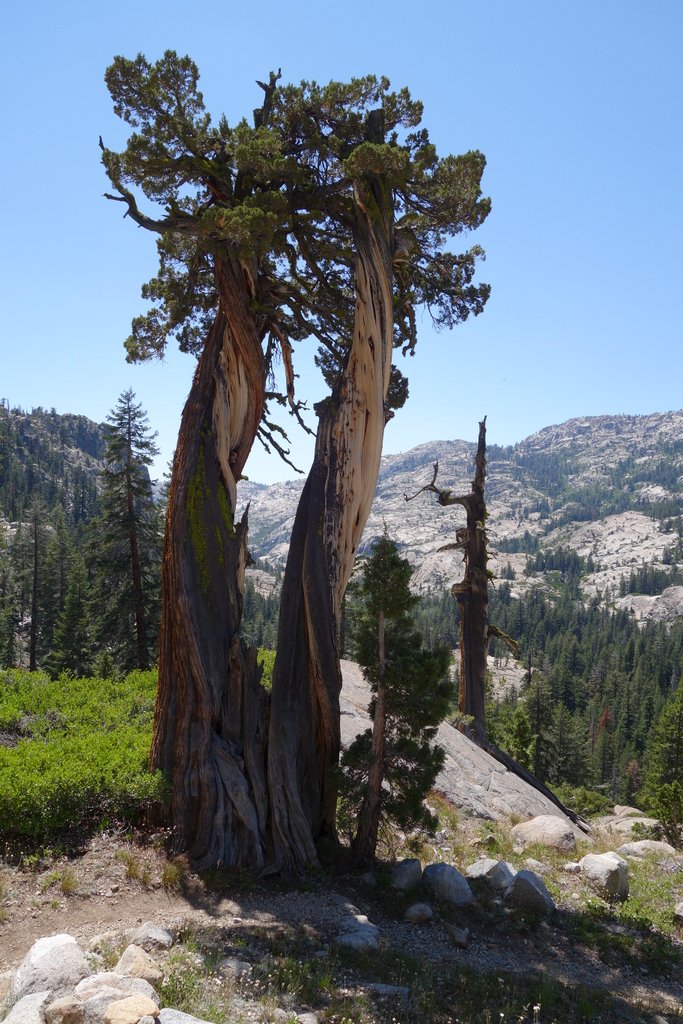
People of the PCT: Floyd Wick

I met Floyd Wick right about mile 1000. He was hiking south, heading towards Tuolumne Meadows, where his wife would meet him for a time on his way, from Burney Falls to Whitney, if memory serves. He said he had served twenty-six years in the military and his wife had served for twenty years in the diplomatic corps, and they figured they had done their duty, raised their kids, and now they were going to enjoy their retirement. And he was having fun coming down the trail, having (he indicated) already walked in this fashion from Wyoming to Washington.

1-DSC03890
Wick said he carried an eighteen-pound pack and tried to stay out no more than two or three days at a time if possible. I didn’t realize it talking to him but the day before he had come over what I like to call the Martian Pass, which is no small feat, but didn’t mention it and had no ill effects whatsoever.

Note the bear spray. This veteran is ready for anything.

Scenes from an explosion: Oilfield waste chemicals shock, puzzle responders

A 120-barrel vacuum truck blew up at about 3:30 a.m. at the Santa Clara Waste Water treatment plant outside of Santa Paula on November 18th, and blasting the intake yard with over 1000 gallons of a toxic soup of chemicals and sewage. Several employees were severely injured, and three first responders had their lungs burned by caustic fumes. In the aftermath of the explosion, before the incident turned into a full-scale disaster, attempts were made to understand what sort of chemical had caused the explosion.

At the time, the vice-president in charge of operations on site, Chuck Mundy, insisted to firefighters that no hazardous materials were involved, even after a fire broke out.

Forty minutes after the blast, an employee of neighboring oil service company Patriot, a driver, noticed that his boot was on fire. From the search warrant request:

“[Transportation supervisor] Dreher grabbed the boot [of one of his drivers] and took it to firefighters. It had combusted and was on fire. The firefighters were initially surprised. Alex [who had been wearing the boot] was taken from the location and they left the boots behind. As soon as the fire truck [standing in the chemicals blasted from the vacuum truck] was moved one inch, there was a loud pop. Everyone on site was then sent to a decomtamination site based on what was occuring. Dreher said the said the initial explosion was not followed by a fire. The fire was a reaction and it did not happen until 40 minutes after the initial explosion.”

Later the fire engine was destroyed in the fire. As investigators talked to people on the site, some proved more helpful than others. Heavy equipment operator Michael Grindrod took cover and avoided the wost of the blast, but later discovered his lungs were damaged by the toxic. He talked freely, and expressed anger.

“Grindrod said during his time of employment he has seen numerous hazardous conditions including mislabeled or unlabeled containers. At the time of the explosion there were twenty-two 240-gallon totes that contained different chemicals to treat waste. The tanker truck that exploded was in the process of emptying these tote containers. Only five of the twenty-two totes were labeled. The other labels had been removed by employees at the facility and placed into a dumpster at the facility. They did this at the direction of supervisors.”  

“He has also seen the mixing of materials without proper precautions to taken to determine possible or potential reactions. The materials in the totes are vacuumed into the truck without regard for what the materials actually consist of.” 

This is a KTLA segment on the explosion from the day after, showing the scope of the disaster, with their embedded code. It gives a sense of how puzzled investigators were by the chemical.

http://player.ooyala.com/iframe.js#ec=Y4bWRzcTqCiG3Vic62TwpRjrWXQtZ-Iy&pbid=f987944e2b8d47c5ad7da7977780b8bd

To be continued…

Scenes from an explosion: Santa Clara Waste Water exec admits falsifying records

In the wake of the tanker truck explosion that set the Santa Clara Waste Water plant near Santa Paula on fire last November, causing a multi-million dollar disaster, not to mention many serious injuries, the Ventura County District Attorney presented 67 witnesses to the Grand Jury in building a massive case against SCWW. After the Grand Jury issued the indictment, and Judge David Hirsh unsealed it and fifteen search warrants, followed by arrests, included were records of the police interviews immediately after the explosion, fire, and toxic cloud of November 18th.

The records make for interesting reading.

The testimony is damning in the extreme in the case of vice-president Chuck Mundy. He admitted to falsifying records. He did not admit this in the first two interviews with police, claiming the plant handled only non-hazardous waste, even after a fire broke out under the boots of the firemen who came in the wake of the explosion, and even after investigators raided offices at Santa Clara and seized files. But when investigators came to Mundy’s house with a search warrant, he talked.

In testimony in the first of the search warrants, the special investigator Jeff Barry writes:

“During the execution of the search warrant at Mundy’s resident, he consented to a recorded interview with me, Supervising Investigator Frank Huber, and Special Agent Kristine Wilson of the Environmental Protection Agency. Mundy was not under arrest and was told he was free to leave. This was the third time I interviewed Mundy within a short period of time following the explosion.”

“Mundy admitted to falsifying and forging chemical analytical results and sending them to the City of Oxnard regarding waste product SCWWC sent to Oxnard’s Waste Treatment Center via a dedicated 14-mile pipeline. Mundy said he cut out lab results with acceptable numbers and then glued that piece of paper on the actual lab results for testing on waste (which had unacceptable numbers). The result was a forged and falsified document that did not represent the actual waste SCWWC was sending to Oxnard’s Waste Treatment Center and eventually the Pacific Ocean.”

Since that time, Mundy has hired a lawyer and no longer is talking to investigators. Twenty bags of evidence were removed from the site, including examples of forgery.

The District Attorney charged the company, its corporate parent, and seemingly the entire management team at Santa Clara Waste Water with felony crimes. But they threw the book at Mundy. He faces trial on 49 counts of 11 felony types, including “causing impairment to the body of an employee,” “handling of hazardous waste with reckless disregard for human life,” and “conspiracy to impede enforcement.”

An oilfield waste plant blows up in Santa Paula: from the police interviews

On November 18th of last year, a vacuum truck at an oilfield wastewater treatment plant outside Santa Paula blew up. Besides severely injuring several people on site, including three firefighters, the explosion led to an extraordinarily dangerous fire and a cloud of toxic chlorine gas that drifted west over farm fields and sent 46 people to the hospital. Last week nine people were arrested and charged, including the president and former CEO of Santa Clara Waste Water, and this week the judge unsealed the Grand Jury indictment, which totalled 71 — that’s right, 71 — felony charges, based on the testimony of 67 — that’s right, 67 — witnesses.

Also available, for the price of the copying, were the first two of nine search warrants, which contain all sorts of information based on interviews by police immediately after the disaster.

Here, based on interviews with three truck drivers who were on the site and working the night shift that disastrous night, a couple of accounts of what it was like in the moments just before the 120-barrel vacuum truck blew up.

About five hours after the explosion, special investigator Jeff Barry interviewed Chuck Mundy, a vice-president in charge of operations. But first, the booking photo of Mundy:

Charles Mundy
Charles Mundy

Here’s what Mundy said was going on just before the explosion.

“Mundy said a vaccum truck was doing on site work and cleaning out tanks and trenches. The vacuum was sucking solids out of the trench and then sucked up material from the domestic centrifuge tanks at the site. The employee then sucked up materials located in the “totes” [large plastic containers] on the site and cleaning out and rinsing polymer totes.”

Catch that? The employee was indiscriminately mixing unknown chemicals from a variety of industrial sources.

If it was true that the plant handled only non-hazardous materials, as Santa Clara Waste Water executives and employees repeatedly assured police officials and regulators, that might have been okay.

But Santa Clara employees were lying about not handling hazardous materials.  Or so the district attorney alleges. Continue reading “An oilfield waste plant blows up in Santa Paula: from the police interviews”

GMOs: a week of ironies and surprises

Yours truly doesn’t profess to *know* anything about genetically modified organisms (GMOs), not having researched the subject, although he thinks the chasm between the reporting and the fear cannot be overlooked. (Notably this New Yorker story from last year, called Seeds of Doubt, in which Michael Specter politely and almost apologetically reported that a slew of peer reviewed scientific studies from around the world have found no health impacts and identified no harmful biological mechanisms to human health in GMOs themselves.)

Dr. David Katz, of Yale, put it a little more spikily, pointing out that among the safe and accepted genetically modified organisms in our common experiece is the tea rose and the dog, which is a genetically modified wolf.

But even if GMO impacts on human health have not been found that’s not to say that their impacts on natural systems and agriculture have no consequence. Far from it. Nor does that let manufacturers such as Monsanto, who profit mightily from their use, off the hook. This month in Harper’s, contrarian and leftist Andrew Cockburn writes a remarkably sharp piece about a seemingly different subject — invasive species — in which he shows that the fiercest scientific opposition to invasive species, from a famous ecologist named Peter Raven, allied with a personal faith in GMOs that was enormously useful to Monsanto.

The piece is called Weed Whackers. In it Cockburn shows that GMOs and glyphosate are very much intertwined in history of action on invasive species.

For his part, Raven spoke publicly about the virtues of GMOs. The company’s grand scheme was to genetically modify crops — particularly corn, soybeans, and cotton — to render them immune to the glyphosate in Roundup. This would allow farmers to spray weeds without killing the crops. Teaming with Life featured a Monsanto photograph of a flourishing bioengineered plant next to a pathetic nonengineered plant obviously about to expire. “Major companies will be, are, a major factor if we are going to win world sustainability,” Raven told an interviewer in 1999. “There is nothing I’m condemning Monsanto for.” (In his conversation with me, Raven defended his former patron even more stoutly, noting Monsanto’s many civic philanthropies and absolving the company of any ill intent: “They obviously have no interest in poisoning everybody or doing something bad.”)

I asked Raven whether his efforts to protect the natural world didn’t clash in some way with his support for something very unnatural: GMO technology. “What’s natural anymore?” he replied. “If we’re going to play God, we might as well be good at it.”

With the backing of Al Gore, an admirer of Raven’s, and support of the Clinton administration, in the 1990’s GMOs were encouraged by federal anti-invasive prioritization that promoted new formulations of Round-Up, Monsanto’s leading herbicide, for “habitat restoration markets.”

Even if well-intended, surely the prospect of massive applications of herbicides to the natural landscape for the sake of wildness has to give pause. “It became necessary to destroy the town to save it” and all that. Continue reading “GMOs: a week of ironies and surprises”

People of the PCT: Honeybun [in section I]

On day four of my section hike from Tuolumne Meadows to South Lake Tahoe, I was taking a break and swatting flies in spectacular but hot Jack Main Canyon, about forty miles from town, when a fellow in a straw hat with an enormous staff dashed by, flashing me a smile.

I caught up to him and his friend from New Zealand a couple of miles down the trail. Honeybun (aka Griffin Barry) was on his sixth-third day on the trail and looked it — but also looked to be loving it. I didn’t get a great picture, but maybe you’ll get the idea:

Honeybun
Honeybun


He with his friend Miner, from New Zealand, blog at nomadspct.wordpress.com and I recommend you take a look — one of the better pictures of what it’s like to hike the trail from what I’ve seen.

But I also recommend you take a look at some of the pictures to follow from this part of Section I, miles 986 to 996 or so (Dorothy Lake). The Yosemite Wilderness.  Sets a high bar:Continue reading “People of the PCT: Honeybun [in section I]”

Limbaugh’s Big Lie on immigration in California

Predictably, radio talk show host Rush Limbaugh is cheerleading for GOP presidential candidate Donald Trump and his demagoguery on immigration. Birds of a feather stick together, to put it as gently as possible.

Limbaugh’s blast today (from his transcript) includes a lot of fulminating against “the Beltway” and the media, of course, but it also includes a classic example of the Big Lie, as defined by Adolf Hitler in his classic “My Struggle,” meaning “a lie so “colossal” that no one would believe that someone “could have the impudence to distort the truth so infamously.” (Wikipedia)

In this case Limbaugh lies and tells his followers that:

Look at California.  If you want to find the future of the Republican Party and the country, look at California.  There isn’t a single Republican in statewide office.  There never will be in the future.  It’s not gonna happen.  The Republican Party practically doesn’t exist statewide…And I’ll tell you when you can tie it to. You can tie the end of the Republican Party in California to 1986, and that was the Simpson-Mazzoli amnesty immigration bill. We’re talking back then 3.9 million illegal aliens granted amnesty.  Since then it’s been curtains for the Republican Party, which means constant victory for the Democrat Party.

[that’s from the transcript on Limbaugh’s site, folks]

Well, the truth is that California Republicans were doing just fine, despite the state’s well-known liberalism, throughout the 80’s and well into the 90’s — heck, the state elected Arnold Schwarzenneger governor for two terms, beginning in 2003. The collapse of the party had nothing to do with Simpson-Mazzoli and amnesty (passed by Ronald Reagan’s administration, of course).

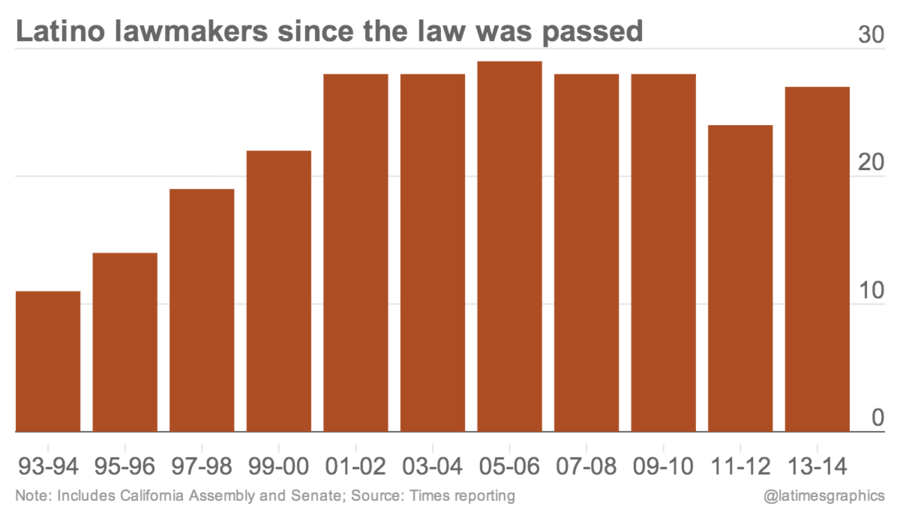
The collapse of the California GOP followed the passage of a GOP-led anti-immigration act called Proposition 187 in l994. Before the passage of that law, Latinos in California were fairly supportive of the Republican party — among males, the GOP had about 50 percent backing.

This is a consensus analysis, as evidenced by this chart published a couple of months ago in the LA Times.

LatinolawmakersCA

To accompany the chart, the paper writes:

1994, California voters approved Proposition 187, a controversial ballot measure to deny public services, such as public education and healthcare, to people in the country illegally.

Although most of its provisions were struck down in court, passage of the initiative was a seminal event in recent California political history.

It energized a growing Latino voter population and badly damaged the image of the Republican Party, which was most closely associated with the measure, helping turn California into one of the bluest states in the country.

An effort, led by Latino lawmakers, is now underway in Sacramento to wipe Proposition 187 from the books.

One measure of the political sea change in the 20 years since the initiative passed is the number of Latino lawmakers in the Legislature then and now; with larger numbers comes greater clout.

The Latino lawmakers of today succeeded: Prop 187 has now been completely wiped off the books. Even as Limbaugh and Trump champion even cruder measures to insult and deport the Latino population nationwide.

The nihilism of the extreme right is something to behold. Cheerleading the self-destruction of the GOP! Who would’ve thunk it?

CA leading on climate as well as water: LA Times

Yesterday the NYTimes’ lead op-ed in the Sunday Review was about how California is Winning the Drought (as discussed here a couple of days ago) from a respected author on water issues.

Today the lead op-ed in the editorial pages of the LATimes comes from a well-known expert on drought, who argues that California is leading the way for the nation when it comes to mitigating climate change damages such as drought. It’s called Get Ready for the New Normal: Dry and Drier.

If California points the way to dry times ahead, it also gives us a glimpse of how a responsible society can adjust to a warmer future. In general, the state’s individual consumers and water districts are meeting conservation goals, thanks to a range of innovations and sacrifices.

Perhaps most impressively, the state has adopted its own pioneering cap-and-trade program aimed at rolling back greenhouse gas emissions to 1990 levels. Emissions are capped and emitters are assigned a certain number of carbon permits. If they emit less, they can sell their extra permits in a state auction, creating incentives to cut carbon pollution.

Will cap and trade enable the state to meet its greenhouse gas goal? That’s unknown, but there is no debating its positive effect on the state treasury. In fiscal year 2015-16, the permit auction will net about $2.2 billion for mass transit, affordable housing and a range of climate-adaptation programs. And by the way, the warnings of naysayers and climate deniers that cap-and-trade would prove a drag on the economy have proved groundless.

California a “responsible society!” Doesn’t fit our flaky image does it? Columnist Joe Matthews wrote about our flaky image for Zocalo Public Square a couple of years ago, and pretty much blew it out of the water.

It’s true that in our personal lives, Californians can tend toward the unreliable. But in our work lives, we have never been flakes. If we’re social flakes, we have a good excuse: It’s because we’re working too damn hard.

While the federal government doesn’t break out productivity by state, academics have found California to be among the top places in the country in worker productivity, right up there with New York. If you want to find flakes in the workplace, try Alaska or Louisiana—or the big slacker, Texas. (No wonder Texans find so much time to criticize our business climate).

[edit]

Our state attracts more venture capital than the rest of the country combined. We lead in agriculture revenues, high-wage services, fastest-growing companies, patents and inventions (more than 20,000 a year), job creation (at least recently), initial public offerings, and (by any measure you want to use) in innovation. We’re paying more in taxes, and getting back less, than virtually every other state. If you’re reading this in another state, odds are we’re subsidizing your flakiness.

So there. Here’s the image that went with the “Winning the Drought” op-ed.

winningthedroughtimage