“It Can’t Be Our Fault. We’re the Good Guys.”

For all the Internet’s flaws–including its ability to keep people like myself inside the house, when they should be outside, tending to their spring gardens–I adore its ability to bring forward pure ideas.

Here’s a question that’s been bothering me for years. Why it is that so-called conservatives are resistant to the idea that humans could change the climate? We’ve changed the landscape of the planet, obviously. Is it so crazy to suggest that we could change the climate too?

(Rush Limbaugh was recorded bellowing on this subject, claiming that environmentalism was a religion, because he claimed–ironically–that "there is no evidence that we could destroy ecosystems." Well, now that that’s settled.)

I’ve been waiting for some brilliant writer to come along and explain this bizarre right-wing faith in our ineffectuality, but no such essay has yet appeared on the horizon.

But thanks to a discussion on TPM Cafe, the truth has finally come out. A commentator and concert violinist named Tom Wright explains:

I was going to say I didn’t understand the resistance to accepting we are affecting the climate, but there is an easy answer. I heard this sentiment from my conservative sparring partner (and business partner): "Some people just want it to be our fault, like we’re inherently evil or stupid." The converse is that he wants to believe humans are inherently good and smart so it can’t be our fault. For humans read "Americans." The same sentiment supports our foreign policy. It can’t be our fault, we’re the good guys.

It seems a little like wanting to be the chosen people but if we’re screwing the planet then we aren’t anointed by God, but just another animal pooping in its nest.

In a brief email discussion, Wright added another example of this right-wing myopia, from a commentator on the same site named Primob:

I am unconvinced that the people inhabiting the planet can have such a destructive impact on the Earth’s climate over such a short period of time. Such presumption borders on pathological arrogance.

Note that Primob assumes the worst; not just that we as a species are changing the climate, but that we are destroying it. In fact it’s not that black and white, as scientists like James Hansen continue to insist. It’s possible for us to change the climate, but not destroy life as we know it. If we can only open our minds to new possibilities, including the possibility that we are not heroes…

Models of Ice Sheets Useless–A Thousand Years Too Early?

Last week in Science two researchers reported on the Greenland ice sheet, which is melting about twice as fast as expected ten years ago. American’s leading climatologist, James Hansen, wrote in the UK’s Independent (archived here) about what this means for us in the temperate zone:

Today’s forecasts of sea-level rise use climate models of the [Greenland] ice sheets that say they can only disintegrate over a thousand years or more. But we can now see that the models are almost worthless. They treat the ice sheets like a single block of ice that will slowly melt. But what is happening is much more dynamic.

Once the ice starts to melt at the surface, it forms lakes that empty down crevasses to the bottom of the ice. You get rivers of water underneath the ice. And the ice slides towards the ocean.

Dr. Jeff Masters Wunderblog discusses the issue in depth, and makes the same point as Hansen:

The most worrying aspect of the paper’s findings is that we are told that the computer models used to estimate how long it will take Greenland’s ice will melt are significantly in error–and in the wrong direction!

Exxon/FOXNews hack Stephen Milloy eagerly agrees with "Calamity Jim" that circulation models:

are not the tools for the [predictive] job and we have little prospect of developing such tools in the foreseeable future.

But he waves off the idea that the melting of the Greenland ice sheet could be a problem, declaring:

Gosh Jim, there’s a lot of noise here but seems precious little substance…

In his post, which is highly recommended, Masters discusses the same "noise" of conflicting studies as Milloy mentions, but he’s significantly less reassured:

However, the doubling in glacier flow observed in the past ten years comes as a major shock. The models used to come up with the 1000 year estimate do not account for changes in glacier speed at all! The unexpected increase in glacier flow probably occurred in response to the lubrication effect of melt-water penetrating down to the glacial bed, as well as other poorly-understood processes. The paper concluded: "Current models used to project the contribution to sea level from the Greenland Ice Sheet in a changing climate do not include such physical processes and hence do not account for the effect of glacier dynamics." In other words, the models were wrong. Climate change skeptics are find of criticizing computer models, and cite their inadequacy as grounds for dismissing the threat of climate change. Well, it works both ways. Climate change models can be off in the wrong direction–as we also saw with the Antarctic ozone hole, which was completely missed by the models. These new results imply that if Greenland warms significantly (at least 3° degrees C), Greenland’s ice could melt in a few centuries, not 1000 years. With 20 feet of sea level rise locked up in its ice, sea level rises well beyond the capability of humans to handle could occur later this century.

The World We Have Known

David Roberts at Gristmill catches a great letter to the NYTimes from James Speth, a dean at Yale in Forestry and Environmental Studies:

The world we have known is history. A mere 1 degree Fahrenheit global average warming is already raising sea levels, strengthening hurricanes, disrupting ecosystems, threatening parks and protected areas, causing droughts and heat waves, melting the Arctic and glaciers everywhere and killing tens of thousands of people a year.

Yet there are several more degrees coming in our grandchildren’s lifetimes.

It is easy to feel like a character in a bad science fiction novel running down the street shouting "Don’t you see it!" while life goes on, business as usual.

Climate change is the biggest thing to happen here on earth in thousands of years, with incalculable environmental, social and economic costs. But there is no march on Washington; students are not in the streets; consumers are not rejecting destructive lifestyles; Congress is not passing far-reaching legislation; the president is not on television explaining the threat to the country; Exxon is not quaking in its boots; and entire segments of evening news pass without mention of the climate emergency.

Instead, 129 new coal-fired power plants are being developed in the United States alone, and so on.

There are many of us caught in this story. We must find one another soon.

James Gustave Speth

New Haven, Feb. 20, 2006

BLM Won’t Let Biologists Outside

Another example of the Bush administration quashing scientists, or another example of the Bush administration raping the land?

You decide.

Crucial quote:

The BLM’s pace of issuing new permits to drill in Wyoming and across the West has continued to increase, even though the oil and gas industry — which is chronically short of drilling rigs and skilled workers — cannot drill nearly enough holes in the ground to keep up with the permits that have already been granted. In the past two years, the BLM issued a record 13,070 drilling permits on federal land, but industry drilled just 5,844 wells.

"The pressure comes from Washington," said [Gov.] Freudenthal, [D-Wy.] who said he has assigned more state wildlife biologists to Pinedale and other active drilling areas in an attempt to keep up with the federal push. "As you go up the chain of command of BLM and into the Department of Interior, I am not sure they share our commitment to balance. No matter how large the benefits are from this development, it does not justify turning a blind eye to the environment."

White House: Climate Change “Private” Matter

After persistent prodding by Chris Mooney, the White House press corps recently actually asked a question to the Bush administration on the subject of anthropogenic global warming.

Predictably, spokesman Scott McClellan gave a non-answer:

I’m not going to get into talking about private meetings [Bush has] had, but look at the initiatives we’ve outlined, look at the leadership the President is providing to address the challenges of climate change.

Of course, the President has made no attempt to reduce the emission of greenhouse gasses in this country, and this month didn’t even mention climate change while admitting we are addicted to oil.

His administration opposed the one measure that would have an immediate impact: Conservation.

As in: Conservative.

But never mind. In a few recent speeches, Bush has proposed a coal sequestration demonstration plant known as Newgen that will take ten or more years to construct and, according to the Department of Energy, cost about a billion dollars.

That’s ten years from now. This year British Petroleum launched an effort to build, on a site already licensed for power generation, a plant in the Los Angeles area that will cost much less than a billion dollars and produce massive amounts of energy with the same zero emissions.

Instead of Dick Cheney’s preposterous proposal to build a power plant a week in this country for twenty years.

Given this insulting refusal by the Bush administration to face reality today, or to answer questions from the press corps, one of Mooney’s commentators, Harris Contos, suggests the proper response of the White House press corps is a boycott:

If only the major news outlets would have the courage to say in their nightly newscasts, "Our correspondents, and others, are in day seven of the boycott against the White House press office. Once spokesman Scott McClellan has something informative to say, our coverage will resume."

The dramatist in me loves this idea.

Suddenly I can see the encounter in the briefing room making the transition from farce to comedy.

If the national media refused to ask questions as long as the administration refused to answer them, perhaps we’d hear more from one particular gentleman in the press corps on the subject of India and Pakistan. Perhaps others less often heard would find a way to ask questions on other topics.

Perhaps some of the questions would be completely ridiculous, and remind everyone that this whole dull exercise in image management is completely pointless.

Perhaps reporters might put Cabinet officials or other legislators on the record on environmental issues, and perhaps some of those officials would level with the country and help us face the facts. Perhaps even Democrats might get an opportunity to speak and be heard.

Who knows what might happen?


That Wacky, Wacky Wall St. Journal

The Wall Street Journal is known for its tight focus on the issues of interest to American businessmen, and for the seriousness of its reporting, which doesn’t even allow for photographs on the front page.

But when it comes to climate change, the editorial side of the paper seems to go a little crazy. In an editorial last year, for example, the paper claimed that global warming, if an issue at all, was "a problem that’s a few centuries off."

They take the head-in-the-sand position despite the example of countless American and foreign corporations who are not just convinced of the reality of global warming, but see it as a rich new field for innovation and profit, including heavyweights such as Duke Energy, GE, and British Petroleum.

Not to mention Fortune magazine, the first publication in this country to review Time reporter Eugene Linden’s new book on global warming, "The Winds of Change," which sharply warns of the risks of WSJ-style inaction, to businesses and citizens alike.

This year the WSJ published, an editorial that dismisses the threat of global warming in language so arch that you can practically hear the creaking of the old leather club chairs and get a whiff of cigar smoke just from reading it. It’s behind a subscriber firewall, conveniently for the paper, but was reproduced in an entry in the comments below this Real Climate post on the subject, which is very funny, and posted in its entirety below:

The Wall Street Journal has published another fair and balanced critique of climate change science and negotiations, in a Business World commentary by Holman W. Jenkins, Jr, here. A summary of the arguments is as follows:

1. It will never be possible to prove that global warming is real. In the same way, we point out, it will never be possible to prove that anybody died from lung cancer because of smoking. Did you actually witness that first DNA mutation?

2. The reasonable lay person cannot be expected to read a scientific paper, so the rational response is to ignore the issue.

3. A paper about frogs did not argue convincingly that people cause global warming.

4. People sometimes distort the truth (truly a shocking charge coming from the WSJ).

5. Global change negotiations are stalled in politics, so the science must be wrong.

Final thought: When climate does change, we’ll be able to fix it anyway.

Winter Returns, Thank God!

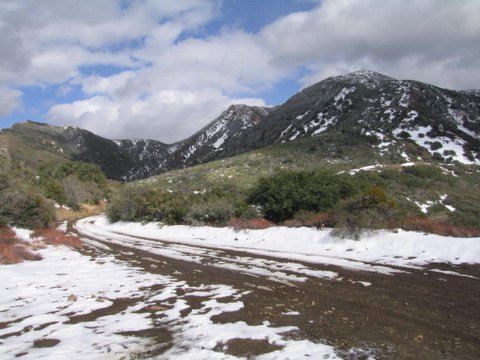
In a post below, I regretted the coming of spring in early February, which for Southern Californians could mean ten months or more of unrelenting heat, smog, and fear of wildfires…but my fears were premature: Winter has returned!

Yesterday with my wife, a friend, and our delirious dogs, we walked all day to the top of our local ridge, the Topa Topas, where snow was abundant (at 6,000) feet. This is not a matter of earth-shaking import, but let us take our blessings where we find them…

Inthetopatopas_2

The Way the Story Is Told

Two interesting perspectives on story-telling about the environment came out this weekend.

In Orion, editor and novelist Kelpie Wilson contrasts the mythic approach to environmental disaster apparent in the Bible story of Noah’s ark and other accounts of the floods of 7600 years ago…with our present, science-based method of story-telling:

How ironic then, that a past climate change for which humans bore no blame should inspire such a tremendous sense of collective responsibility, while the current one, for which we are certainly culpable, inspires only a mad rush to place the blame on anyone or anything but ourselves.

[cut to]

The logos of our science tells us that human behavior is a primary cause of today’s climate chaos; but we have as yet no mythos that allows us to take it to heart and to admit our guilt. And we will never act to save ourselves until we do.

[cut to]

The new mythos cannot emerge from the art of today’s popular culture, in which the hero saves the day. Art as entertainment only drives us deeper into denial. Art as a cathartic experience is different.

The argument looks strong, especially in regard to the need for a hero, but conflates differing modes of story-telling in our culture. It’s true that scientific stories tend to be boring, but then, scientists aren’t interested in the human attention span. Wilson then springboards from this blending of science and popular culture into offering a myth to supply a cathartic experience and lead us as a people towards a new understanding. It’s a noble effort, but to this reader, looks like an attempt to put today’s environmentalism into Biblical language, and perhaps as a result, just sounds hollow.

On the visual story-telling side of the coin, in Saturday’s NY Times appears a story about Richard Misrach, a photographer who has spent decades documenting environmental disasters in the desert, and who is bringing out a new book called "Chronologies." (Misrach has appeared in this blog before, in an interview with artist Barbara Medaille, who cited him as an inspiration.)

In his interview with the Times, Misrach makes an important point. Critics complain that his work "anesthetizes disaster," because he makes environmental catastrophes so pretty to look at, but Misrach brings simple practicality to his response, pointing out that

Shakespeare uses profoundly rich and gorgeous language to convey the most terrible and tragic elements of the human condition. It’s the way the story is told that makes us re-examine life afresh.

An even better example, if you ask yours truly, is Charles Dickens, who wrote about the most abject and appalling horrors of the Industrial Revolution with amusement and sprightly good humor. Heroes were surely no more easy to find in his era than in ours; if unavailable, he focused instead on victims (such as Bob Crachit) and made them wonderfully endearing and memorable. And, of course, Dickens had the temerity to suggest that even bad guys like Scrooge could be reformed.

So let’s not throw in the towel yet on popular culture and global warming. Past crises made us just as complicit as a people (remember nuclear proliferation?) and yet popular culture found a way to bring them to the forefront of our consciousness, with works such as "Dr. Strangelove." Perhaps some as yet undiscovered genius will accomplish the same feat with global warming. Crazy optimism? Perhaps, but surely no crazier than assuming that we all must go back to Biblical-style storytelling.

Sure this picture makes Misrach’s point as well as any myth any of us could create:

Desert_fire_249


The White House Bothers to Mislead on Global Warming: Will the White House Press Corps Care?

Chris Mooney highlights the hypocrisy of the White House regarding global warming, forcing the conflict between the President’s private and public views into the open.

In private, George Bush is a denialist: According to "Rebel-in-Chief," admirer Fred Barnes’ just-published inside look at the President, "…Bush is a dissenter on global warming. To the extent it’s a problem, Bush believes it can be solved by technology. He avidly read Michael Crichton’s 2004 novel State of Fear, whose villain falsifies scientific studies to justify draconian steps to avoid global warming. Crichton himself has studied the issue extensively and concluded that global warming is an unproven theory and that the threat is vastly overstated. Early in 2005, political adviser Karl Rove arranged for Crichton to meet with Bush at the White House. They talked for an hour and were in near-perfect agreement. The visit was not made public for fear of outraging environmentalists all the more." (pp22-23)

In public, Michelle St. Martin, a White House spokesperson quoted in yesterday’s NYTimes, "pointed to several speeches in which Mr. Bush had acknowledged the impact of global warming and the need to confront it, even if he questioned the degree to which humans contribute to it."

What’s interesting here is that the White House feels the need to deny the obvious. If the President isn’t going to mention global warming in a State of the Union speech largely devoted to convincing the country that we have an unhealthy "addiction to oil," why bother with the hypocrisy now?

But it does raise the question: Which speeches? Before he was allowed to assume office, Bush did speak about global warming and the need to reduce carbon emissions, but all that was forgotten as soon he took residence in the White House. Since then only when pressed very hard–by the likes of Tony Blair–does Bush even mention climate change and global warming. It’s a bit like Ronald Reagan and AIDS.

Perhaps this allegation of caring will be worth a follow-up question, but if I know the White House press corps, they won’t bother. (As discussed below, I went through the entire month of January in the press gaggle transcripts looking for questions on the environment. How many did the press corps ask? Zero.)

In today’s LATimes, Jonathan Chait tartly points out why this may be: "The rules of political journalism hold that reporters aren’t supposed to take sides in debates over public policy…You quote one side’s claims, you counter with the other side’s claims, and you make no attempt to establish which side is right. After all, there’s nothing at stake in these debates but trillions of dollars and the odd war. Bor-ing."

Not to mention the health of the planet that supports us.

A Scorecard for the Climate Change Players

Something surpising’s happening with the meandering climate change discussion; quite a number of the players are getting hard to predict. We’ve almost reached the stage of requiring a scorecard to distinguish the players. A contrarian has to wonder: Could a real debate break out soon?

On the left, at Gristmill, David Roberts puts together an "index-card manifesto" for the environment that deliberately leaves out global warming, because:

"It’s vague, and large, and slow-moving, and the enemy is structural and pervasive, and we’re all complicit. That kind of shit is just no fun to think about. It does not stir the blood."

On the right, at the Weekly Standard, Steven Hayward takes on the issue for the first time in this thought-leading conservative publication (to my knowledge). Unsurprisingly, he goes out of his way to deride "alarmists," the IPCC climatological consensus, and the Kyoto Protocol…but he doesn’t resort to infamous Exxon/FOXNews hack Stephen Milloy’s-style eye-rolling or derision, beginning his discussion with:

Very few people who follow closely the subject of climate change argue that there’s nothing to it. There is unanimity that the planet has warmed by about 1 degree over the last century. Just about everyone agrees that the growth of greenhouse gas emissions from fossil fuels cannot continue forever. That’s where the agreement ends. The range of possible temperature increase over the next century is fairly wide in the official forecasts, from 1.4 degrees Celsius on the low side, which might not be difficult to cope with, to 5.8 degrees Celsius on the high side, which would mean major environmental problems for the planet.

(Such as might be experienced in Greenland, where, according to a story on National Public Radio yesterday, Greenland’s ice is melting at twice the rate expected, probably because the climate has warned 3 degrees Celsius…just in the last few years.)

But most surprising of all, a close associate of the new chairman of the Federal Reserve, an economist named Robert Frank, wrote in "The New York Times" on Thursday to propose a major tax increase on gasoline, linked to a tax rebate. The idea sounds brilliant; surprisingly workable for taxpayers, a money-maker for the Treasury, and exactly the sort of measure likely to reduce CO2 emissions. Frank admits that politicians won’t like it, but eloquently suggests (see below the fold for the full story) why they should:

In the warmer weather they will have inherited from us a century from now, perspiring historians will struggle to explain why this proposal was once considered politically unthinkable.

Economic Scene

A Way to Cut Fuel Consumption That Everyone Likes, Except the Politicians

By ROBERT H. FRANK

SUPPOSE a politician promised to reveal the details of a simple proposal that would, if adopted, produce hundreds of billions of dollars in savings for American consumers, significant reductions in traffic congestion, major improvements in urban air quality, large reductions in greenhouse gas emissions, and substantially reduced dependence on Middle East oil. The politician also promised that the plan would require no net cash outlays from American families, no additional regulations and no expansion of the bureaucracy.

As economists often remind their students, if something sounds too good to be true, it probably is. So this politician’s announcement would almost surely be greeted skeptically. Yet a policy that would deliver precisely the outcomes described could be enacted by Congress tomorrow — namely, a $2-a-gallon tax on gasoline whose proceeds were refunded to American families in reduced payroll taxes.

Proposals of this sort have been advanced frequently in recent years by both liberal and conservative economists. Invariably, however, pundits are quick to dismiss these proposals as "politically unthinkable."

But if higher gasoline taxes would make everyone better off, why are they unthinkable? Part of the answer is suggested by the fate of the first serious proposal to employ gasoline taxes to reduce America’s dependence on Middle East oil. The year was 1979 and the country was still reeling from the second of two oil embargoes. To encourage conservation, President Jimmy Carter proposed a steep tax on gasoline, with the proceeds to be refunded in the form of lower payroll taxes.

Mr. Carter’s opponents mounted a rhetorically brilliant attack on his proposal, arguing that because consumers would get back every cent they paid in gasoline taxes, they could, and would, buy just as much gasoline as before. Many found this argument compelling, and in the end, President Carter’s proposal won just 35 votes in the House of Representatives.

The experience appears to have left an indelible imprint on political decision makers. To this day, many seem persuaded that tax-cum-rebate proposals do not make economic sense. But it is the argument advanced by Mr. Carter’s critics that makes no sense. It betrays a fundamental misunderstanding of how such a program would alter people’s opportunities and incentives.

Some examples help to illustrate how the program would work. On average, a family of four currently consumes almost 2,000 gallons of gasoline annually. If all families continued to consume gasoline at the same rate after the imposition of a $2-a-gallon gasoline tax, the average family would pay $4,000 in additional gasoline taxes annually. A representative family with two earners would then receive an annual payroll tax refund of $4,000. So, if all other families continued to buy as much gasoline as before, then, this family’s tax rebate would enable it to do so as well, just as Mr. Carter’s critics claimed.

But that is not how things would play out. Suppose, for example, that the family was about to replace its aging Ford Explorer, which gets 15 miles per gallon. It could buy another Explorer. Or it could buy Ford’s new Focus wagon, which has almost as much cargo capacity and gets more than 30 miles per gallon. The latter choice would save a whopping $2,000 annually at the pump. Not all families would switch, of course, but many would.

From the experience of the 1970’s, we know that consumers respond to higher gasoline prices not just by buying more efficient cars, but also by taking fewer trips, forming carpools and moving closer to work. If families overall bought half as much gasoline as before, the rebate would be not $2,000 per earner, but only $1,000. In that case, our representative two-earner family could not buy just as much gasoline as before unless it spent $2,000 less on everything else.

So, contrary to Mr. Carter’s critics, the tax-cum-rebate program would profoundly alter not only our incentives but also our opportunities.

A second barrier to the adoption of higher gasoline taxes has been the endless insistence by proponents of smaller government that all taxes are bad. Vice President Dick Cheney, for example, has opposed higher gasoline taxes as inconsistent with the administration’s belief that prices should be set by market forces. But as even the most enthusiastic free-market economists concede, current gasoline prices are far too low, because they fail to reflect the environmental and foreign policy costs associated with gasoline consumption.

Government would actually be smaller, and we would all be more prosperous, if not for the problems caused by what President Bush has called our addiction to oil.

At today’s price of about $2.50 a gallon, a $2-a-gallon tax would raise prices by about 80 percent (leaving them still more than $1 a gallon below price levels in Europe). Evidence suggests that an increase of that magnitude would reduce consumption by more than 15 percent in the short run and almost 60 percent in the long run. These savings would be just the beginning, because higher prices would also intensify the race to bring new fuel-efficient technologies to market.

The gasoline tax-cum-rebate proposal enjoys extremely broad support. Liberals favor it. Environmentalists favor it. The conservative Nobel laureate Gary S. Becker has endorsed it, as has the antitax crusader Grover Norquist. President Bush’s former chief economist, N. Gregory Mankiw, has advanced it repeatedly.

In the warmer weather they will have inherited from us a century from now, perspiring historians will struggle to explain why this proposal was once considered politically unthinkable.

Robert H. Frank, an economist at the Johnson School of Management at Cornell University, is the co-author, with Ben S. Bernanke, of "Principles of Economics." E-mail: rhf3@cornell.edu