Mr Willis Goes to Washington

Not long after the COVID-19 pandemic began, a media attack on masking, epidemiology, and vaccination came in the form of a film called “Plandemic,” made by Ojai resident Mikki Willis, which dropped on May 4th, 2020. Spread by thousands of anti-vax and QAnon followers — according to a follow-up investigation by the Stanford Internet Observatory — the film attained instant popularity. Among its many falsehoods — which have been refuted by Science, NPR, USA Today, among many others — the film planted the conspiracy theory that the COVID-19 outbreak was part of a scheme by Anthony Fauci and others to create a new vaccine.

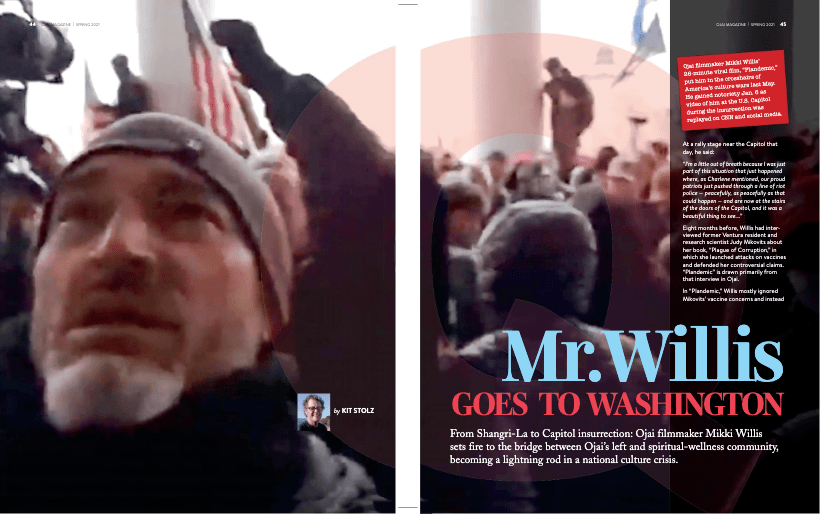
The film — featuring Willis interviewing discredited former researcher and anti-vax author Judy Mikovits of Oxnard — made Micki Willis nationally famous, but provoked a backlash in Ojai among former friends and associates. Not long after its release Willis left Ojai for Texas, where he lives with his family today. Willis went on to join the mob at the US Capitol on January 6th, and was photographed outside the Capitol Dome amidst a crowd chanting “Hang Mike Pence,” ensuring himself a moment of infamy on Twitter. (Willis insists that he never entered the Capitol building itself, and has not been questioned or arrested by authorities.)

Below the virtual fold is a web version of the story on Willis and “Plandemic” I wrote for Ojai magazine in May (reformatted and updated).

Willis has turned his back on his former progressive causes (such as composting, women’s empowerment, and Bernie Sanders) and now works with the likes of sanctioned right-wing attorney Lin Wood, on the defense of accused murderer Kyle Rittenhouse, among other right-wing media figures.
In April of last year Willis interviewed Judy Mikovits around the release of her book “Plague of Corruption.” In the interview — which Willis amplified unquestioningly — Mikovits claimed she was driven out of science by Anthony Fauci and others. In fact a study she published in 2009 claiming to have found a viral cause of Chronic Fatigue Syndrome was withdrawn under allegations of malfeasance and subsequently renounced by Science magazine. Mikovits was then fired by her employer, the Whittemore Peterson Institute, and arrested in 2011 in Ventura County for allegedly stealing research materials. Mikovits no longer works in the field, but in the last fifteen months has published three popular books railing against vaccination, masking, and Fauci, among other targets.

In “Plandemic,” Willis mostly ignored Mikovits’ false claims about vaccination and instead focused on allegations not found “Plague of Corruption,” such as the false claim that wearing masks against COVID-19 “activates” the virus in the body.

This directorial choice brought “Plandemic” and Willis immediate and enormous fame — and scrutiny. Because “Plandemic” now has been banned from social media and excluded from streaming platforms, Willis said he has had to move his new work to other media outlets and has turned his focus to a new controversies far from Ojai and even California.

Willis said his filmmaking team now works as a “forensic filmmaker” with public footage for the defense team of Kyle Rittenhouse, the 18-year-old charged with two counts of homicide in a Black Lives Matter protest that took place Aug. 25 in Kenosha, Wisconsin. In an appearance in October 2020, Willis said that he also worked on footage of the Covington Catholic School student Nicholas Sandmann, accused of taunting a Native American veteran in a confrontation at the Lincoln Memorial on Jan. 18, 2019. From other footage gathered from the scene, Willis’s team made a longer video that he says helped turn the tide of public opinion in Sandmann’s favor.

“We made the video that won the lawsuit against CNN and the Washington Post, and I was no longer the darling of the Left,” Willis said in a videotaped appearance at a Red Pill Expo in Jekyll, Georgia, in October 2020.

In interviews, Willis said that he rejects partisanship and extremism on both sides of the political spectrum, but complained of “the incredible volume of people [in Ojai] who became hateful and unwilling to have a dialogue after “Plandemic.’”

For himself, Willis continues to speak reverently of “sacred” Ojai, but last year moved with his family to Corpus Christi, Texas.

MIKOVITS AND ‘PLANDEMIC’

In “Plandemic,” Mikovits claimed that “wearing the mask literally activates your own virus.” In May of 2020, she alleged in an YouTube interview that public health authority Anthony Fauci “basically let this disease spread around the world so he could get glory, fame, and money.” She called for health authorities to lift lockdowns, and in August published a best-selling book against masking.

Despite — or perhaps because of —  the falsehoods, duplicity, and lack of verification, the alarming “Plandemic” film shot to overnight fame. “Plandemic” was released to the Internet on May 4, 2020, and went viral, recording nearly 1.8 million views within three days, according to the Digital Trends online publication. This far outranked other popular web videos released to the web that week, and went on to rack up more than an estimated 7 million views, according to Facebook’s Crowd Tangle research tool. Here’s an image depicting the groups spreading the video.

The spread of Plandemic on Facebook was powered by QAnon, anti-vax, and chemtrails groups, according to CrowdTangle datasets.

Facebook soon took “Plandemic” down.

“Suggesting that wearing a mask can make you sick can lead to imminent harm, so we’re removing the video,” Facebook said in a statement to news outlets on May 7, three days after it achieved explosive popularity and millions of views.

After “Plandemic” was removed from Facebook, where it was most often shared, other social-media sites followed suit, including YouTube and Vimeo. It is not readily found on the Internet by search engine today.

“Plandemic” made Willis nationally famous, but with prominence has come public pressure and a great deal of criticism from former allies in Ojai. Willis continues to defend the film, and maintains an active personal presence on some social media, but in interviews and appearances in recent weeks, he expressed anger toward the so-called mainstream media and mixed feelings about fame.

WILLIS IN THE CAPITOL RIOT

On Jan. 6., Willis spoke at a “MAGA Health Freedom Event” on the east side of the U.S. Capitol, and joined — with a small film crew in tow — the crowds of Trump partisans from around the country who gathered at the U.S. Capitol. In the aftermath, a five-second cellphone video image of Willis, surrounded by a crowd of protesters chanting “Hang Mike Pence” at the Capitol, was widely circulated on social media and CNN.

Some commentators called on the FBI to arrest him.

After news of Willis’s attendance at the Capitol riots spread on social media around the country, the Kiss the Ground nonprofit organization (a Los Angeles-based 501c3 headquartered in Ojai), severed connections with him in a statement released to Instagram:

“This past weekend, Kiss the Ground was made aware that a member of its extensive advisory council was present at the insurrection at the Nation’s Capitol,” the Jan. 12 statement read. “Upon learning this, we immediately terminated Mikki Willis’ position at the advisory council.

Without equivocation, Kiss the Ground stands firmly on the side of American democracy and condemns the hatred and violence that ensued.”

Despite the furor on Twitter, Willis has not been arrested or charged.

In the aftermath, on Facebook and in interviews, Willis insists that he went “as a journalist” to the Capitol, but never inside. He condemns the violence that took place, and argues in a seven-minute unreleased film that the violent mob assault took place largely on the on the front side of the Capitol, where the Inauguration was held later in January, and not on the back side of the Capitol, which is where Willis joined another large crowd that was marching on the building.

In his speech at the “MAGA Health Freedom Event of the Century” on Jan.6 outside the Capitol, Willis spoke warmly of what he saw at the Capitol, describing it as “the human organism rising up” and “a beautiful thing to see.” He added that he “had done a 180” from his past as “part of the Far Left.”

For some of his critics, such as holistic foods entrepreneur John Roulac, a former Ojai resident and founder of the health food company Nutiva, who worked on a film about hemp with Willis in 2008, “Plandemic” is a part of the problem that the spirituality and wellness movement now has with right-wing conspiracism.

“Millions of Americans and many people I know were “red-pilled” by this conspiracy theory that moved very strongly into the wellness/alternative/New Age world,” he said. “Last spring, I saw this happening and started asking: What is going on? If you talk to these people, you will hear that very powerful people are controlling the financial destiny of the world and we need to push back. Okay, that’s not crazy — until they say the answer is Donald Trump.”

To be “red-pilled” is a reference to a pivotal moment in the hugely popular 1999 movie “The Matrix.” The idea is that an individual is presented with a choice in life: He can take a blue pill and stay in a pleasantly false fantasyland, or take a red pill, and go down the rabbit hole to see the dark truth of a conspiratorial, and often right-wing, perspective.

Roulac wrote an essay on the social media site, Medium, in September critical of Willis and the QAnon movement called “Is the Wellness Movement Being Tainted by QAnon and the New Age Right?” In the essay, Roulac challenged Willis on the subject of “Plandemic” and its anti-masking message.

“He recently released “Plandemic 1” (tens of millions of views), which claims that masks can actually harm you,” Roulac wrote. “It’s like he shouted fire in thousands of crowded theaters across the world. Convincing people to see masks as ineffective and dangerous could contribute to the illness and death of tens of thousands.”

John Roulac, who once worked with Willis, now considers him dangerous to public health.

Willis admitted that he does wear masks on occasion.

“I wear a mask primarily for the protection of other people,” he said, but added that researchers have pointed out issues with mask-wearing and proper fit and cleansing. “I don’t think I’ve seen a single person in this year-long experience not fumbling with their mask in a way that makes it useless and in some cases potentially dangerous,” he said.

For Roulac, the question is bigger than masks or Willis.

“To me, this is really an example of a society in disarray. People are unsure of their own financial future, they’re concerned about the climate crisis, and it’s as if, in response, they’re grasping at bizarre conspiracies,” he said. “Look at Christiane Northrup, a well-known M.D. who has gone full QAnon. This is rampant in the Ojai Valley. And I’m like — really? And so I wrote this article telling people that this isnot a good thing and to watch out. A lot of people got upset with me for saying it, but a lot of friends in Ojai wrote to thank me for speaking up.”

OJAI NEW AGE COMMUNITY DIVIDED

Willis and his Elevate filmmaking collective have a long history in Ojai. Willis rented a large hilltop mansion in Ojai called Glen Muse from retired software engineer Darakshan Farber in the fall of 2010. Impressed by Willis’s “magnetic” personality and his creative spirit, Farber lived for nearly two years at the estate with Willis and up to 15 people at a time from the Elevate collective, he said.

“I was intrigued by his vision and his spiritual approach,” Farber said. “He was a very spiritual guy, no doubt about it. But from what I saw, it was very difficult for them to focus on the business side with all the people and the transition; they were trying to live in this grand place for the sake of the collective.”

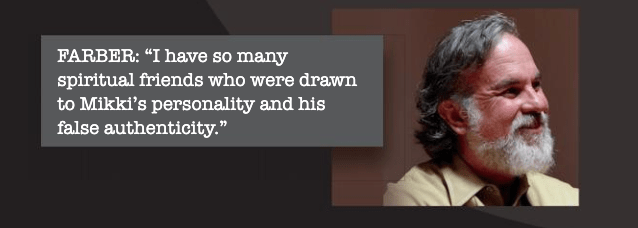
Farber said that, over time, he became disillusioned with Willis and asked him to leave. He later sold the estate and traveled overseas. He watched “Plandemic” in Thailand last year and was once again reminded of his time with Willis and the collective. He called the film “hogwash.”

“I have so many spiritual friends who were drawn to Mikki’s personality and his false authenticity,” he said, looking back. “It makes me very sad.”
For Nora Herold, a well-known channeler based in Meiners Oaks, who, like Farber, knew Willis personally, the conspiracism of “Plandemic” threatens the health of the spiritual community of Ojai.

“I think “Plandemic” is disinformation,” she said. “That’s not the same as misinformation, which implies a mistake, and a willingness to own that mistake. Disinformation involves an underlying agenda to promote theories or ideas that run counter to the traditional narrative. These ideas are there for an underlying reason, and that’s often because there’s a financial gain involved.”

Many in Ojai charge that Willis has been motivated in his choices primarily by money, but Herold and a few others see the potential for an even darker agenda. Herold said that QAnon references began to crop up in her work in Ojai in 2017.

“QAnon and COVID denial and anti-mask statements and extreme beliefs about sovereign identity create a split in the spirituality/wellness community,” she said. “The split in our community is reflected in a split in the larger world. I think it’s an ancient wound — a form of unhealed trauma.”

Jack Adam Weber, an author and climate activist in Ojai, said he also sees a connection between the conspiratorial rhetoric of “Plandemic” and the conspiratorial rhetoric of the cultic group known as QAnon.

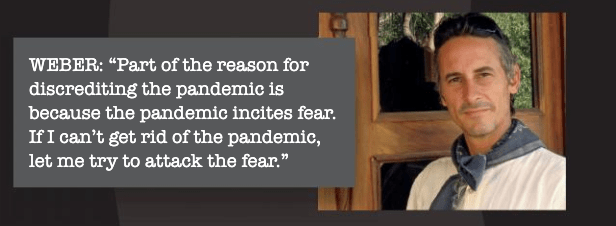
“For New Agers, conspiratorial thinking is spiritual bypassing,” he wrote in an essay, invoking the idea that among the spiritually-mindedin particular, the pandemic evokes pain, and it’s easier to deny COVID-19 than to deal with that deeply rooted pain.

“Part of the reason for discrediting the pandemic is because the pandemic incites fear,” he said. “If I can’t get rid of the pandemic, let me try to attack the fear.”

In fact, the follow-up to “Plandemic,” called “Plandemic: Indoctrination,” which was released last fall and is still available online, ends with a fierce rejection of the emotion of fear.
Although Farber said he now distrusts Willis and hasn’t seen him in years, he doesn’t know how intentional Willis is in his choices.

“I wonder if Mikki almost unconsciously shifted from a purely spiritual world to this world where he gets more of an audience, more adulation, and more money, but I don’t know.”

WILLIS DEFENDED

Willis still has defenders in Ojai. Among them is Reno Rolle, a longtime resident, who said he has known Willis since 2003 as a filmmaker, neighbor, and family man, and continues to support him and his work. He scoffed at the idea that “Plandemic” could damage Ojai’s spirituality/wellness community.

“If the spirituality of the Ojai community is that fragile, then perhaps there’s a bigger question that needs to be expressed,” he said, adding that he knows Willis did not produce “Plandemic” to make money.

“On the heels of his ‘Plandemic’ project, I was approached by people who specialize in monetizing data because they thought I might be able to get to Mikki,” he said. “They suggested emphatically that if they had access to Mikki’s database, they would market to that database, and they guaranteed seven figures over the course of one week. I know it sounds incredible, but I’ve been in direct-response community marketing and these people are very credible and legitimate. Mikki flatly refused, because he was concerned people would think he had made ‘Plandemic’ for the money.”

Willis said he has not taken any opportunity to profit off the success of “Plandemic.” Looking back on his tumultuous year since making the viral film, Willis now says that his appearance at the Capitol riot was a mistake, perhaps his biggest mistake. However, he denies any involvement with QAnon. He blames the media for conflating his appearance at a rally on health and vaccination issues with support for former President Trump’s “Stop the Steal” campaign, and rejects the idea that he made “Plandemic” to become rich and famous.

“Consider this — for 30 years I’ve been doing good business in and around Hollywood,” he said. “I had collected a community of supportive investors and established solid connections with all the major distribution platforms, including Netflix and Amazon. Every one of these has gone away. I will never again have a film on a major distribution platform. You don’t make these choices for financial or political gain — I think fame is a curse, particularly in an age where one tweet can leave your entire career ruined.”

Update: This fall Willis will release a book version of “Plandemic,” which he is promoting with QAnon merchandising.

END

The article appears on page 44 of the Ojai Magazine above in pdf format.

the still-surprising John Lennon

The anniversary of John Lennon’s assassination forty years ago has brought forth a rich crop of rediscovered valedictions from 1980, one notably by Robert Christgau, the dean of rock critics, written on rush deadline for the Village Voice. Read this (as I have for the first time this week) and you understand exactly why they “crucified” him, (as Lennon predicted they would in the bouncy but bitter Beatles song near the end of his time with the band, “The Ballad of John and Yoko.”)

Christ you know it ain’t easy
You know how hard it can be
The way things are going
They’re going to crucify me

Christgau wrote of this sad consequence of Lennon’s idealism in his 1980 farewell:

“As my wife said despondently an hour after the assassination: “Why is it always Bobby Kennedy or John Lennon? Why isn’t it Richard Nixon or Paul McCartney?” The fact is obvious enough. Dylan, of course. Jim Morrison, possibly. Neil Young, conceivably. But Paul McCartney? Neil Diamond? Graham Nash? George Harrison? Ringo Starr? Never — because they don’t hold out hope, even if they’d sort of like to be able to. John Lennon held out hope. He imagined, and however quietistic he became he never lost that utopian identification. But when you hold out hope, people get real disappointed if you can’t deliver. You’re famous and they’re not — that’s the crux of your relationship. You command the power they crave — the power to make one’s identity felt in the world, to be known. No matter that the only thing you’re sure it’s good for is room service. No matter that you’re even further from resolving anyone’s perplexities than the next bohemian, artist, or intellectual. You’re denying your most desperate admirers the release they need, and a certain percentage of them will resent or hate you for it. From there, it only takes one to kill.”

That insight remains true, don’t you think? It’s tragic, but it’s also astonishing how creative Lennon was, how much he gave, how much light he shed. This year, in the pandemic, Lennon’s ground-breaking flight from music and fame by choice in the 1970s. choosing to be a “househusband” became — says Rolling Stone — more timely than ever. In a best of the pandemic records for this year list they extoll Lennon’s first solo record.

John Lennon/Plastic Ono Band was released nearly 50 years ago, but with songs like “Working Class Hero,” “Mother,” and “God,” it’s remained more relevant than ever. “Isolation” is particularly fitting, and not just for its obvious title. It’s a song about Lennon shedding his Beatles skin and revealing himself for the first time, while admitting that he and Yoko are just like everyone else — afraid of being alone and trying to make the world a better place. Celebrities can wallow in their wealth and sing “Imagine” all they want, but it’s “Isolation” that truly captures this horrifying moment. ” —A. Martoccio

As he sang:

People say we got it made
Don't they know we're so afraid
Isolation

Up until the very end of his life he remained capable of surprising us, and even perhaps of surprising himself. I was pleasantly shocked and thoroughly charmed to read in a last interview with the New York Times Lennon rhapsodize about the younger self he rediscovered out walking:

“There’s a difference between being alone and being lonely. That’s what I learned in the last five years. I rediscovered [in Hong Kong], the feeling I used to have as a youngster, walking in the mountains of Scotland with an auntie. You know, you’re walking [gestures fast] and the ground starts going beneath you, and the heather, and the clouds moving above you, and you think, Ah, this is the feeling they’re always talking about, the one that makes you paint or put it into poetry because you can’t describe it any other way. I recognized that that feeling had been with me all my life. The feeling was with me before the Beatles.

So this period was to re-establish me, as me, for myself. That’s why I’m free of the Beatles. Because I took time to free myself, mentally, from it, and look at what it is. And now I know. So here I am, right? It’s beautiful, you know. It’s just like walking those hills.”

from the cover of the 1998 box set of Lennon solo recordings

Amen John. Miss you still.

180k farmworkers sickened w/Covid

According to this excellent and short WSJ video feature, 180k farmworkers this year have tested positive for COVID-19, and some of them have died. Here’s a story from Santa Maria in Santa Barbara county about a group of 250 or so such guestworkers living in crowded conditionsin a motel…and interviews with two who contracted the virus.

Contra Janet Malcolm, not all journalists are betrayers

The great New Yorker/New York Review of Books writer/author Janet Malcolm threw down like a rapper on journalism in one of her most famous works, The Journalist and the Murderer.

This post will grapples a bit with this contention, but simply as a writer, one has to respect the ferocity of her lede.


“Morally indefensible?” “Treachery?”

I understand that Malcolm gestures grandly to make a point to one and all. I know too that the people I write about are not murderers or politicians running for president, and the stakes are correspondingly lower, and perhaps, the people less in need of betraying. But still, with all due respect to Ms. Malcolm, journalism can be defended and actually commendable. Or so I am told. Alasdair Coyne is one of the reasons Ojai isn’t like every other place — and numerous neighbors have thanked me for writing about him. In this case, journalism is a way of paying attention to heroism. I feel someone should make this boring but necessary and truthful point on line.

Fire weather and climate change

In Ventura County this week, the local National Weather Service station in Oxnard has issued the following warnings:

On Sunday, a Red Flag Warning (for high heats and offshore winds)
For the week, a Critical Fire Weather warning (for high heat, low humidity)
for the last three days, an Excessive Heat Warning

Do these “fire weather”warnings seem increasingly common? That’s because they are, in fact, more common — about twice as common as in the previous climatology of the 80’s. Here’s the story on the subject I published this week in the Ventura County Reporter:

As new wildfires in Shasta, Napa and Sonoma counties in Northern California exploded in flames this past weekend, forcing evacuations and destroying vineyards and homes,  a “Red Flag warning” was issued on Sunday for the mountains of Ventura and Los Angeles County. The National Weather Service warned of winds gusting up to 40 miles per hour, relative humidity falling into the single digits, and temperatures expected up to 105 degrees. A “critical fire weather” warning for Ventura County was extended through this week due to “an extended period of hot, dry conditions, along with offshore breezes and plume dominated fire potential.”

Screenshot of National Weather Service front page for Ventura County area, Sept. 28, 2020: www.weather.gov/lox/

This is to be expected across California in fall now, scientists say. “Fire weather” conditions have become far more common in the 21st century, according a study released in late August, in which a team of climate scientists from Stanford, UCLA, Columbia and other research institutions showed that the sort of conditions that foster massive wildfires have doubled since the 1980s. 

Were the warnings this week in Ventura County an example of the underlying change in California climate?

Yes, according to Daniel Swain, a climatologist with UCLA and the National Center for Atmospheric Research and one of the authors of the study.

“The upcoming weather pattern is indeed exactly the kind of fire weather pattern we find is occurring more frequently due to climate change: unusually warm and dry conditions co-occurring with an offshore wind event in the context of already record or near-record dry vegetation,” he said. “The main climate signal comes through the ever-increasing dryness of vegetation, which is itself mainly a production of warming temperatures.”

Ventura County vegetation levels in early September fell to “critical” danger levels of 60 percent or less, according to a statement from the Ventura County Fire Department. The Ojai area already stands below 60 percent, in contrast to this time last year, when vegetation moisture levels were at about 71 percent. 

National Weather Service alert. Sept. 30, 2020.

The study, “Climate Change is Increasing the Likelihood of Extreme Autumn Wildfire Conditions,” shows that 1950-79, the South Coast region that includes Ventura County recorded five to six days a year in which the Fire Weather Index was at an outlying extreme, with hotter, drier, and windier conditions than 95 percent of the days recorded. From 2006 to 2020, with projections extending to 2035, the South Coast region registers about 10 days of these extreme fire weather conditions a year. In years to come, that trend will intensify, bringing a total of at least two weeks of extreme fire weather a year to our region, depending to some extent on whether greenhouse gas emissions continue at the current rate, or decline with hoped-for reductions in the burning of fossil fuels. 

Swain said that one of the motivations for the study was to test a claim that Southern California — which has fewer forest environments, and more chaparral — might be less vulnerable to climate change than forested regions in Northern California. But the research found that climate change is bringing the same dangerous “fire weather” conditions to the entire state. 

“It was a bit surprising to us that historical warming and drying has already produced such a large increase in extreme fire weather days, but that’s what the data shows!” Swain said. “And since the vast majority of major fire ignition and much of the spread of established fires occurs on such days, this has major practical implications.” 

This year has seen five of the six largest wildfires in California history, totaling over 3.6 million acres burned, 7,630 structures destroyed, and 26 people killed, according to CalFire

Bob and Neil in 2020

Two of the leading lights of folk-rock in the 1960’s and 70’s — and still, arguably, its lead singers — were Bob Dylan and Neil Young.

Each in his own way has stepped forward to sing to this calamitous moment in American history.

Dylan released a month ago a record of blues, dirges, and — arguably — a sort of spoken word history/rap of the 60’s, in Murder Most Foul. It’s about the assassination of JFK, and the point is the murder, so it bathes the reader unapologetically in the blood of a president. Yet it’s as much a litany as a song, a cornucopia of nostalgic references, many of them musical. Perhaps Dylan is unpacking that moment in his life in the culture?

Air Force One coming in through the gate
Johnson sworn in at two thirty-eight
Let me know when you decide to throw in the towel
It is what it is and it’s murder most foul

I think Dylan, America’s leading poet, hears the anodyne phrase “it is what it is” and recognizes it as an evasion, a way to pass off an unpleasant reality, the lie in other words, that it is. So when Trump declares in interviews, re: the death of hundreds of thousands of Americans, that “it is what it is,” well, Dylan heard that one coming from years away. “It is what it is/and it’s murder most foul.” Yes.

And for his part, Neil Young last week released a single on the Internet, Lookin’ for a Leader, that speaks directly to this moment, and eloquently. It’s worth recalling that Young wrote “Ohio” in May of 1970 after seeing a magazine story reporting on the shooting of four students at Kent State: Crosby, Stills, Nash and Young released it as a single within weeks, and it became an instant hit. This will not have that one’s impact, but I dare hope it finds an audience — that possibility is alive for me.

You can see Neil play the song solo, the central offering of an excellent set of his political classics, released for July 4th, on his vast Neil Young Archives site, which contains the body of his music and work, and at this time is free. See him play it here (for a time at least).

performance from Neil Young’s website: Lookin’ for a Leader

The lyrics don’t have Dylan’s depth or range — whose do? — but I think they depict this political moment inspiringly well.

Congressman Covid

The coronavirus has provided an extraordinary new image for cartoonists around the world to work into their satirical art. Here’s an example I think really clicks, from John Arlington of the US, discovered on the international — and great — Cartoon Movement, of the Texas Republican Louie Gohmert.

Gohmert has been waging a brazen culture war against masks. He refuses to wear them, and mocks others for taking precautions. He was only diagnosed with COVID-19 because he intended to fly with the President, and was given a test, and failed.

“Congressman Covid,” Minority Speaker Kevin McCarthy mistakenly — but accurately — called him.

John Muir taken down from the pedestal by Sierra Club

Two days ago the Sierra Club made the front page of the Los Angeles Times when the 122-year-old environmental organization took down the monument in esteem that was its hero, John Muir, the co-founder of the organization, from his emeritus leadership position in the great beyond.

Joseph LeConte, his friend and co-founder was outright disowned, for explicitly advocating white supremacy.

In the words of long-time director Michael Brune on July 22, in a piece entitled Pulling Down Our Monuments:

The most monumental figure in the Sierra Club’s past is John Muir. Beloved by many of our members, his writings taught generations of people to see the sacredness of nature. But Muir maintained friendships with people like Henry Fairfield Osborn, who worked for both the conservation of nature and the conservation of the white race. Head of the New York Zoological Society and the board of trustees of the American Museum of Natural History, Osborn also helped found the American Eugenics Society in the years after Muir’s death. 

And Muir was not immune to the racism peddled by many in the early conservation movement. He made derogatory comments about Black people and Indigenous peoples that drew on deeply harmful racist stereotypes, though his views evolved later in his life. As the most iconic figure in Sierra Club history, Muir’s words and actions carry an especially heavy weight. They continue to hurt and alienate Indigenous people and people of color who come into contact with the Sierra Club. 

To me it’s noteworthy that the first charge brought against Muir is his friendship with white supremacists such as Henry Fairfield Osborn and Joseph LeConte. Muir’s personal views take on a darker tone when you see that his preaching of the “untouched by man” beauty of the mountains and glaciers and meadows actually fits all too well into the idea that these mountains and lands were not for the Miwok and Paiute and others who had lived there long before the Spanish and then the Americans came on to the scene.

Though the Sierra Club’s announcement didn’t go into detail, it’s known that Muir supported ejecting Native Americans from their lands to make way for people-free open spaces. He described the Miwok people, most of whom had been killed or driven from Yosemite by the time he arrived in 1868, in the ugliest of terms, writing that they were “dirty,” “altogether hideous” and “seem to have no right place in the landscape.”

This land may have been made for you and me, but to Muir and other early conservationists, “you and me” meant the class of white gentlemen who made occasional forays to what Muir saw as the untouched beauty of wilderness.

This brings to mind the Wilderness Act, once considered a high-water mark in environmental action and land conservation, now perhaps due for a reckoning. The LATimes’ sly reference to Woody Guthrie and “This Land is Your Land” is aptly drawn: the famous language of the l964 bill has no room it seems for people.

A wilderness, in contrast with those areas where man and his works dominate the landscape, is hereby recognized as an area where the earth and its community of life are untrammeled by man, where man himself is a visitor who does not remain. An area of wilderness is further defined to mean in this Act an area of undeveloped Federal land retaining its primeval character and influence, without permanent improvements or human habitation, which is protected and managed so as to preserve its natural conditions and which (1) generally appears to have been affected primarily by the forces of nature, with the imprint of man’s work substantially unnoticeable; (2) has outstanding opportunities for solitude or a primitive and unconfined type of recreation; (3) has at least five thousand acres of land or is of sufficient size as to make practicable its preservation and use in an unimpaired condition; and (4) may also contain ecological, geological, or other features of scientific, educational, scenic, or historical value.

The LA Times adds an interesting ecological and historical note:

Muir actually misunderstood the “untouched” part as well. The open meadows he admired that afforded broad views of the geological splendors of Yosemite weren’t the hand of nature; they were the result of strategic fires set by the Miwok to prevent undergrowth and catastrophic forest fires. Forty years after the Miwok were gone, so were the meadows.

Perhaps it’s time for a correction. I expect Muir himself would be appalled to discover that he has become a media star, in documentaries, recordings, theater shows, guided tours, historical homes, schools, parks, and on and on. I don’t believe he’ll be disappointed to be consigned once again to the wilderness. That’s where he always went for solace.

John Muir (Library of Congress)https://www.latimes.com/opinion/story/2020-07-23/john-muir-conservation-movement-racism-eugenics

Megadrought in the Southwest: LA Times vs NYT

Let me point out how different the same study can look to different reporters in different arenas.

Bettina Boxall, the Pulitzer Prize-winning LA Times reporter, looks at California in her big front-page story a week ago about long-term drought in California and SoCal, and finds little change in rainfall but substantial change in human behavior and technology.

Annual water use by the city of Los Angeles has stabilized at the lowest levels in nearly half a century.

In the early 1970s, when the city’s population was approaching 3 million, Angelenos used an average of 586,000 acre-feet of water a year. Now, as the population hovers around 4 million, the average is 502,000 acre-feet.

Despite including a glancer at a dire report on megadrought in the southwest by Park Williams, in other words, Boxall finds something approaching a happy ending.

In the NYTimes, focusing on the same study, but a Southwest dominated not by the coast but by the Colorado River water basin, Henry Fountain finds a far more dire picture.

“We had a really warm spring,” said Graham Sexstone, a hydrologist with the United States Geological Survey. “Everything this year has melted really fast.”

The Southwest has been mired in drought for most of the past two decades. The heat and dryness, made worse by climate change, have been so persistent that some researchers say the region is now caught up in a megadrought, like those that scientists who study past climate say occurred here occasionally over the past 1,200 years and lasted 40 years or longer.

No happy ending for the southwest in this story. What is a megadrought, btw? Twenty years of drought. Happens all the time.