From a new record by Jeff Tweedy of Wilco, paired with a “Silly Symphony” video by a fan (apparently). For a rainy day…
a poem from the late Paradise

A poem I wrote the other night while grieving the loss of my hometown of Paradise:
I’m sorry – Please excuse the smoke.
It’s just the dreams and hopes of 27 thousand yesterdays.
It’s just the minuscule evidence of
That one baby picture,
That painting of the sea captain by my brother,
And those family portraits of the past 40 years.
It’s just the piano from my grandmother who passed away years ago that my brother just brought back from Iowa.
Excuse the hazardous air quality.
It’s just the thousands of saved kid’s drawings and crafts, books, children’s toys from years gone by that had been unpacked for grandchildren, wedding certificates, diaries, the favorite pillows, that favorite teddy bear from baby years, the 1960s records and the VHS tapes of birthday parties and graduations.
It’s just the houses of my childhood friends where we would play in the late summer evenings and spend nights dreaming of what our grownup years would bring. Not knowing that our futures would all hold this moment in time as our collective yesterdays ascend to the sky.
Please excuse the falling ash.
It’s just the church where I grew up attending with all the children’s songs, VBS programs and the baptismal where I chose to dedicate my life to God. It’s just the aisle where I stood and looked at the man on the day that I said “I Do”.
The falling ash – It’s just Paradise.
A little non-destination town that’s not on the way to anything important. It’s just that end-of-the-road town where people settle and know each other and roots run deep. It’s just a place where the biggest news was that Taco Bell came to town 20 years ago – until Starbucks finally made it 4 months ago.
Paradise – it’s just the place where everyone is your neighbor, as backyards are shared and simple icons are known and loved. Icons that are now ashes falling around you (sorry about that).
Icons like Fosters Freeze.
Gold Nugget Days.
Honey Run Road Covered Bridge.
That one antique store, just to name a few.
Icons like Kalico Kitchen where my dad and I had breakfast on the day of my wedding, just the two of us.
Icons like Darlene’s Frozen Yogurt and Round Table Pizza where many birthday parties growing up took place, not to mention the take home pizzas to mom and dad on weekends we would visit.
Personal icons like the Lucas’s house where many days and nights were spent as we grew up from toddlers, to grade school, to junior high, taking care of animals, watching movies, going trick-r-treating, and discovering our first crushes together.
Icons like the Muth house, where we made brownies and talked about boys and got ready for banquets and wrote songs, and led out in different high school student leadership opportunities.
Icons like the youth room at the church where we discovered so many amazing things together and planned mission trips and prayer conferences and learned what it meant to be used by God right here and right now.
Icons like Rankin Way house where we would watch different phases of our family’s life every year as we gathered for potlucks, game nights or just hear some good music.
Or Country Club where huge gatherings would take place like the 4th of July party for the neighborhood, or just coming together for brunch, or talking about religion and politics.
Or Peterson’s house where we would eat the most delicious Swedish treats and have a visit from Santa.
Or all the houses around town that we lived in since age 2, (that are now all gone) and finally settling on what would become home: Boquest Blvd. Boquest, where breakfast was late, like nights, and eras of my life passed within those 4 walls – from preteen, to high school, and as the walls of my room changed their decor as they held my changing eras like a quiet, constant friend. The early mornings getting ready for school, the late nights studying or dreaming of tomorrows that are now todays. The Christmas eves and mornings where my brother would wake me up to go open our stockings. The night I spent in that room with my sister before the day of my wedding, our conversations waning into the early morning. The years and eras fleeting now in hindsight, as most recently these four walls had been a refuge for my aging parents. And not knowing that 1 month ago would be my final farewell to my constant silent friend – my room – where I spent a few nights with my infant son as we cherished time with family.
Icons like Billie Park where I would go on hikes with my friends as a preteen and teen, and then later take my hubby as we dreamt of the future, and then most recently would take my own 2 children to play and romp and just be…in Paradise.
… And not to mention all the lives that were lost: mothers and fathers, brothers and sisters, grandparents, beloved pets …
But please, once again, excuse our smoke.
It’s just what’s left of what was one of the most unique little settlements in the foothills of the Sierra Nevada Mountains: what was Paradise.
2018 headline: “Finland’s president denies telling Trump that his country rakes its forests”
This is an actual headline on the homepage of the Washington Post this evening. To explain the misleading: Prez Trump said that the President of Finland told him that Finland had many forests but no problem with forest fires. “He called it a forest nation,” Trump said, “and they spent a lot of time on raking and cleaning and doing things, and they don’t have any problem.” This claim brought a torrent of Twimockery from Finland, complete with a Finnish raking squad at work.
Forest raking in #Finland per @realDonaldTrump 🤣🤣🤣 pic.twitter.com/Y6qYC22ika
— 45 Rapscalion Charlatan (@45Charlatan) November 18, 2018
The truth seems to be that Trump told another crazy story about raking leaves in forests to Fox News on Friday, and needed to clean up that mess, so he makes up a new reason to blame the fire on “forest mismanagement.” Apparently not raking up fallen leaves in California forests is the real problem.
“I was watching the firemen the other day, and they were raking areas. They were raking areas!” Trump told Fox News from the Oval Office on Friday — before he left for California. “They’re raking trees, little trees like this — nut trees, little bushes, that you could see are totally dry. Weeds! And they’re raking them. They’re on fire.” “That should have been all raked out,” he concluded. “You wouldn’t have the fires.”
It’s not surprising that Trump made up an idiotic story. What’s surprising is that some of his fans are beginning to rebel against the crass b.s.ing. Especially when Trump points the finger of blame at them.
While Trump was touring damaged areas, The Guardian interviewed evacuees in a Walmart parking lot in Chico, California. One man, Kirk Ellsworth, said his adult children’s homes were destroyed by the flames. Ellsworth said he had been a Trump supporter, but the president’s reaction to the fires made him reconsider. “My kids lost everything. I voted for him — and now? He can kiss my red ass. What he said was ridiculous. It hurts my heart. A lot of us voted for him and he [talks] down to us?”
Nothing personal, but yep.
The fires this time, in Paradise and SoCal
A WSJ video look at the fire that destroyed Paradise a couple of days ago — destroying even big box stores, McDonalds, etc — and another fire that is is now moving through Thousand Oaks towards Malibu, destroying (reportedly) even fire stations. Scary stuff.
A Gillum test: a “brilliant” idea

 Some of the best — and most amusing — coverage of our very stable genius has come from the often-stunned but ever-indefatigable opinion writer and interviewer Virginia Heffernan, of Slate, and the Los Angeles Times, but most of all of the podcast Trumpcast. Never thought I’d like a political podcast so much, but it’s the free-wheeling and in-depth interviews with notable guests that make this half-hour shine.
Virginia Heffernan, the lead host for the past few months, reacts to the mid-terms, reveling in the Democratic victory in the House, and mourning the losses, especially of “brilliant” Andrew Gillum.
“I especially wanted Gillum [to win], because he had sealed the deal when he pointed out in a debate that his opponent Ron DeSantis had bigoted and avowedly racist figures in his corner.
As Gillum put it, “I’m not saying you’re a racist, I’m saying that racists believe you’re a racist.”
I’ve decided to call this a Gillum test. Instead of opining about who is a bigot or what which new dog whistle means, I’ve decided I’m going to leave it to the Proud Boys, David Duke, the incels, and all the far-right nuts. If they give you so much as a retweet, or a bitcoin, or half a bitcoin, you’ve passed the Gillum Test.”
Amazingly, even after conceding in the governor’s race, the slow-rolling count has brought Andrew Gillum back into the race even after he conceded on election night. Now the governor Rick Scott has filed a lawsuit even before the first count has been finished. Back to the trauma for the Dems — and the world — of Bush v. Gore.
The New Dark Ages: the poetry of global warming
Poets have been thinking quite a lot about global warming in recent years: here’s a recent example worth remembering. Will post more as I find them.
The New Dark Ages
Thunderstorms stir me up—
the stillness right before
the first close tremor,
the pond shivering
at the height of summer,
the field full-blown, going to seed.
But this storm scares me.
A foreign climate occupies the land.
When nature was God, in my childhood,
I wasn’t afraid. Snow buried the town,
the river flooded it,
lightning set the woods on fire.
In months the damage bandaged itself
with mosses and ferns.
This storm comes from another
world, here by mistake,
its rain blistering the birch leaves.
Has it been weaponized?
No one knows what to expect
of a storm with human parents.
Things as It Is
Copper Canyon Press
(h/t: Poetry Daily)
The Blob is back: Will the RRR return? What about drought in CA?

This decade, the worst drought in California’s recorded history happened in large part due to a formidable ridge of high pressure off the shores of the Pacific Northwest in 2012 that persisted for years in the winter months. This bumped the winter jetstream that brings us low pressure systems and precipitation to the north and away from California, and plunged Southern California in particular into a long, punishing drought.
By strange coincidence, climatologist Daniel Swain published a long post on the research into this subject last December 4th. Strange because that very night the Thomas Fire broke out not far from here, and became a firestorm that visited this property and Upper Ojai, causing vast damage.
But the question then remains as it does now: Will the RRR return? Will we in SoCal go back into drought?
Worryingly, this week the Washington Post reported on the return of the Blob — warm North Pacific sea temperatures — to the Gulf of Alaska. This in the past was associated with the Ridiculously Resilient Ridge, or RRR that brought California the drought.
Throughout early fall, Alaska has been oddly warm and pleasant. The cause of the freakishly nice weather has been massive high pressure anchored over and around the state. One of the strongest on record for fall, this sprawling dome of warm air has helped keep the usual transition to cold stunted.
Since days are still long in early fall across Alaska, the sunny September (and into October) skies have also allowed ocean temperatures in the Northeast Pacific to rise significantly, as well. This has led to a return pool of abnormally warm ocean water in the Northeast Pacific known as “the blob,” and just in time for Halloween!
But scientists are unsure whether the blob will remain a fixture or fade away. If it manages to linger into the winter, the consequences for the Lower 48 could be profound.
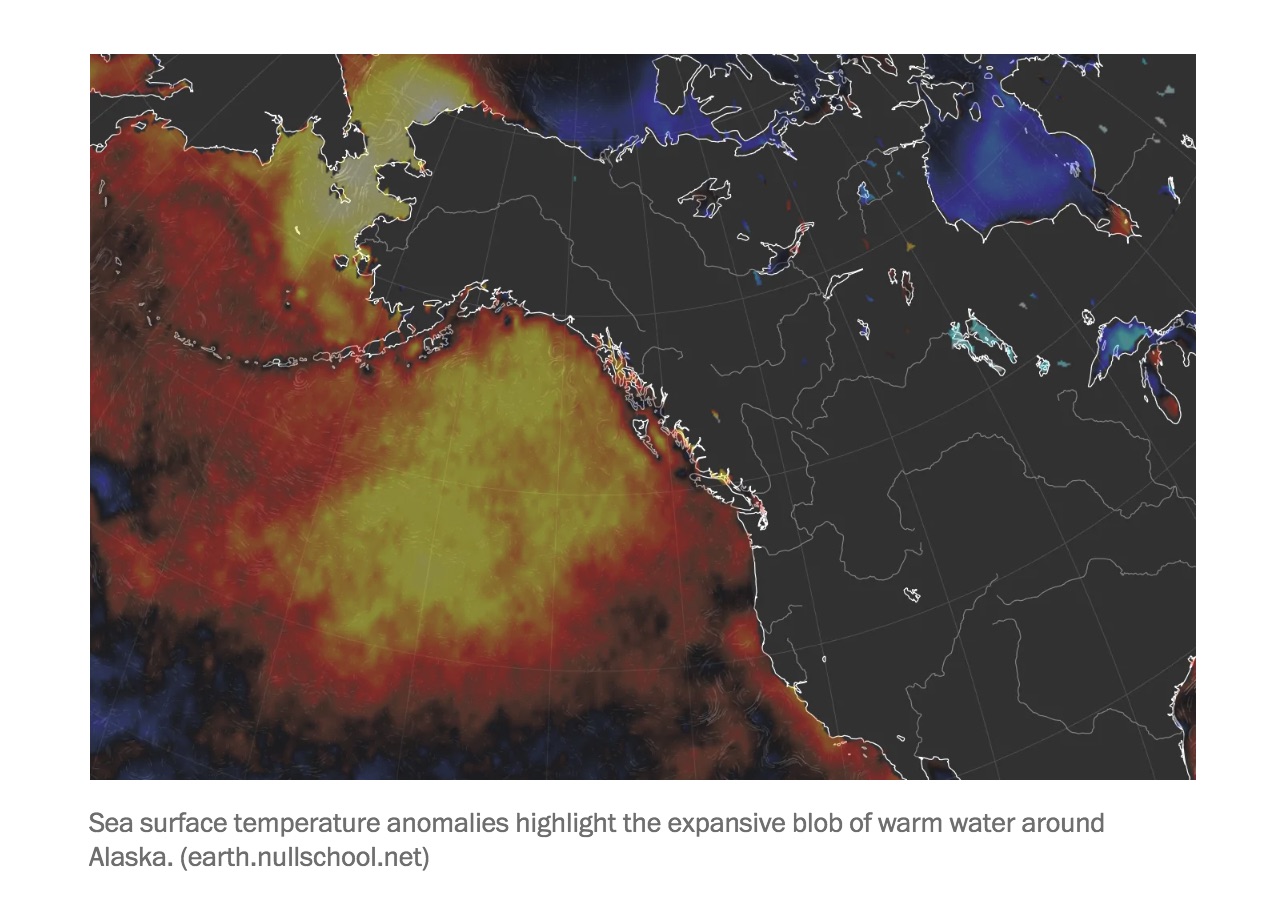
Daniel Swain talked about this association in his post of last December: In his usual judicious way, he laid out the leading possibilities, without choosing a single causal factor, but hinting at the associations between the various possibilities.
To date, the strongest evidence appears to implicate unusually warm ocean waters in the tropical western Pacific, which can trigger a hemisphere-scale wave pattern favoring an enhanced subtropical ridge near California. Other work has suggested that unusually warm ocean conditions in the “extratropical” Pacific (i.e. the so-called “Warm Blob” in the Gulf of Alaska) may also be linked to the persistent ridge—though there’s considerable evidence that the atmospheric Triple R caused the oceanic Blob, rather than the reverse. Still others have wondered whether the striking loss of Arctic sea ice in recent years may have played a role, though the evidence supporting this connection remains sparse. Finally, it has also been shown that random variations in the atmosphere can occasionally produce an extremely persistent North Pacific ridge. In other words: the Triple R may be at least partially attributable to “bad luck.”
“Bad luck” in that context means of course that good luck could bring us some other weather than drought. Let us hope. In Alaska, the state’s citizens are enjoying the strangely mild early winter, and wondering too.
It’s still quite early in the cold season, even in the snowy north. For now, it’s a waiting game. Waiting for summer to finally end, and waiting to see what winter might bring. It won’t only have implications for Alaska, but for all of us.
Climate change polarizes an election in Ojai
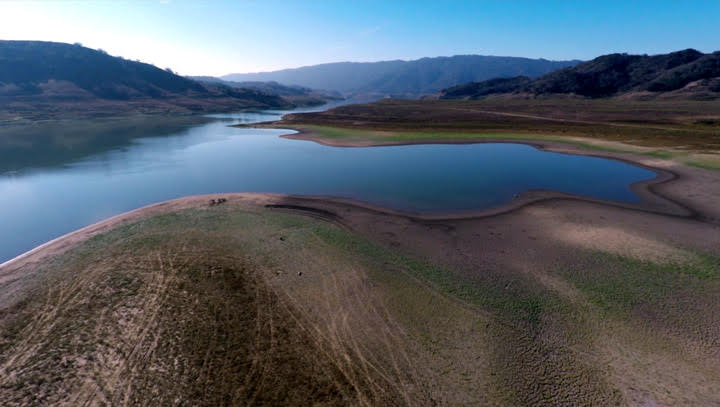
Ojai, California is a little town with a lot of big opinions. This fall an election between a long-standing incumbent and a self-educated water wonk has stirred up a good deal of controversy. Here’s my attempt to report on the issues for the Ventura County Reporter. My focus was to give the candidates a chance to speak to policy:
I thought both explained themselves well. Here’s the “nut graph” for challenger Angelo Spandrio:
“I think climate change is probably a factor,” Spandrio said. “If you look at our history, we have never had under 10-12 inches of rain in a year for six years straight before this drought [from 2011 to 2016]. We had a better-than-average year in 2017, but this year we were again back in the 10-12 inches range. This could be the first year of another five-year drought. I would really like to see Casitas plan on more of a worst-case situation than a best-case situation.”
And here’s the incumbent Mary Bergen, trying to balance costs vs the need to find water sources:
“There is no magic wand out there,” Bergen said. “If there were some magic, cheap, affordable solution, we would have done it. This is not to say anything bad about Angelo; it’s just that he’s beginning to learn that it’s not easy.”
And here’s the picture of the diminishing Lake Casitas, courtesy of Andy Gilman of the Ojai Chautuaqua.
Oy. Seems that climate change challenges democracy at a fundamental level.
Summer’s End (via John Prine)
John Prine brought out a record this year, his first in thirteen years, that has fans and critics alike raving (and won the Artist of the Year Award at the Americana awards in Nashville). The best song on the record — or at least the prettiest — is Summer’s End, of which I cannot get enough.
As friend Cary Odes points out, the simplicity and ever-amusing lack of pretension of Prine’s writing leaves you open to get emotionally “walloped.” Love these lines esp:
Well I don’t know
But I can see
it snowing
In your car
the windows are
wide open
Insurers see new risks, markets w/climate change
From the Wall Street Journal, a new series debuts today: The Price of Climate
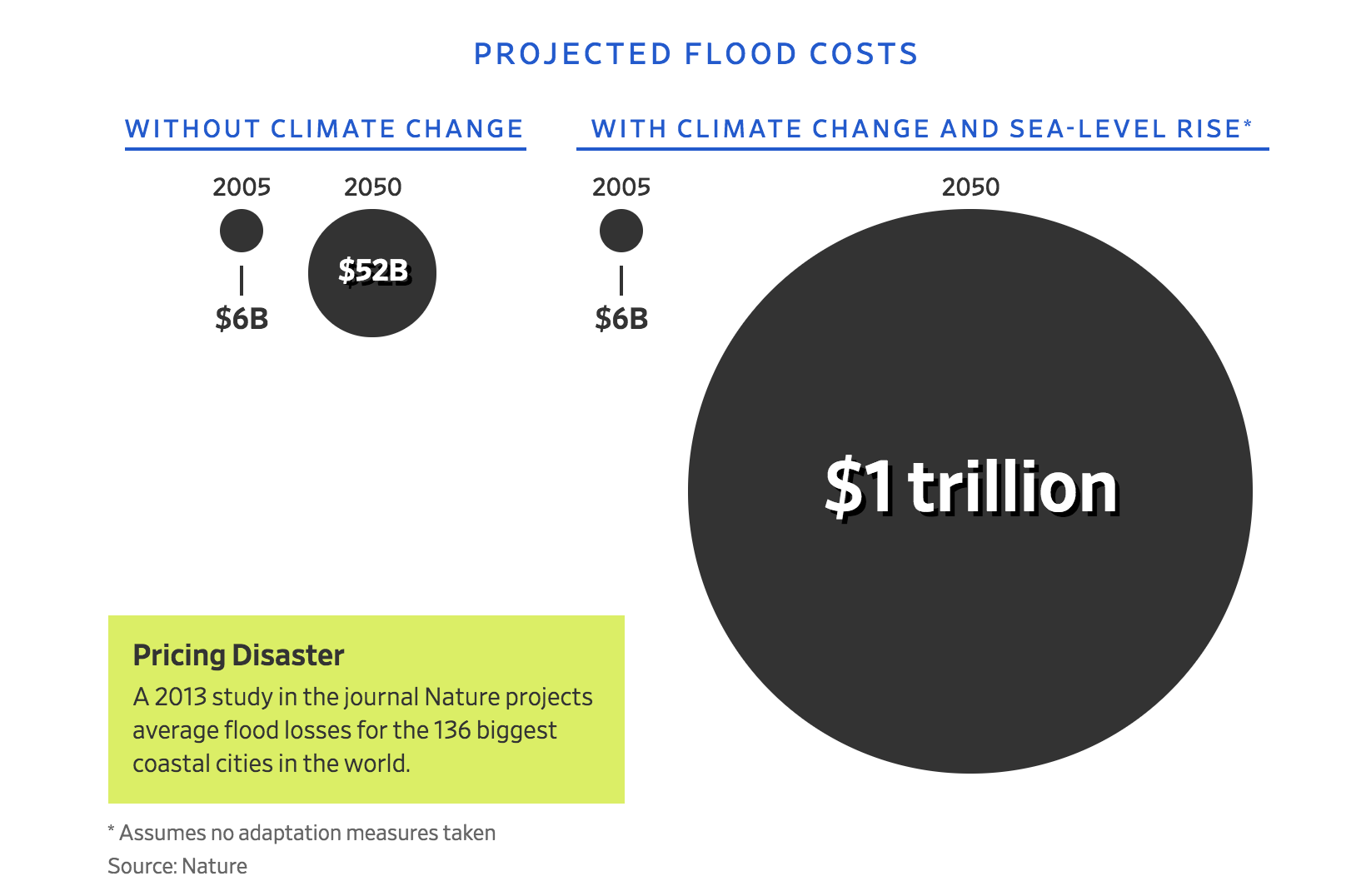
Insurers’ most immediate climate peril is water. More heat means more moisture held in the atmosphere and greater precipitation. Melting ice is pushing up sea levels. A 2013 study in the journal Nature projected average flood losses for the world’s 136 biggest coastal cities could rise from $6 billion a year in 2005 to $52 billion a year by 2050 due to increased population and development. When taking climate change and a sea-level rise into account, flood losses could exceed $1 trillion a year by 2050, the study concluded, unless the cities invested about $50 billion annually in adapting.
It’s possible to read Wall Street Journal stories without subscribing for a week via a well-regarded and admirable app called Read Across the Aisle. Check it out here (for Chrome).

