Reagan and American Ruin (USA! USA! USA!)

From the jaw-dropping Andrew Becevich of The American Conservative:


As portrayed by [President Jimmy] Carter, the mistaken idea of freedom was quantitative:
it centered on the never-ending quest for more while exalting narrow
self-interest. His conception of authentic freedom was qualitative: it
meant living in accordance with permanent values. At least by
implication, it meant settling for less.


How Americans dealt with the question of energy, the president
believed, would determine which idea of freedom would prevail. With
this in mind, Carter outlined a six-point program designed to end what
he called “this intolerable dependence on foreign oil.” Although he
expressed confidence that the United States could one day regain energy
independence, he acknowledged that in the near term “there [was] simply
no way to avoid sacrifice.” Implicit in Carter’s speech was the
suggestion that sacrifice just might be a good thing. For the sinner,
penance must necessarily precede redemption.


As an effort to reorient public policy, Carter’s appeal failed
completely. Americans showed little enthusiasm for the president’s
brand of freedom with its connotations of virtuous austerity. Not
liking the message, Americans shot the messenger.


Carter’s speech did enjoy a long and fruitful life—chiefly as fodder
for his political opponents. The most formidable was Ronald Reagan. He
portrayed himself as conservative but was, in fact, the modern prophet
of profligacy—the politician who gave moral sanction to the empire of
consumption. Beguiling his fellow citizens with talk of “morning in
America,” Reagan added to America’s civic religion two crucial beliefs:
credit has no limits, and the bills will never come due. Balance the
books, pay as you go, save for a rainy day—Reagan’s abrogation of these
ancient bits of folk wisdom did as much to recast America’s moral
constitution as did sex, drugs, and rock and roll.

[edit]

The Reagan
Revolution was never about fiscal responsibility or small government.
Far more accurately than Carter, Reagan understood what made Americans
tick: they wanted self-gratification, not self-denial. Although always
careful to embroider his speeches with inspirational homilies and
testimonials to old-fashioned virtues, Reagan mainly indulged American
self-indulgence.

[edit]

The events of
Sept. 11, 2001 only hardened this disposition. Donald Rumsfeld
summarized the prevailing view: “We have two choices. Either we change
the way we live, or we must change the way they live. We choose the
latter.”

Global Warming Helps Cool CA Coast, Study Finds

In a story that has yet to be covered by the San Diego Union-Tribune, the San Francisco Chronicle, or even the Los Angeles Times, this week the Ventura County Star featured on the front page (see here) a story about a San Jose State researcher, Robert Bornstein, who has found substantial evidence that global warming in California over the last fifty-plus years has led to a cooling along the coast in the summer.

Bornstein revealed his study at the state-funded California Climate Change Research conference. The curious can find his slides at the portal (along with numerous other studies).

The study is called Cooling Summer Daytime Temperatures in Coastal California during l948-2005: Observations and Implications for Energy Demand.

Two aspects of the study are especially striking for Ventura County residents.

First, Bornstein relies on a familiar causal mechanism to explain the cooling along the coast during the summer (which as he is quick to point out, is not an original idea). As summer heat warms California, inland areas become hotter than coastal regions, creating an onshore flow. Increased warming in the interior leads to stronger breezes. Stronger breezes lead to cooler temps along the coast.

The cycle is described more eloquently in David Carle’s "Air in California," from the UC Press:

Coastal marine climates are moderated by the local ocean temperatures: hot weather is "air conditioned" on summer days while cold winter days are warmed. The ocean is a very effective heat sink, storing heat during the day and then releasing at night when the air cools off…Weather and the climate in inland portions of California are shaped by a thermal low that forms in summer as heat rises out of the Central Valley and desert basins. The rising air creates low pressure that sucks marine air inland. Onshore sea breezes form after the land heats each day.

Second, this is not a model study. Bornstein has found evidence to buttress the claim. In the Carquinez Straits in the north of San Francisco Bay, he documents a strengthening sea breeze in the summer. Further, over the past forty years, even as inland California overall has warmed (by about 1 degree Fahrenheit, or .57C, according to a 2006 paper from the climate center), coastal California has slightly cooled (by about .25C per decade).

This is not an enormous number, but it’s hugely good news for Californians living not too far from the ocean, in places such as the Bay Area, Los Angeles, and Ventura County. Will follow up asap. For now, here’s a map of summer of warming in SoCal over the last forty years (from Bornstein’s slides).

Note the mostly rising temps inland, and the cooling temps along the coast…

Temps_in_socal_19752005

Larison Loses His Temper

The eloquent conservative Larison lost his temper a week ago at Sarah Palin’s "Bridge to Nowhere" lie.

Now he’s just pissed:

The main innovation of the Bush administration in U.S. foreign
policy, the one for which he will be remembered for good or ill, is the
placement of preventive war as a means of nonproliferation and
antiterrorism at the center of national security strategy.  Related to
this is the abandonment of traditional concepts of deterrence and
containment.  Democracy promotion as stated U.S. policy dates back at
least to the Carter administration, and the “freedom agenda” has
rhetorical precedents as far back as Kennedy’s Inaugural.  What Bush
did with democracy promotion that was distinctive was to marry this
terrible idea to his existing terrible idea of waging preventive war
against “rogue” states.  The “freedom agenda” did not replace and
eliminate the earlier iteration of the Bush Doctrine, but formalized
the administration’s mad ideological fixation on democratization as an
addition to that Doctrine.


Are You Calling McCain a Liar? Ummm, yes…

"The McCain campaign said Governor Palin opposed the Bridge to Nowhere,
but now we know she supported it. They said she didn’t seek earmarks,
but now we know she hired a lobbyist to get millions in pork for her
town and her state. They said she visited Iraq, but today we learned
that she only stopped at the border. Americans are starting to wonder,
is there anything the McCain campaign isn’t lying about?"

Tommy Vietor, the Obama campaign, 9/13/08

The GOP and the Oil Industry: Afraid of Barack

It’s pitiful but unsurprising that the GOP has become the party of "drill, baby, drill."

As someone wise (I forget who) said somewhere on the Internet, it’s almost as troubling as that time long ago in the 60’s, when the Left became the party of "burn, baby, burn."

(I’d like to think both the Right and the Left are better than that, but I wasn’t cognizant back then, and I see little evidence that the GOP is rising above it now. To the contrary, in fact. 

Countless reporters and bloggers, including yours truly, have shown that lifting the moratorium on offshore drilling will have, at best, a trivial impact on gas prices over the next two decades…if that.

According to the EIA, it’s in the range of four cents per gallon in 2025. A geophysicist at Harvard makes the point again in a strong column (here) for The Bulletin of Atomic Scientists. The writer, Kurt House, admires John McCain, and supports more drilling, but he knows it’s not the answer:

What we’re watching is the thread of a decent argument–that when oil
prices are very high, the United States should expand oil exploration
and extraction–get oversold by liars and fools who cannot perform
basic arithmetic.

It’s worth recalling Al Gore’s speech at the convention, which called out the GOP and the oil industry, but which seems mostly to have been forgotten, in just a week and a half.

So why is this election so close?

Well, I know something about close elections, so let me offer you my opinion.

I believe this election is close today mainly because the forces of
the status quo are desperately afraid of the change Barack Obama
represents.

There is no better example than the climate crisis. As I have said
for many years throughout this land, we’re borrowing money from China
to buy oil from the Persian Gulf to burn it in ways that destroy the
future of human civilization. Every bit of that has to change.

Oil company profits have soared to record levels, gasoline prices
have gone through the roof and we are more dependent than ever on dirty
and dangerous fossil fuels. Many scientists predict that the entire
North Polar ice cap may be completely gone during summer months in the
first term of the next President. Sea levels are rising, fires are
raging, storms are stronger. Military experts warn us our national
security is threatened by massive waves of climate refugees
destabilizing countries around the world, and scientists tell us the
very web of life is endangered by unprecedented extinctions.

We are facing a planetary emergency which, if not solved, would
exceed anything we’ve ever experienced in the history of humankind.

In spite of John McCain’s past record of open mindedness on the
climate crisis, he has apparently now allowed his party to browbeat him
into abandoning his support of mandatory caps on global warming
pollution.

And it just so happens that the climate crisis is intertwined with
the other two great challenges facing our nation: reviving our economy
and strengthening our national security. The solutions to all three
require us to end our dependence on carbon-based fuels.

Instead of letting lobbyists and polluters control our destiny, we
need to invest in American innovation. Almost a hundred years ago,
Thomas Edison said, “I’d put my money on the sun and solar energy. What
a source of power! I hope we don’t have to wait until oil and coal run
out before we tackle that.”

We already have everything we need to use the sun, the wind,
geothermal power, conservation and efficiency to solve the climate
crisis – everything, that is, except a president who inspires us to
believe, “Yes we can.”

So how did this no-brainer become a brain-twister?

Because the carbon fuels industry – big oil and coal – have a
50-year lease on the Republican Party and they are drilling it for
everything it’s worth. And this same industry has spent a half a
billion dollars this year alone trying to convince the public they are
actually solving the problem when they are in fact making it worse
every single day.

Would like to see some documentation for the $500 million figure…but if it’s true, that far outstrips both Obama and McCai’s political advertising budget, doesn’t it?

Is McCain Losing It?

Yesterday, he claimed to a hard-nosed TV reporter from Maine who wanted to know what experience Sarah Palin has in the field of national security that "she knows more about energy than probably anyone else in the United States of America."

Today on "The View" he claimed that as governor she never asked nor accepted earmarked money for the state of Alaska, when in fact she asked and accepted nearly $200 million dollars worth. When pressed on this obviously false point, McCain said: "Not as Governor she didn’t."

Huh?

Then he added, as if to make sure we got it, that his campaign commercials are "not lies." Which will remind some of us of a certain age of Nixon’s "I am not a crook."

What does it say that a Presidential candidate has to make such a statement?

McCain seems to be morphing into a blend of Richard Nixon and Ronald Reagan right in front of our eyes: the dottiness of Reagan, crossed with a Nixonian willingness to say anything, regardless of the truth. It’s freaking me out. McCain used to be interesting: now he’s acting like a tool. What happened?

Not Against the Environment: Against Environmentalists

Sometimes I think rightwingers (I’m talking about you, Jonah) write these columns just to drive enviros up the wall. It’s such malarkey, to put it politely. Goldberg admits he’s no environmentalist, blames John Muir for environmentalism (which of course includes heinous measures to improve air quality, water quality, and reduce energy consumption) and claims he’s a conservationist, as if he were on the front lines with David Brower, saving Mineral King from Disney, and Julia "Butterfly" Hill, saving Luna. Right.

Goldberg then declares he’s trying to save environmentalism from environmentalists.

Insincerity, meet Jonah Goldberg.

But taking these arguments on with logic is probably the wrong way to go. Better to respond with the right’s favorite weapon, mockery, as Benjamin Cohen did for McSweeney’s, in a piece entitled An Anti-Environmentalist Drafts His Next Newspaper Column While Eating Takeout and Driving His Hummer.

Cohen opens:

Those alarmists have complained for
years that unsightly gobs of plastic bags won’t deteriorate for
centuries. In landfills, in oceans, flying out of the garbage truck in
front of me as I write this column on my PDA. Then they go and complain
about the tiny, tiny chemicals inside, like this bisphenol-A thing they
made up—chemicals they can’t even see! Or pronounce! So which is it?
Unsightly gobs or invisible fake chemicals? The environmental movement
is riddled with these moral contradictions.

And concludes…

You don’t have to worry about
global warming anyway. Some are now arguing that what we lose in cooler
temps we make up for with less spending on clothes. Bad news for Old
Navy; good news for Americans and the environment. It all evens out
economically, just like in that Seinfeld episode where everything always evens out. Can you believe that Kramer guy? What a racist!

Incidentally, racism is no longer a problem. They caught Kramer. And that one guy is running for president.

Thank you, Ben.

Hurricane Felix, As Seen from Space

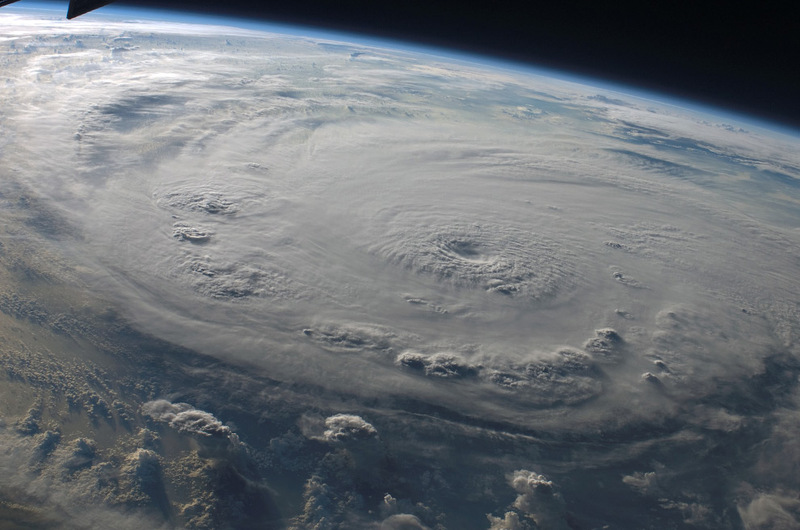
As Ike whirls towards the southwestern coast of Texas, we must regret the chaos and destruction it has brought the lands and people of the Gulf of Mexico, but also stand back in utter awe at the enormity of these storms…here’s a photo taken from the International Space Station of Hurricane Felix last year, as it overwhelmed the Honduran coast on September 3, 2007.

Hurricanefelixfromspace

Palin Did Not Ban Books — But She Did Try to Fire the Librarian

A list of the books Sarah Palin allegedly tried to ban from the Wasilla Library has been circulating at the speed of light: don’t believe it. According to Snopes, the list (supposedly taken from the library minutes) is bogus (here). Further, the book blog from the Los Angeles Times, Jacket Copy, takes a closer look at the issue and digs deeper into the past to find out exactly what we do know.

According to a local article at the time (l996), Palin asked the chief librarian, Mary Ellin Emmons:

"How I would deal with her saying a book can’t be in the library?"

A little later, still in l996, Palin claimed was "only trying to get acquainted with her staff." She did ask three times about banning books, according to the Anchorage Daily News, and did threaten to fire Emmons, along with several other city officials that did not support her election, and she did fire the police chief, and force another resignation. 

Draw your own conclusions — but please, stick to the facts.