Green and Conservative in East Tennessee

Interesting post from Kayla Webley of Off the Bus, who reports  (here) that East Tennessee is conservative politically — and environmentally.

…conservative here implies much more than tight tax laws and low
government interference. To be conservative is, well, to conserve.

"It’s been interesting living in East Tennessee because I think it
is very much a pro-environment mind set," said Randy Gentry, director
of the Institute for a Secure and Sustainable Environment at the
University of Tennessee at Knoxville. "Although it is a very
conservative base traditionally."

But it’s not just academics. It’s also businessmen such as George Thacker, who is fiercely pro-Republican, but believes just as fiercely in conservation…for others as well as for himself.

"I’m environmentally minded," Thacker said. "I think everyone should
change. I don’t know if so much it’s Al Gore’s global warming idea or
if it’s the Bible. But if you read the Bible it pretty much lays out
all these things."

He’s fiercely Republican, pro-business, owns several oil change
shops and is making quite a profit out of developing the area
surrounding Watts Bar nuclear reactor.

Yet he designed the Howard Johnson hotel he owns to be as energy
efficient and green as possible. He uses compact fluorescent light
bulbs and has the ability to shut off all power to the second floor if
the hotel is not full to capacity. Not only does this help conserve
during today’s swelling energy crisis, it helps keep his energy bills
down to under $2,000 a month, which he said is rather low for a hotel.

The most controversial part of his green hotel? There is no elevator, just stairs.

American politics can’t seem to keep up with the American people…


Obama as a Community Organizer: Left v. Right

Now that a former community organizer is running for the White House, reporters from both the right (Byron York, from the National Review) and, arguably, the left (the Boston Globe) have visited his former stomping grounds in Chicago, and reported on what folks there think about Barack Obama.

It’s a case of the dog that didn’t bark: everyone seems to like Barack, even though he’s moved on.

York writes (in a blog post, since his formal article is behind a paywall):

I spent some time in Chicago last month talking to the people who
worked with Obama there. Everyone I interviewed, from the man who hired
him, to a fellow organizer, to a pastor allied with Obama, to the women
Obama trained to be "leaders" in his group — they all told me they have
high regard for Obama and support him for president.

The Globe, a real newspaper, even if it does come from a liberal part of the country, digs a little deeper:

…some residents remain upset at Obama’s characterization of the people
in the projects and his role in helping them. He writes unsparingly of
his frustration, for example, with a "plump woman with a pincushion
face who was president of the official tenant council and spent most of
her time protecting the small prerogatives that came with her office: a
stipend and a seat at the yearly banquet; the ability to see that her
daughter got a choice apartment."

That woman in the project known as Altgeld Gardens is apparently no longer alive, but small-mindedness remains. One woman in the project complains that she was organizing before Obama arrives. York points out that Obama’s legacy on the South Side isn’t too visible.

But when it comes to lasting accomplishments, Obama’s list isn’t very
long. His greatest hits seem to have been a successful effort to
convince the city of Chicago to locate a jobs placement office on the
far South Side and his part in a drive to push the city to clean
asbestos out of a housing project in the same area.

Obama’s successor as a community organizer, Johnny Owens, seems to agree, as he told the Globe.

"The problems on the local level were so huge that you could spend the
rest of your life working on those sort of things and have some
marginal success," Owens said. "So he understood that change would take
a much more global approach. I do remember him saying at that time that
the country was politically in a more conservative mode but that things
operated in cycles and that a much more liberal mindset would begin to
develop in the country and he wanted to be prepared to be an effective
leader."

Far-sighted, I’d say. The upshot is that reporters from two publications with very different politics visited the South Side to talk to those who knew Obama as a community organizer, and both returned saying he was an extremely likable young man, ambitious, who had real but limited success.

Once again Obama passes the truth test. The Globe concludes:

For all its impact on Obama, Altgeld Gardens today seems far from the kind of success story politicians like to tout.

Dozens
of buildings are boarded up, with fences surrounding much of the
property. The roads are a potholed mess. Blinking lights illuminate a
series of towers where police have mounted cameras.

Last fall,
Obama returned here for a television interview, walking past the
boarded-up buildings, waving at children, and promising not to forget
the residents as he runs for president. "It was, it is, a tough, tough
place," he said.

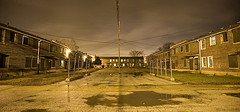
Below, a photostitched panorama of Altgeld Gardens at night, courtesy of a Chicago photographer on Flickr who goes by the name Metroblossom.

Altgeldgardens

The Uselessness of the Instant Expert

David Appell takes Matt Ygleisias, his readers, himself, and the entire blogosphere to task in a memorable rant.

He’s got a point: instant experts on any issue can be worse than useless, especially on difficult subjects — such as drought in the Southwest — that require more than an hour’s reading to understand.

Why am I wasting my time reading this? Nothing Yglesias wrote there
matters to me in the least. Nothing about it teaches me even the
slightest thing, offers the slightest insight, solves even the smallest
problem. I would be far better off reading anything by John Fleck or
Charles Bowden or Colin Fletcher or or even Edward Abbey. It’s only
designed to get him some hits and maybe an appearance on MSNBC some
night, and then tomorrow it’s off to stories he’ll cover equally
vapidly.

And anymore I’m finding the entire blogosphere like
this. Even what I write. It takes weeks and months and years to
understand situations, to write from anything like a position of
expertise. You don’t get it by quickly flying out to Aspen and back, or
by reading an article from the Brookings Institute or from Harvard’s
321 course on Environmental Philosophy. It takes blood, sweat, and
tears, it takes going out and looking at rivers, pouring over
government reports and spreadsheets, hiking to the tops of mountains
for the big picture, calling 25 people a day — precisely the thing the
blogosphere does least of.

So I am wondering why I am reading it
any more, or why I am even writing meaningless tidbits in this blog
(and that’s all they are). Or why anyone is reading. Is this seriously
the future of this magnificent medium? It would be a full-time job to
really blog about a few serious issues on a particular beat, and who
can possibly attract 125,000 readers a day and support yourself doing
that?

But I disagree, for this reason. We live in a soundbite society. As pollster George Barna told me: "We hear the Federal budget is three trillion dollars a year and we want to understand that in fifteen seconds."

Given this vast chasm between the facts and the willingness of the American public to face them, the blogosphere performs a vital function — an experiment in how to bridge the gap.

Personally, I think a big part of the answer is more visuals and less snark.

“World’s Greatest Polluter” Has Fun

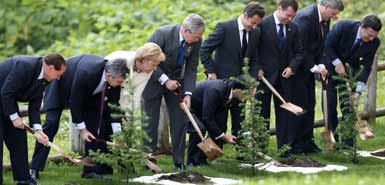
From the Times of London (here) on the unsuccessful G-8 effort to reduce carbon emissions.

The G8 summit concluded on a light-hearted note, as President Bush bade
farewell to world leaders with the words: “Goodbye from the world’s greatest
polluter.”

The other statesmen laughed, at first nervously, and then more
enthusiastically when they realised Mr Bush was making a joke, mocking
America’s reputation on global warming.

It’ll look great in a documentary someday. 

G8worldleadersonclimate

Fire in the Hills

Strange but true: the best coverage I’ve seen of the firest in Goleta and Big Sur has been coming not from the San Francisco Chronicle, not from the Los Angeles Times (although they got some good quotes yesterday), and certainly not from the Associated Press, which has been snore-inducing, but from a reporter from The New York Sun, Josh Gerstein, whose piece Paradise is Burning (here) stands out for its verve, its color, and its depth of understanding.

The spate of fires is being blamed on an unusual dry spell that has
left much of Northern California with little or no rain for more than
four months. "It’s exceedingly dry," a meteorologist with the National
Weather Service in Monterey, Diana Henderson, said.

While some parts of California were walloped with snow and rain in
February, totals for the season were about 70% of normal. "It’s one dry
year on top of another," Ms. Henderson said. "The conditions out here
are just ripe for the fire situation.

This has been mentioned by other papers, notably The New York Times, but tends to be glossed over. To be fair, the AP did bring up the $1 per single family residence fee the Gobernator wants to impose on California, and this morning The Los Angeles Times quoted him on the subject fully:

"Something is happening, clearly. There’s more need for resources than
ever before," he said. "It’s fire season all year round. . . . It’s a
different ballgame, so we have to respond."

There is some good news: Deetjens, the irreplaceable non-profit collection of supremely funky plank homes/rental units tucked into a creek canyon in Big Sur, does not appear to be endangered, at least so far. Thank God for that favor.

Maybe we should thank the Marines, too. Here’s a photo from forstonsr on Flickr, showing what a "Bambi Bucket" drop looks like from on high in a big U.S. Marines helicopter. It’s called "Hell Yeah! That was a Good Drop!"

Bucketdrop_2

Ventura Pollster: Obama to Win, Landslide Possible

That’s my headline — the editor had a different version, unfortunately
unsupported by what pollster George Barna actually said. Sigh.
Headlines are so often where newspapers go wrong.

Nonetheless, the story itself (here) is well worth reading. Here’s the crux (highly technical journalism term). I’ll post the rest of the story, without the paper’s headline, below the fold.

“Americans sense that something has gone astray in our political
sphere,” he said. “One of the conclusions widely drawn — especially by
younger voters, — is that attacking one’s opponent more and more
viciously as the campaign progresses, or the farther behind a candidate
falls in the polls is a show of self-interest, not national interest.
Add to that the existing perception that McCain represents the old,
tired politics of Beltway insiders, and you get a public that is not
particularly interested in hearing the old man criticize the younger
man, the white man question the integrity of the black man, or the
career politician challenge the newcomer.”

Barna is a mild-mannered man with
graying hair, and he doesn’t speak in colorful quotes, but the pollster
all but pounds the table on this point.

“People are already
concerned that McCain represents the old way of doing business,” he
said. “They don’t want the next president to be a mud-slinger. They
want him to stay above the fray. They’re worried about the future.”

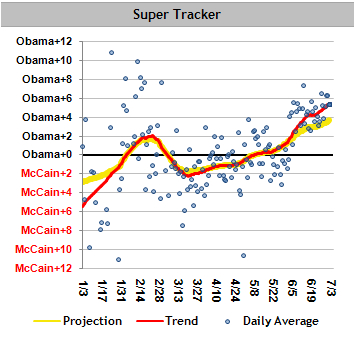
And here’s the invaluable Supertracker composite of polls via FiveThirtyEight (here). You’ll note that the trend (the red line) is above statistician Nate Silver’s projection, which means the race should tighten, but it’s still looking very good for Obama right now.

July4thsupertracker

George Barna, a Ventura-based national
pollster, projected earlier this month on the basis of hundreds of
interviews with voters around the country that Barack Obama will win
the presidential election in November easily unless his campaign
“commits political suicide.”

Barna said Sen. Obama had taken a
50-35 percent lead over Sen. McCain, and that to win McCain would have
to “sweep all these undecided votes — and then some.” Barna added that
this is a “particularly remote” possibility because most of the
undecided among likely voters are already leaning toward Obama.

Barna’s results jive with two other national polls released weeks later — the Newsweek poll, which found Obama had taken a nearly identical 51-36 percent lead, and the Los Angeles Times/Bloomberg
poll, which pegged Obama’s lead at 49-36 percent among all voters. The
best known of all pollsters, Gallup, has the race at a dead even 44-44
percent, but although Barna respects Gallup’s work, he stresses that
his interviewing questions better distinguish likely voters from
registered voters.

He points to the fact that Obama voters are
much more excited about their candidate: 53 percent of Obama voters
believe their man will win, while only 31 percent of McCain voters
expect the same of their candidate. Many of those McCain voters, Barna
said, will never show up at the polling booth.

In
a follow-up interview conducted in his office, Barna — who moved his
business to Ventura in the early l990s — added that he saw “no reason”
to think that John McCain could win the election, and gave a half-dozen
reasons why he thought Obama could win, quite possibly by a landslide.

Barna
mostly polls for large religious organizations, from liberal groups
such as “One,” which is known for its association with Bono, to
conservative groups such as “Focus on the Family,” which is affiliated
with the prominent right-wing evangelical James Dobson. But even among
voters who attend church weekly, the Democratic candidate is doing
unusually well and the Republican unusually poorly, with more than 23
percent of actively practicing Christian voters who voted for George
Bush in 2004 preparing to cross the aisle and vote for a Democrat.

It’s
not just Christians. According to Barna’s research, McCain has lost
more than 20 percent support to Obama among a wide range of groups that
voted Republican in 2004, including men (22 percent), residents of the
South (22 percent), conservatives (20 percent) and “downscale” adults
(54 percent).  Downscale adults are voters who have not gone to college
and make less than $20,000 a year.

“The nation feels insecure and
uncomfortable,” Barna said. “Voters want a candidate they can trust,
someone who is steady, someone who can bring us into the new
millennium. McCain doesn’t have that persona. People see him as cranky,
irascible. That’s the image that comes through the media filter, and
that’s not what people want.”

Barna stresses the image we see of candidates in the media may have little to do with reality.

“I’ve
worked for a lot of these guys, and I know that the media portrayal is
not necessarily accurate,” he said. “Obama is much more liberal than
most Americans realize. But most people do not vote on issues. People
vote on how a candidate makes them feel. And Obama makes people feel
good right now.”

Can we trust a June poll on a November election?

Skeptics
will point out that national polls for presidential elections in June
have not demonstrated much statistical skill. In four out of five of
the last elections, the leader in the June polls went on to lose in
November, and that includes the last election. John Kerry had a narrow
lead over George Bush in the polls of June 2004, but lost in November
in crucial swing states such as New Mexico, Nevada and Ohio.

The
biggest swing came in l988, when Michael Dukakis, who had a substantial
lead of more than 8 percent in June over George H. W. Bush, went on to
lose by nearly the same 8 percent margin. 

In that election, the
Republican campaign manager Lee Atwater targeted Dukakis as a liberal,
mocked him as a phony elitist, and attacked him with ads linking him to
the release of rapist Willie Horton.

Could the same strategy —
portraying the Democratic candidate as a pretentious liberal — work
again this year? It seems an obvious possibility, because Obama is
already considered a liberal by most voters, and is a professor
besides, and so vulnerable to charges of elitism.

President
Bush’s former campaign adviser Karl Rove launched just such an attack
shortly after the Barna interview. Speaking to a reporter for ABC, the
famous politico compared Obama to a wealthy country club member with a
drink and a cigarette, making “snide remarks about everyone who passes
by.”

But Barna doesn’t think that kind of attack will work on Obama.

“Americans
sense that something has gone astray in our political sphere,” he said.
“One of the conclusions widely drawn — especially by younger voters, —
is that attacking one’s opponent more and more viciously as the
campaign progresses, or the farther behind a candidate falls in the
polls is a show of self-interest, not national interest. Add to that
the existing perception that McCain represents the old, tired politics
of Beltway insiders, and you get a public that is not particularly
interested in hearing the old man criticize the younger man, the white
man question the integrity of the black man, or the career politician
challenge the newcomer.”

But Barna firmly rejected that kind of
attack on Obama. He’s a mild-mannered man with graying hair, and he
doesn’t speak in colorful quotes, but the pollster all but pounds the
table on this point.

“People are already concerned that McCain
represents the old way of doing business,” he said. “They don’t want
the next president to be a mud-slinger. They want him to stay above the
fray. They’re worried about the future.”

A day after Rove’s
attack on Obama, McCain’s chief political adviser Charlie Black was
quoted in an interview with Fortune magazine saying a terrorist attack
could be a “big advantage” to McCain.

Although many independent
election observers believe such an attack could in fact play to
McCain’s strength — polls consistently show that one issue in which the
public has more confidence in the Republican is in his ability to
handle terrorism — immediately McCain disavowed the comment. A second
campaign official repudiated it, and Black himself apologized for it.

Was this a deliberate move, despite the backtracking? Barna thinks so.

“The
statement may have been a strategic move, intended to remind people
that in a time of insecurity, people should support the candidate who
is more likely to keep the nation secure,” he said. “Notice that the
man who said it was not released from his position, even though the
McCain campaign has released dozens of staff over the course of the
campaign.”

Why Obama will win the Christian vote

Barna
is confident Obama will win because McCain has lost millions of voters
from the coalition of voters that helped elect George Bush in 2000 and
2004. McCain still is projected to win 78 percent of likely evangelical
voters, and 75 percent of registered Republicans. But in an era when
the Republican Party has been severely damaged by the unpopularity of
President Bush, Barna points to “a huge degree of support” that has
been lost to the Democrat among other constituencies, including
Catholics, Protestants and non-evangelical born-again Christians.

“The
Christian community in the U.S. has largely shifted its loyalty to the
Democratic nominee in this year’s race,” Barna declared. “Among the
non-evangelical born-again adults, 52 percent supported President Bush
in 2004. Only 38 percent are now supporting Sen. McCain, while 48
percent side with Sen. Obama. And notional Christians, who supported
John Kerry by an 11-point margin in 2004, today support Obama over
McCain by 26 percent.”

Barna’s poll defines Christian voters
differently than other pollsters, categorizing evangelicals not by
their attendance in a particular church, such as the Southern Baptists,
but by seven tests of belief, including whether a Christian believes in
Satan, whether the Bible is accurate in all it teaches, and whether
they believe in a personal responsibility to share the faith with
non-Christians. By this stringent criterion, evangelical voters — who
are universally agreed to be much more conservative than most voters —
only represent about 9 percent of the electorate.

Other
pollsters, such as the Pew Research Center, who do classify voters by
the church they belong to, see evangelical voters as a much larger
group — more than 25 percent of American voters.

Barna is
unshaken by the contrast to Pew and other better-known pollsters.
Although all pollsters have found a rise in support for the Democratic
candidate in 2008, he is confident that his results better explain the
division within American Christianity. In his analysis, truly
evangelical voters are a relatively small group, smaller even than the
“Skeptics,” which he counts at about 16 percent of the population. So
the Republican candidate can win his base of party members and
Evangelicals and still lose by a wide margin.

How McCain could win

Barna,
who betrays not a hint of personal preference among the candidates,
doesn’t entirely rule out McCain’s chances. He offers a half-dozen
possibilities that could allow McCain to come back.

Obama could
commit “a major political blunder.” Pollsters now agree that McCain
took a lead in March when Obama was tarred by the radical statements of
his former pastor, the Rev. Jeremiah Wright. The Republican Party led
by as much as 5 percent points in a consensus of national polls, but
since Obama disowned Wright, he has regained a substantial lead —
larger than any margin registered by John Kerry.

“People will be watching closely to see who Obama associates himself with,” Barna said.

Other
possibilities: Sen. Obama’s voters, expecting a landslide victory,
could fail to show up. A terrorist attack or national security issue
(such as the Bin Laden interview released just before the 2004
election) could remind voters of McCain’s experience in international
affairs. “A massive number of people either not currently registered,
or registered voters who are not currently likely to vote in November,
could actually turn out to vote and select Sen. McCain by a substantial
margin,” he adds, with a hint of skepticism.

But despite
Barna’s attempts to be even-handed, his research leads him back toward
the prospect of an Obama victory, with a good chance of a landslide.
Not only would McCain have to win all the undecided voters to pull
even, but those who plan to vote for McCain are less committed. Among
McCain voters, 59 percent say they are “absolutely certain” to vote for
their candidate; among Obama voters, the figure is 73 percent. Among
registered voters who are likely to vote, 48 percent of Democrats are
“excited” about the campaign, but only 30 percent of Republicans say
the same.

Barna points out that in 2000, George Bush was a much
more conservative candidate than most Americans realized, but that
didn’t become apparent until long after he was elected. Obama could
benefit from the same lack of scrutiny.

“The only people who
pay attention to the details of the issues are journalists,” he said.
“We live in a sound-bite society. We hear the Federal government budget
is $3 trillion and we want to understand that in 15 seconds.”

And
Barna points out a large number of young adults are newly registered
and have “no track record” in a national election. If they show up and
vote for Obama as they did in the primaries in states such as Iowa,
Virginia, Wisconsin and Colorado, chances of an overwhelming landslide
look good.

Nate Silver, a Chicago-based statistician who
applies probability theory to polls by running their published results
through a computer thousands of times for The New Republic and his
site, FiveThirtyEight, backs Barna’s research. Silver lists outcome
possibilities by percentage, from low possibilities, such as chance of
an Electoral College tie (.023 percent), to high possibilities, such as
the chance of Obama winning all the Kerry states (65 percent).

The statistician sees no scenario of a McCain victory at more than a 13 percent probability.

The chance of an Obama landslide?

32 percent.   
Fires: Getting Bigger…and Fast

News from Big Sur area is mixed: the Basin Complex fire (detailed here) is still nowhere near under control, and has forced evacuations and the closure of Hwy 1, but its fellow blaze, the Indians Wildland fire, is 95% contained. Pictures from the area are alarming, but the better-known areas are being well-defended.

But the big picture, as graphed here with data from the National Interagency Fire Center, is troubling:

Average Size of Fires

California: Dry and Getting Drier

Haven’t blogged about the hundreds of fires that have broken out over the last two weeks in California. The good news is that few of them have grown to be large (with the notable exception of the Basin Complex and Indians Wildland fire in the Big Sur area, which total over 100,000 acres). For more, see Inciweb (here).

But here’s the underlying question: Is there a connection between our super-dry spring and these fires?

Not sure, but it would be interesting to superimpose a map of fire outbreaks and a map of precipitation. Here’s one such map for June, via Desert Research Institute’s California climate tracker page (here).

As you can see, it’s been a bit dry lately…

Precipitationincajune08

Why “W” Went to Baghdad: Oliver Stone Tells All

A new movie blogger on the scene is Patrick Goldstein, who writes "The
Big Picture" for the LA Times (here). For some reason, nobody in the
blogosphere seems to like Goldstein at all. Near as I can tell, it’s
became he writes for a real newspaper and they don’t. But be that as it
may, his opening post last week was a scene from the screenplay for the movie biography of George W. Bush that Stone is directing, called "W." It’s the movie that everyone
in Hollywood wants to see, but no one in Hollywood wanted to fund (as
Goldstein put it).

Oliver Stone is a living mess, but when he’s on, no film writer alive
puts better bad guys down on paper. (Takes one to know one?) Remember Gordon Gekko? Platoon?
Nixon? I question Stone’s ability to direct — he can’t seem to settle on a single film stock, far less a single POV — but not his ability to write. Maybe this story will focus him. If so — and the cast is promising — could be something to remember.

The scene is below the fold. You won’t regret reading it, I promise.

Here’s the crucial scene between George W. and his father, H.W. Bush, after the elder Bush has lost his bed for re-election in l992. The scene takes place in a Houston hotel room.

Int. Houstonian Hotel–Suite–Houston, Texas–November 1992

George Jr. turns off the TV. Sr. begins weeping. W looks at his father, jarred, never seen him so emotional, so broken.

                                                       Barbara

               The best person didn’t win, George. The best man did not win tonight.

                                                        Bush Sr.

             It hurts. Hurts so bad. My pride … I don’t like to see
those who wrote me off be right. But I was wrong and they were
right….That hurts more than anything.

                                                        Barbara

                         He is so beneath you. He doesn’t deserve to be
President. And wouldn’t be if it wasn’t for the liberal media, the New
York Times, blaming you for Reagan’s mess.

George Jr. puts hand on his father’s shoulder.

                                                       Bush Jr.

Poppy, you were a great President. Great President.

                                                       Bush Sr.

Gave it all I could. Thought the war would have carried us. Guess I reached my level, son.

                                                      Bush Jr.

        Nah. Maybe, if you had just clobbered the [SOB].

                                                      Bush Sr.

                                   Huh?

                                                      Bush Jr.

         Gone all the way. To Baghdad. Cleaned his clock.

                                                      Barbara

           (sharply to Laura) Did he imbibe in something I don’t know about?

                                            Bush Jr.

Don’t start that. I was talking about decisiveness. Finishing. What I’ve always been told.

                                             Barbara

                                 You’d better stop this. Zip it up, right now, you hear me.

Jr. backs away, turns.

                                                       Bush Sr.

                                 (sharply to Jr.) I won that war.

                                                       Bush Jr.

                                   ‘Course you did, Poppy.            

BEDROOM  –  MOMENTS LATER

                                               Laura

What was that all about?

                                              Bush Jr.

Be damned if I know. Never seen him like this before. It’s strange.

                                              Laura

It’s hard. He knows that this is the end.

                                               Bush Jr.

If Atwater hadn’t died. If he had listened to me and attacked, attacked, attacked! Might have turned out different.                                 

                                                          Laura

           No. That’s not what this is about. His health, all the
medications he’s been taking. He doesn’t have the strength, the fire he
had before. He knows.

Jr. sadly peers at the hunched figure of his father.

                                                         Bush Jr.

Can’t bear to see him like this. Hurts too damn much to lose.   

Then, resolute:

                                              Bush Jr.

I’ll never let this happen to me. Never.