Why “W” Went to Baghdad: Oliver Stone Tells All

A new movie blogger on the scene is Patrick Goldstein, who writes "The
Big Picture" for the LA Times (here). For some reason, nobody in the
blogosphere seems to like Goldstein at all. Near as I can tell, it’s
became he writes for a real newspaper and they don’t. But be that as it
may, his opening post last week was a scene from the screenplay for the movie biography of George W. Bush that Stone is directing, called "W." It’s the movie that everyone
in Hollywood wants to see, but no one in Hollywood wanted to fund (as
Goldstein put it).

Oliver Stone is a living mess, but when he’s on, no film writer alive
puts better bad guys down on paper. (Takes one to know one?) Remember Gordon Gekko? Platoon?
Nixon? I question Stone’s ability to direct — he can’t seem to settle on a single film stock, far less a single POV — but not his ability to write. Maybe this story will focus him. If so — and the cast is promising — could be something to remember.

The scene is below the fold. You won’t regret reading it, I promise.

Here’s the crucial scene between George W. and his father, H.W. Bush, after the elder Bush has lost his bed for re-election in l992. The scene takes place in a Houston hotel room.

Int. Houstonian Hotel–Suite–Houston, Texas–November 1992

George Jr. turns off the TV. Sr. begins weeping. W looks at his father, jarred, never seen him so emotional, so broken.

                                                       Barbara

               The best person didn’t win, George. The best man did not win tonight.

                                                        Bush Sr.

             It hurts. Hurts so bad. My pride … I don’t like to see
those who wrote me off be right. But I was wrong and they were
right….That hurts more than anything.

                                                        Barbara

                         He is so beneath you. He doesn’t deserve to be
President. And wouldn’t be if it wasn’t for the liberal media, the New
York Times, blaming you for Reagan’s mess.

George Jr. puts hand on his father’s shoulder.

                                                       Bush Jr.

Poppy, you were a great President. Great President.

                                                       Bush Sr.

Gave it all I could. Thought the war would have carried us. Guess I reached my level, son.

                                                      Bush Jr.

        Nah. Maybe, if you had just clobbered the [SOB].

                                                      Bush Sr.

                                   Huh?

                                                      Bush Jr.

         Gone all the way. To Baghdad. Cleaned his clock.

                                                      Barbara

           (sharply to Laura) Did he imbibe in something I don’t know about?

                                            Bush Jr.

Don’t start that. I was talking about decisiveness. Finishing. What I’ve always been told.

                                             Barbara

                                 You’d better stop this. Zip it up, right now, you hear me.

Jr. backs away, turns.

                                                       Bush Sr.

                                 (sharply to Jr.) I won that war.

                                                       Bush Jr.

                                   ‘Course you did, Poppy.            

BEDROOM  –  MOMENTS LATER

                                               Laura

What was that all about?

                                              Bush Jr.

Be damned if I know. Never seen him like this before. It’s strange.

                                              Laura

It’s hard. He knows that this is the end.

                                               Bush Jr.

If Atwater hadn’t died. If he had listened to me and attacked, attacked, attacked! Might have turned out different.                                 

                                                          Laura

           No. That’s not what this is about. His health, all the
medications he’s been taking. He doesn’t have the strength, the fire he
had before. He knows.

Jr. sadly peers at the hunched figure of his father.

                                                         Bush Jr.

Can’t bear to see him like this. Hurts too damn much to lose.   

Then, resolute:

                                              Bush Jr.

I’ll never let this happen to me. Never.

U.S. Marine Officials Oust Blogger/Photographer for Photographing Suicide Attack in Iraq

Bloggers sometimes get an inflated sense of their own importance, but Zoriah is no ordinary blogger. He’s an experienced combat photographer who has been doing something unprecedented. He publishes from Iraq — and allows other bloggers to post his images. And he cares about what’s happening there.

A few days ago he photographed the aftermath of a suicide bombing in Iraq (here). The images are so horrific they’re almost beyond comprehension. But because two U.S. Marines were among the victims of the bombing, and because Zoriah included them in his pictures of the fallen, the Marines have hustled Zoriah out of the country. Too much truth from him, evidently.

Here’s one of Zoriah’s gentler images from the bombing, of a old man peacefully dead in his chair amidst the chaos of the aftermath of the bombing in Anwar province. Sorry to include it, but this is the kind of blunt factuality that the U.S. doesn’t want people to see — so I think it should be shown.

Aftermathofsuicidebombing

Quote of the Year (religious)

"The opposite of the religious fanatic is not the fanatical atheist but the gentle cynic who cares not whether there is a God or not. The atheist is a religious person. He believes in atheism as though it were a new religion [as Dostoyevsky said]….according to Renan, "The day after that on which the world should no longer believe in God, atheists would be the wretchedest of all men."

Eric Hoffer, The True Believer

What the World Needs Now: New Paper Towel Dispensers

From King Kaufman’s often-hilarious sports blog for Salon:

Every time I go into a public restroom, there’s a new device for
dispensing paper towels. Sometimes you have to pull the paper towels
out of a little round hole in the bottom of a cylinder. Sometimes
there’s a lever to push or pull or bang on. And then there are the
motion-detector dispensers, which you have to wave your wet hands in
front of before they deign to let you have a few inches’ worth of pulp.

What all these devices have in common is that they don’t work. A nation
of public restroom users is even now contorting itself in front of
motion detectors in the vain hope that a little bit of paper will zitz
out. It’s disturbing.

Where was the demand for this? Who were the people saying, "You know,
if I could have one thing it would be a new way of getting paper towels
when I use a public restroom. This metal box on the wall with the slot
in the bottom that feeds out paper towels, the one that’s been serving
humanity just fine for decades on end. It’s no good. I want a new way
of getting paper towels every few weeks. I want moving parts. I want
electronics, dammit!"?

Rove Describes Barack — Or Does He?

Quote of the Day:

Karl Rove was impressed with Barack Obama when he first met him. But now he sees him as a “coolly arrogant” elitist.

This was Rove’s take on Obama to Republicans at the Capitol Hill Club Monday, according to Christianne Klein of ABC News:

“Even if you never met him, you know this guy. He’s the guy at the
country club with the beautiful date, holding a martini and a cigarette
that stands against the wall and makes snide comments about everyone
who passes by.”

Actually, that sounds more like W.

(via Maureen Dowd)

The End of Progress — in Poetry as in Life

A couple of years ago the poet Tony Hoagland published (here) an essay about the allusive nature of most modern American poetry, in which narrative — storytelling — had fallen by the wayside. Hoagland wasn’t happy about that, but he understood why it had happened. He quoted the great Carolyn Forche:

Our age lacks the structure of a story. Or perhaps it would be closer
to say that narrative implies progress and completion. The history of
our time does not allow for any of the bromides of progress, nor for
the promise of successful closure
.

The connection to climate change is inescapable. Our development as a society appears to be leading to our downfall; worse, we seem to want to take the entire planet with us when we go. As cynics often say, as a species we seem to be no smarter than yeast bacteria, which in a closed system inevitably end up consuming all the sugars in a solution, heading for self-annihilation.

It’s a great essay, and kept me on the look-out for Hoagland’s poetry. Here, courtesy of Slate, is a wonderful example of his recent work, which braids strands from different stories together, creating a rich but contradictory whole, and showing that storytelling can in fact still be part of the art. I won’t quote the whole poem, which is called Containment, but just an aside, a few lines which tell a little story that is touching and complete in itself. Or so it seems: a minute later, we wonder…

Later, at the reception, I saw my beautiful ex-wife,
wearing a simple black dress
that showed off her beautiful neck

standing next to a guy I would like to call
her future second ex-husband.
A long time since she and I had been extinct,

but still I found inside myself an urge
to go over and tell her one more time
it wasn’t my fault—

The Psychology of “the Mindset” that Got Us into the War in Iraq

As brilliantly defined by Prof. Andrew Bacevich, of The American Conservative:

The Iraq War represents the ultimate
manifestation of the American expectation that the exercise of power
abroad offers a corrective to whatever ailments afflict us at home.
Rather than setting our own house in order, we insist on the world
accommodating itself to our requirements. The problem is not that we
are profligate or self-absorbed; it is that others are obstinate and
bigoted. Therefore, they must change so that our own habits will remain
beyond scrutiny.

Of
all the obstacles to a revival of genuine conservatism, this absence of
self-awareness constitutes the greatest. As long as we refuse to see
ourselves as we really are, the status quo will persist, and
conservative values will continue to be marginalized. Here, too,
recognition that the Iraq War has been a fool’s errand—that cheap oil,
the essential lubricant of the American way of life, is gone for
good—may have a salutary effect. Acknowledging failure just might open
the door to self-reflection.

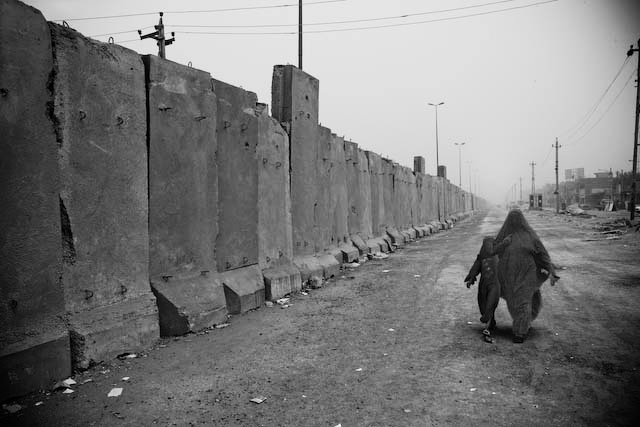
Here’s a photo taken by a combat photojournalist known as Zoriah, who helpfully allows blog posts of his work, and talks about the scenes he photographs. This is a blast wall constructed around Sadr City.

He writes:

The Sadr City Wall: a highly controversial project which has effectively walled two to four million Iraqis inside the planet’s most dangerous neighborhood.  The U.S. Military sees it as show of strength to the insurgents who call Sadr City home, as well as way to control who and enters and exits the city.  The locals see it as another hostile move by the occupying forces, a major inconvenience for working and moving from place to place, as well as a potential danger since peaceful residents may not be able to escape when more rounds of fierce fighting erupt.

Part of our "success" in Iraq, no doubt.

Sadrcitywall

The End of 9/11 Politics?

Fortune: Mr. McCain, what do you think is the single greatest economic threat to the United States?

McCain at first says nothing. He sits in the corner of a sofa, one
black, tasseled loafer propped against a coffee table. We’re in the
presidential suite on the 41st floor of the New York Hilton. McCain has
come here – between a major speech on the economy in Washington, D.C.,
this morning and a fundraiser tonight at the 21 Club – to talk to us
and to let us take his picture. He is wearing a dark suit, as he almost
always does, with a blue shirt and a wine-colored tie. He’s looking not
at us but into the void. His eyes are narrowed. Nine seconds of
silence, ten seconds, 11. Finally he says, "Well, I would think that
the absolute gravest threat is the struggle that we’re in against
radical Islamic extremism, which can affect, if they prevail, our very
existence. Another successful attack on the United States of America
could have devastating consequences."

Not America’s dependence
on foreign oil? Not climate change? [ed. — nice to hear Fortune magazine asking this question!]  Not the crushing cost of health
care? Eventually McCain gets around to mentioning all three of those.
But he starts by deftly turning the economy into a national security
issue – and why not? On national security McCain wins. We saw how that
might play out early in the campaign, when one good scare, one timely
reminder of the chaos lurking in the world, probably saved McCain in
New Hampshire, a state he had to win to save his candidacy – this
according to McCain’s chief strategist, Charlie Black. The
assassination of Benazir Bhutto in December was an "unfortunate event,"
says Black. "But his knowledge and ability to talk about it
reemphasized that this is the guy who’s ready to be Commander-in-Chief.
And it helped us." As would, Black concedes with startling candor after
we raise the issue, another terrorist attack on U.S. soil. "Certainly
it would be a big advantage to him," says Black.

Apparently not. Today the article was published. McCain repudiated Black’s claim. Black apologized.

"I deeply regret the comments — they were inappropriate," Black said outside a McCain fundraiser in Fresno, Calif. today.

This fits precisely with what a pollster was telling me last week. (More to come soon.) The public has rejected the politics of "the mindset that got us into war in Iraq," as Barack Obama memorably puts it.

If this pollster is right, McCain has been neutered. If he cannot attack Obama on his strength — national security issues — what does he have to say?

Update: Nate Silver at FiveThirtyEight wonders if even a terrorist would always help the war candidate.

Coming soon to a used bookstore near you…

Thestoryofjohnmccain

Obama on Ethanol: Supports Corn, Taxes Sugar Cane

For an enviro-type, it’s difficult if not impossible to support Barack Obama when he claims we should be giving ample taxpayer support to growing corn for ethanol, but should not allow Brazil to sell its sugar cane ethanol in this country free of tariff….even though sugar cane ethanol is a far more efficient fuel.

That’s according to The New York Times (here):

Corn ethanol generates less than two units of energy for every unit of
energy used to produce it, while the energy ratio for sugar cane is
more than 8 to 1. With lower production costs and cheaper land prices
in the tropical countries where it is grown, sugar cane is a more
efficient source.

I hate to have to agree with the National Review on anything, but they rightly criticize Obama for backing subsidies to grow corn for ethanol in the Midwest. All the while Obama enthusiastically supports taxing the importation of ethanol from Brazil, which requires no subsidy, is a better fuel, environmentally speaking, and doesn’t crowd out land better used for food crops.  Stuttaford writes:

The Times
goes on to report that Obama "talk[s] regularly about developing
switchgrass, which flourishes in the Midwest and Great Plains, as a
source for ethanol." So he should. It’s promising, but not for years,
much like the drilling for oil off the U.S. coast that Obama opposes
partly because it will, uh, take too long.
Odd, that.

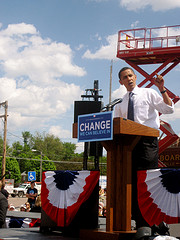
Argggg. My political innocence is getting pounded. Here’s Obama speaking at the Corn Palace in South Dakota, thanks to John Haroldson.

Obamaatcornpalaceinsd

Missing the Fog

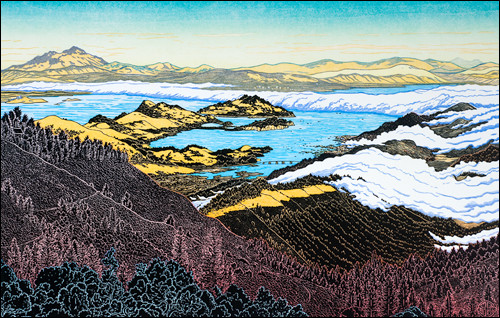
It’s been just insanely hot here in SoCal: 108 yesterday in Ojai. It’s times like this that I miss the fogs of the Bay Area, which sooner or later would always come in…the woodcut artist Tom Killion, who grew up in my neck of the woods, knows how to portray the wonders of that oceanic substance as it pours in, here seen from West Point on Mt. Tamalpais.

Westpoint_b