(Potential) Good News Friday: “If the World Pays Attention…”

Over Asia, according to a new study in Nature reported in Scientific American, a high percentage of the local warming threatening Himalayan glaciers is the result of black carbon from cooking fires. It’s so prevalent it shows up in NASA images taken from space. The Times of London ledes with the bad news:

They call it the Asian Brown Cloud. Anyone who has flown over South Asia has
seen it – a vast blanket of smog that covers much of the region.

It is also what colours those sunsets at the Taj Mahal. Now a group of
scientists has carried out the first detailed study of the phenomenon and
arrived at a troubling conclusion.

They say that it is causing Himalayan glaciers to melt, with potentially
devastating consequences for more than two billion people in India, China,
Bangladesh and other downstream countries.

In a study published yesterday by Nature, the British journal, they say that
black soot particles in the cloud are absorbing the Sun’s heat and pushing
up temperatures at the same altitude as most Himalayan glaciers.

Scientists have already observed that two thirds of the 46,000 glaciers in the
Himalayas are shrinking, leading to increasingly severe floods downstream
and, eventually, to widespread drought. Greenhouse gases were previously
thought to be the main cause of the problem, which threatens the sources of
Asia’s nine main rivers – including the Indus, the Ganges and the
Yangtze.

But the research team from the Scripps Institution of Oceanography in
California says that the Asian Brown Cloud – made up of gases and
suspended particles known as aerosols – is just as much to blame. “My
one hope is that this finding will intensify the focus of Asian scientists
and policy makers on the glacier issue,” Veerabhadran Ramanathan, who led
the research, told The Times. “These glaciers are the source for major river
systems, so at least two billion people are directly involved in this.”

The cloud is an enormous plume of smoke from factories, power plants and wood
or dung fires that stretches across the Indian subcontinent, into SouthEast
Asia.

But within that news, there is a potential for change. As Ramanathan told the Scientific American:

But the problem can be solved by swapping other fuels and methods
for the wood in cooking fires. "The aerosol lifetime is two weeks,"
Ramanathan says. "If the world pays attention and puts resources to it,
we will see an effect immediately. I’m talking weeks, at most a few
months, not decades or centuries."

That contrasts with solutions for CO2 emissions, which
will require much longer periods to show effects. Because the brown
cloud appears to be at least as important, eliminating it could buy
time to implement more far-reaching solutions before catastrophic
glacial melt and other climate change impacts occur, Ramanathan argues.

Ramanathan and colleagues plan to demonstrate this on a small scale
over the next few years in the Himalayas, over a 12-square-mile area in
the foothills. "We want to create a black carbon hole," he says.

Here’s the researcher with his drone aircraft, courtesy of Scripps:
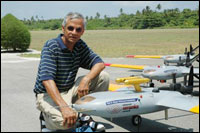
V_ramanathan_and_drone_aircraft_for

Washington Post Reports Odd Outbreak of “Wild Weather” in Europe

Today the Washington Post runs a front-page story reporting on "wild, wild weather" in Europe this summer, with floods in England, killer heat in Greece, fires in the Canary Islands, and unseasonable cold in Paris — and doesn’t even mention the possibility of a connection to climate change!

Shameful.

Yes, weather is not the same as climate, but to not even discuss the connection that scientists in Europe are actively debating — ridiculous.

Climatologists have long argued that global warming will lead to greater variability, which is exactly what we’re seeing in Europe this summer. For example, in a Los Angeles Times story quoted a week or so ago, a scientist at Oxford named Jon Finch put it this way:

"One
thing to remember is that what seems to be indicated with global
warming is much more variability in the climate," [Jon Finch of Oxford U.] said. "So this
[flood] event, which basically looks like it’s a 1-in-200-year event, may with
a change in climate come down to a 1-in-50-year event."

Finch hastens to add that his number is speculative, but it shows that European scientists are already trying to quantitatively assess the increased variability that global warming is bringing us, which will no doubt soon show up in insurance quotes, as increased hurricane risk has already in the East and along the Gulf Coast.

Why is this concept of a connection between climate change and "wild weather" so difficult? We can grasp that smoking cigarettes leads to an increased chance of lung cancer. According to the Centers for Disease Control, smoking is a risk factor that means that people who smoke are ten or twenty times more likely to contract lung cancer than those who do not.

Now we have an Oxford University researcher estimating that climate change means a 4x greater chance of devastating floods. Is this concept so difficult it cannot be mentioned to American news readers?

When it comes to weather and climate, apparently most American reporters don’t want to do the hard work of assessing the possibility of a connection between global warming and strange weather occurences.

Or they are in denial. Or they are afraid of being battered by deniers.

Is that too harsh?

Treasury Secretary Lobbies China on Global Warming

From the Wall Street Journal today:

Mr. Paulson has tried to broaden the discussion beyond
the currency, talking about further openness in the financial sector as
a key step for China’s reforms and cooperation on mitigating climate
change, preserving the environment, and developing more secure energy
supplies.

Ahead of his meetings in Beijing Tuesday and
Wednesday, Mr. Paulson visited China’s western Qinghai province to tour
a lake area damaged by global warming.

Different reporters take different angles on a story. The WSJ story above looks mostly at currency lobbying. A Reuters story below stresses a White House pushback against a Congressional move to pressure China.

Snore. Interestingly, the Reuters photographer and caption look at an entirely different story barely mentioned in either news account — how Paulson toured Chinese efforts to prevent desertification thanks to global warming. The picture’s far more dramatic than the currency discussion.

Hmmmm….are these reporters going with the talking points (the trees) and missing the forest  — the big story? Just asking! Here’s the picture and illuminating caption from Reuters.

And Mr. Paulson? If you’re interested in showing high officials what can be done against global warming — would you please talk to your boss?

Paulson_views_lake_threatened_by_ag

Thinking of Red Desert

Some people–the brilliant few–do not let a lack of means prevent them from making true art. The late Michangelo Antonioni was one of those few. His movies are fascinating, exasperating, mysterious, but never cliched. For the environmentally minded, his Red Desert–featuring the beautiful Monica Vitti in an industrial wasteland, is not to be missed. Rest in peace, Mr. Antonioni.

The_red_desert_by_antonioni

Cloudy with a Chance of Chaos

Tom Englehardt, of TomDispatch and The Nation, brings us a terrific essay by a Utah writer named Chip Ward. It focuses on what has gone wrong with bees in this country, with unusual depth (and grasp of the English language), but also offers a way forward different from our present path, and touches on the other disasters encircling our destructive way of life, such as climate chaos.

Think the way nature thinks: Surprises happen. Resilience matters. Control is impossible.

Think modularity.

I also have to link because Englehardt in his introduction makes the same point I’ve been making about the floods these past few weeks in England, now considered the worst in 200 years. He writes:

No American media figure, for instance, has wondered publicly whether,
someday, England could become, in Gore-like "inconvenient truth" terms,
the partially sunken Florida
of Europe (along undoubtedly with Holland and other low-lying areas of
the continent). It’s no less true that a season of startlingly
widespread and fierce wildfires, based on long-term drought in the
West, Southwest, and Southeast has been a news leader for months — the
TV news just adores the imagery of storms and fires — again, most of
the time, with little linkage to larger possible changes underway. We
are, it seems, a resistant species when it comes to thinking about the
need to truly reorganize ourselves on this fragile, but resilient, planet of ours.

(HT: JMG, of Grist)

Sunday Morning on the Planet: If This Isn’t Nice…

"I had a good uncle, my late Uncle Alex. He was my father’s kid
brother, a childless graduate of Harvard who was an honest
life-insurance salesman in Indianapolis. He was well-read and wise. And
his principal complaint about other human beings was that they so
seldom noticed it when they were happy. So when we were drinking
lemonade under an apple tree in the summer, say, or talking lazily
about this and that, almost buzzing like honeybees, Uncle Alex would
suddenly exclaim, ‘If this isn’t nice, I don’t know what is." So I do
the same now, and so do my kids and grandkids. And I urge you to please
notice when you are happy, and exclaim or murmur or think at some
point, ‘If this isn’t nice, I don’t know what is.’"

– Kurt Vonnegut

(HT: The Mississippi Project)

Floods Show Global Warming, Says Conservative British Paper

Echoing the liberal Prime Minister, the conservative British broadsheet the Daily Telegraph runs a long story arguing that "the worst floods to hit England in 200 years" show that global warming has arrived.

Here’s the heart of the piece, by environmental editor Charles Clover:

I have covered the subject of climate change, in what I hope has been a relatively neutral way, since around the time Margaret Thatcher asked if we had begun a giant experiment with the planet in 1988. I would suggest no year has been more joltingly significant in
    our coming to terms with the reality of what is now happening than the past 12 months.

It began with Sir Nicholas Stern’s report on climate change last autumn. There followed an extraordinary scientific reaffirmation of the predictions made in the late 1980s and early
    1990s by the UN’s Intergovernmental Panel for Climate Change (IPCC).

And all the while there have been numerous tangible signs visible to everyone in our own latitudes that our climate is changing in ways that politicians in Europe now realise can only be explained by human activity.

Many were already sure we were talking about the effects of climate change after 4.1in (103.1mm) of rain was measured in 24 hours at Fylingdales in Yorkshire last month, a one-in-80-year event that inundated Doncaster, Hull and surrounding areas.

Hull has the largest number of homes on the flood plain of any city other than London. The run-off from the rivers met high groundwater levels caused by run-off from the permeable chalk on the Yorkshire Wolds.

The city’s 19th-century sewerage system overflowed with rainwater and sewage. The foul water had nowhere to go, other than into the 6,500 homes now estimated to have been damaged by the resulting flood.

The Met Office says sea-surface temperatures over a large part of the North Atlantic have been above average this year, a likely consequence of the exceptionally warm weather conditions over north-west Europe in the winter and spring.

The air is warmer in summer and can hold more water vapour. The warm summer combined with the stronger jet stream may be the reason for the heavy rain we have experienced.

By an extraordinary coincidence, the unprecedented summer floods that struck Herefordshire, Worcestershire and Gloucestershire this week overlapped with the publication in the scientific journal Nature of a study that compared rainfall levels predicted by climate models involving only natural trends and those taking into account
    human activity.

While studies have previously found that human activities have altered air temperatures, sea levels and ocean temperatures, this one, by the Met Office’s Hadley Centre and authors including the American chairman of the scientific working group of the IPCC, Susan Solomon, was the first to show clear evidence of an overall increase in precipitation in the models that included human activity.

The overall trend for Britain identified by the computer models as a result of global warming was wetter winters and drier summers. However, Dr Peter Stott, a climate scientist at the University of Reading and another of the paper’s authors, said more intense rain storms in wetter years would also fit into the pattern.

"Generally speaking, the models are tending to show a drier trend in summer in the UK," he said. "Nevertheless, when it rains it can rain harder, because the atmosphere can contain more moisture in a warmer world."

The story opens with a helicopter shot of London landmarks standing in water almost worthy of a disaster movie. I’m not allowed to copy that, but here’s a nice photo from a fellow Flickr subscriber Lazlo Woodbine as compensation.

River_amber_in_flood_june_2007

Jet Stream Shift Over Europe: Climate Change…or Not?

Below is a nice map, courtesy of the BBC, showing the shift in the jet stream bringing unprecedented rain and flooding to the UK. As Kim Murphy put it for the Los Angeles Times today:

Few scientists are ready to immediately blame the quirky weather on
global warming. For one thing, current climate change trends predict
just the opposite in Britain: warmer, drier summers and wetter winters.

"One
thing to remember is that what seems to be indicated [with global
warming] is much more variability in the climate," [Jon Finch of Oxford U.] said. "So this
event, which basically looks like it’s a 1-in-200-year event, may with
a change in climate come down to a 1-in-50-year event. But that’s just
speculation."

The jet stream displacement is expected to right
itself in the coming weeks, and stay that way through the rest of
summer, said Jim Dale, a meteorologist with British Weather Services in
High Wycombe.

But note the caveats: "few scientists are ready to immediately blame…" Of course not! No scientist worth his salt is ready to attribute without causal evidence.

But those of us who watched the weather maps in Southern California during our record breaking floods of 2005 saw a similar phenomenon — an unexplained swing in the jetstream that surprised even the most experienced of climatologists. Usually the jetstream in the winter turns eastward over the West Coast far north of SoCal, but in December and January of 05, it swooped all the way down to Catalina Island…for weeks at a time, causing huge floods, vast damage, and killing quite a few people.

Now reputable climatologists (such as Kelly Redmond) say that swing was "not inconsistent with" global warming, in the murky double negative phrasing that scientists prefer. 

Why not drop the "speculation" and say, as we can with assurance, that in the 21st century a warming ocean and atmosphere means increasing overall variability with a far greater chance of climate chaos?

Jet_stream_over_europe_in_2007

Good News Friday: Coal Plants Cancelled Nationwide

According to the Wall Street Journal, the coal industry is struggling to build new plants, because of fear of climate change. It’s a long story, so I’ll put a couple of other excerpts (one relating to Florida) below the fold, but here’s the lede:

From coast to coast, plans for a new generation of
coal-fired power plants are falling by the wayside as states conclude
that conventional coal plants are too dirty to build and the cost of
cleaner plants is too high.
[cut]
As recently as May, U.S. power companies had announced
intentions to build as many as 150 new generating plants fueled by
coal, which currently supplies about half the nation’s electricity. One
reason for the surge of interest in coal was concern over the higher
price of natural gas, which has driven up electricity prices in many
places. Coal appeared capable of softening the impact since the U.S.
has deep coal reserves and prices are low.

But as plans for this fleet of new coal-powered plants
move forward, an increasing number are being canceled or development
slowed. Coal plants have come under fire because coal is a big source
of carbon dioxide, the main gas blamed for global warming, in a time
when climate change has become a hot-button political issue.

[cut]

It’s hard to say how many proposed plants will never
be built. Some projects suffer public deaths when permits are denied.
Many more simply wither away, lost in the multiyear process of
obtaining permits, fending off court challenges and garnering financing.

In the wake of the fading coal proposals, and others
that are expected to follow, Citigroup downgraded the stocks of
coal-mining companies last week, noting that "prophesies of a new wave
of coal-fired generation have vaporized." On Monday, Steve Leer, chief
executive of Arch Coal Inc., said some of the power plants he had
expected to be built "may get stalled due to the uncertainty over
climate concerns."

[cut]

The rapid shift away from coal shows how quickly and
powerfully environmental concerns, and the costs associated with
eradicating them, have changed matters for the power industry. One
place where sentiment has swung sharply against coal is Florida.
Climate change is getting more attention there because the mean
elevation is only 100 feet above sea level, so melting ice caps would
eat away at both its Atlantic and Gulf of Mexico coasts.

In mid-July, Florida Gov. Charlie Crist convened a
climate-change summit to explore ways the state could improve its
environmental profile. In June, he signed into law a bill that
authorizes the Florida Public Service Commission to give priority to
renewable energy and conservation programs before approving
construction of conventional coal-fired power plants.

The law was bolstered by a recent report from the
nonprofit American Council for an Energy Efficient Economy that found
Florida could reduce its need for electricity from conventional
sources, like gas and coal, by 29% within 15 years if it implemented
aggressive energy efficiency measures.

On the eve of the governor’s summit, backers of a
major power-plant proposal said they would suspend development
activities for an 800-megawatt coal-fired plant proposed by four
city-owned utilities including the one serving the state capital,
Tallahassee. (One megawatt can power 500 to 1,000 homes.) The backers
cited environmental issues.

That decision followed the rejection by the utility
commission of a proposal by Florida Power & Light Co., a unit of
FPL Group Inc., to build a 1,960-megawatt coal plant in Glades County,
Fla. The commission found that the plant was cost effective in fewer
than half the scenarios examined. One reason for its poor showing is
uncertainty about the future cost to curb carbon dioxide pollution.
Coal plants emit more than twice as much carbon dioxide per unit of
electricity produced as natural-gas-fired plants, but there’s no cheap,
easy way to capture and dispose of the greenhouse gas.

[Ed. note — the story also provides, for the first time I’ve seen, a rough estimate of how much more it costs to build a so-called "clean coal" plant — about a half-billion dollars more to build a plant that will capture 30% of CO2 emissions, and another 600+ million to build a pipeline to send CO2 to deep offshore storage. This would raise the costs of power from so-called "clean coal" to twice the usual figure, at which point it becomes uneconomic. Great story from Rebecca Smith.]

Graph of the Week

Take a look at this world, as described by a new study on how global warming is leading to substantial increases in rainfall in some regions, substantial decreases in others.

Here’s the abstract in Nature,, and here’s a nice recap from GreenCarCongress, along with a graph from the study by Francis Zwiers and seven coauthors.

[Ed. Note — Yellow bands indicate anomalous dryness vs. the historical record. Grey indicates mixed signals. Green bands show anomalous wetness. Here’s a story in the Guardian re: the recent floods in England. And here’s a spirited discussion of same by scientists and interested observers participating in the the Global Change GoogleGroup.]

Precipitation_trends_in_21st_centur