Ian McEwan To Write Funny Global Warming Novel

Allegedly. I admire (and envy) McEwan as a writer, but don’t think of him as a funny man, even in comparison to an old devil like Kingsley Amis, and doubt that his novel will turn out to be hilarious, despite this inspiring scene:

The impetus for this novel came in 2005 when he was part of an
expedition of artists and scientists who spent several weeks aboard a
ship near the North Pole.

"While I was on board I soon realized that the boot room, where we all
changed our clothing and left our shoes, had turned into a scene of
social chaos," McEwan said, describing how the eminent scientists, who
were gathering down the hall to talk earnestly about the future of
humankind, were also capable of stealing each others’ footwear and
regarding their colleagues with deep distrust.

"I realized that it’s all about human nature. The way to write about climate change is through writing about human nature."

Well, can’t argue with that. But McEwan’s characteristic seriousness comes through in another piece in the Guardian, in which he looks at the apocalypse through the "posthumous irony" of Susan Sontag.

Oy. If we’re going to be serious, with all due respect to the hard-working and brilliant Mr. Ewen, give me The Road.

The Confessions of Cassandra

The Ojai Music Festival is known for its adventurous spirit, for its lust for risk — musically speaking.

In turn, Libbey Bowl audiences are known for their patience, and often they are rewarded with the  unforgettable. When Steve Reich’s difficult "Four Organs" was premiered in New York in the early l970’s, a near-riot erupted. When played for the first time on the west coast In Ojai, the piece piqued interest and resulted in a recording (according to a story recounted by Mark Swed in today’s Los Angeles Times.)

Last Saturday night at Libbey Bowl the festival broke away from its celebration of the hypnotic music of  Reich for an exploration into the outer limits of voice and music today. The evening began with a baffling piece in which one woman alone sang wordlessly against an array of electronica without a beat.

This was called En Echo, by Philippe Mandury, performed with preternatural calm by soprano Juliana Snapper, against a spectrum of electronic effects rendered by the unseen Miller Puckette.

But what followed was something else.

Mesmerizingly so.

Described as a "spoken opera" by composer Michael Jarrell, "Cassandre" is actually a monologue with orchestral support, but most of all it’s a stunning piece of writing, drawn from the ancient myth of Cassandra, as written by one of the greatest of German writers today, the novelist Christa Wolf.

Barbara Sukowa, a compelling actress with a guttural voice, growled her way through an English translation of the monologue. Cassandra is a ruined woman. Once she was a princess, but now she has been brought low by a god.Because she refused Apollo, he spit into her mouth, and forever after she was cursed to speak the truth to all, but be believed by no one.

"Sounds like the Al Gore story," said one fellow in my section.

Indeed. Although Wolf, an East German, wrote her novel based on the myth in l983, It’s astonishing how up-to-date her words sound today. Cassandra begins by recounting what her enemies said of her:

Prophesizing disaster, you immortalize yourself. Your name will go on, and you know it.

She bitterly derides her own ineffectiveness.

Words die before pictures.

She points out the distracting power of war.

Not everyone could see the naked meaninglessness of these events.

From 2500 years in the past, she speaks to our unhappy plight in Iraq today.

You cannot win a war fought for a phantom.

And in conclusion, she bitterly warns her doubters.

Later, you will know as well as I that we had no chance against a world that needs heroes…if there is a later.

From Ken Hively at the LA Times, here’s a picture of conductor David Robertson and Sukowa, in her alarmingly martial outfit. As festival director Tom Morris promised, she "ate the stage."

Barbarasukowaanddavidrobertson

Big Mo: Landslide Win Predicted for Obama in Missouri

Jay Roberts, an experienced St. Louis pol, tells Off the Bus:

"We’re going to be one of the top four-to-six battlegrounds and at
the end of the day, we’re going to go blue and take back a state that
has historically been Democratic — and that includes sweeping a new
Democratic governor, Jay Nixon, into office. This race isn’t just about
taking over the White House; it’s a change election all the way around,
including changing the electoral map of the country," said Roberts.

Roberts, who also works in real estate, is raising $50,000 for Obama. So, obviously, he has a stake in what he is saying.

But he also has a fact on his side.

Look at the numbers from the spectacularly helpful site FiveThirtyEight:

In January, a poll in Missouri by Research 2K found Obama at +5.

In March, after the Wright scandal broke, polls by Rasmussen and SurveyUSA found Obama sunk and McCain up +15.

In late May and early June these same pollsters now find Obama up by just about +1.

This would be meaningless, except that the momentum is clear…he has put Wright behind him.

1830258325_1bd262fec4_o

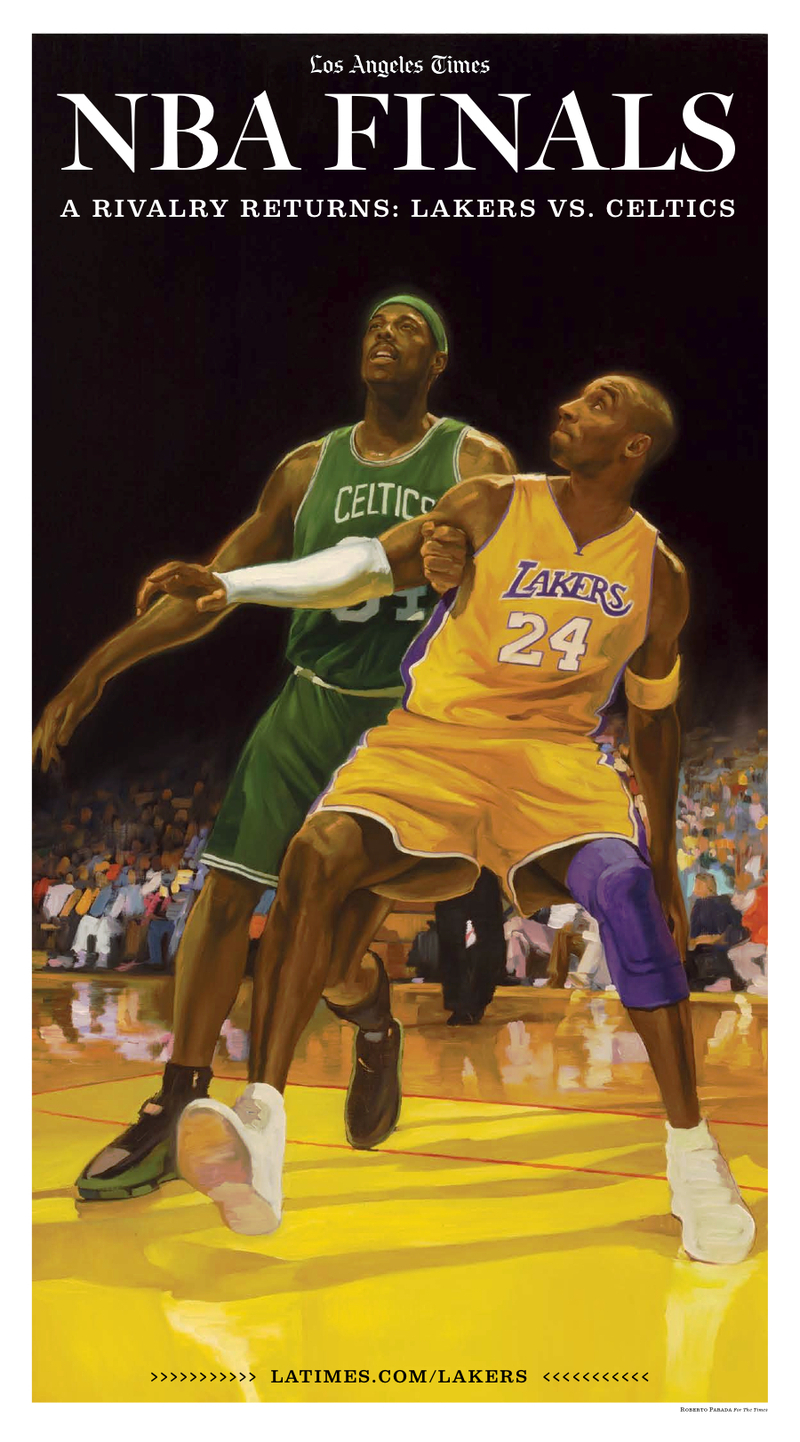
Celtics Get Off the Mat, Win Round One

Pierce sustains a strained knee; Perkins a strained ankle. But despite hearing "a pop" in his knee, Pierce overcomes the pain, comes out of the locker room. gets back into the game. Hits a couple of big shots, and the Celts pull out tgame one in Boston. Lakers rattle out a dozen shots, lose by less than ten. And the paper offers a digitized painting to help us remember, which echoes a Magic/Bird picture, looks cool…

Lakers_celts_2008

Genius Loves Company: Dawn Upshaw edition

My story on the Ojai Music Festival, to begin this evening, featuring the great Dawn Upshaw (here).

…when asked how it felt to be proclaimed a genius to the world, Upshaw,
speaking on the phone from her studio in New York, sounds
ever-so-slightly embarrassed, insisting that “only the media” call it
the genius grant, saying she was “totally shocked,” but laughingly
admitting that “sometimes it’s useful with my children. When they’re
not listening to me, I remind them that other people have called me a
genius, believe it or not!”

Upshaw2_

A Day in the Life, 41 Years Later

For the first time ever, Paul McCartney performs what many consider perhaps the greatest rock song ever (here) at an anniversary concert for Sgt. Pepper’s in Liverpool. And thanks to the miracle of the Internet, you can see it too!

Funny thing is, Paul flubs the lines he sung in the song, but gets John’s right (although when the song goes into his innovative/atonal phase, he switches to another John classic, "Give Peace a Chance").

All in all, it’s lovely. Thank you, Paul.

Are Bush and Cheney Trying to Get McCain Defeated?

Monday Dick Cheney makes a hillbilly/incest joke at West Virginia’s expense, and after all the notable politicians in the state — Republicans and Democrats alike — protest, has to take it back.

Tuesday Bush reveals that "we’ll be in Iraq for forty years"  thus perfectly reinforcing McCain’s gaffe about being in Iraq for 100 years. (McCain protests every time Barack Obama brings this up, but Obama, no fool, knows that: it’s briar patch politics — the more McCain protests, the more he digs himself in.)

Further, the reliably sane conservative Ross Douthat (here) contends that if McCain wins in November, he will end up getting credit for "the surge" that has allegedly saved the war in Iraq, because he took the political risk of supporting it from the start, whereas if Obama triumphs, it will go to Bush-Cheney.

…if the Arizona Senator is elected President on the strength of his
support for the Surge (while insisting that he had the right Iraq
policy all along and Bush only came to it reluctantly, and when it was
almost too late), then the election results will reinforce an
already-existing narrative that associates the policy more with McCain
than with Bush

So from their point of view, why support McCain? Keep in mind, when it comes to Bush-Cheney, it’s all but impossible to be sufficiently cynical.

In 2006, the Prez declared the practice of "extraordinary rendition" had ended, but now word comes of a policy of holding political prisoners on Navy ships.Great. Now even the Navy is involved in torture.

What next — NASA astronauts implicated in torture?

Closed Minds — Libertarian and Religious — Think Alike

Often on the right hand side of the political dial I hear claims that environmentalism is "a religion."

I guess by this it’s meant that some people, maybe including me, think the earth is sacred. Horrors!

Instead of contesting this, I’m beginning to think enviros should agree, and point out that to many on the right, money is a religion, and if a conflict between the value of money and the value of the planet should arise, than that means the planet must fall by the wayside.

(This is absurd and self-defeating, of course, as even huge oil companies like Chevron — which accepts the concept of natural capital — will concede. But never mind that now.)

A prime example comes from a recent interview with Libertarian candidate for president Bob Barr and far-right radio host Glenn Beck:

GLENN: Do you believe in manmade global warming and to what extent will
you try to correct it, if you do believe in manmade global warming?

BARR: Mankind has done a lot of good in the world.
They have done a lot of bad as well, but change in the climate is not
one of them. I’ve seen no legitimate scientific evidence that indicates
that the cyclical — and they are very much cyclical — you know,
increases and drops in global temperatures over the decades and over
the centuries is the result of, you know, mankind.

Barr denies the existence not only of climate change, but of billions of dollars of research, four international reports by the IPCC, the latest totaling 996 pages — but never mind.

Some minds are closed: not much news there.

Here’s my point. In the l9th century, similarly closed-mind religious believers refused to accept the concept of the extinction of species. New York Times blogger Olivia Judson explains in a recent column:

Extinction is so much a part of today’s cultural background — this
species endangered, that habitat lost, save the whale, save the rhino,
save the rainforest — that it’s strange to think that as little as 200
years ago, most people didn’t think extinction was possible. The very
idea was an affront to the Creator: it suggested imperfection and
incompleteness in the original design of the world. So even once it
became accepted that fossils had been formed from living beings — which
itself took some time — most people supposed that the corresponding
organisms were still alive, somewhere, awaiting discovery.

But in the last years of the 18th century and the first decade of
the 19th, the great French anatomist Georges Cuvier made a study of the
fossil bones of enormous animals — giant ground sloths, and extinct
elephants like mammoths and mastodons. Some of the giant ground sloths
reached 6 meters (almost 20 feet) long. The bones and teeth of mammoths
and mastodons showed that they were clearly distinct from living
elephants.

Cuvier argued that such creatures could not correspond to anything
currently alive: if animals that big were still blundering around,
they’d be known about. It was only then, in the years after he
presented and published his work, that the reality of extinction in the
history of life became recognized and accepted.

Like the now-extinct Stellar Sea-Cow, Barr and his fellow climate change deniers simply can’t believe in the facts in front of their faces. The Sea-Cow had not the wit to avoid hunters, and was extinct along the West Coast not long after it was discovered.

I can’t help but hope that the Libertarian fanaticism will be similarly short-lived.

Is that wrong?

A98_seacow

Bush: Dumber Than A Comic Book

The Washington Post brings up the the "confused pep-talk" that our Prez gave to his top commanders after four contractors were brutally killed in Fallujah in 2004, according to Ricardo Sanchez, then the commander of US forces in Iraq:

"Kick ass!" he quotes the president as saying. "If somebody tries to
stop the march to democracy, we will seek them out and kill them! We
must be tougher than hell! This Vietnam stuff, this is not even close.
It is a mind-set. We can’t send that message. It’s an excuse to prepare
us for withdrawal."

"There is a series of moments and this is one of them. Our will is
being tested, but we are resolute. We have a better way. Stay strong!
Stay the course! Kill them! Be confident! Prevail! We are going to wipe
them out! We are not blinking!"

The usually thoughtful Tom Englehardt of The Nation works this attack on Bush into a larger attack on movies in general and Iron Man in particular, talking of cartoon villains who are "not only fanatical, but usually at the very edge of madness as well."

But this makes one wonder if Englehardt even saw the movie, or if his politics have blurred his vision. Yes, the movie includes some cartoon villains obviously modeled after the Taliban, who indeed are not beyond punishing innocents, including the people of Afghanistan (as in the movie) or their cultural icons. But in the movie they are pawns of fate, as goons in movies (and fiction) usually are, and certainly not the chief or worthy antagonist to our hero.

No, the real villain is a corporate string-puller, Obadiah Stone, whose very name hints at a fanatical devotion of his own, but to money, not faith. As Roger Ebert, America’s greatest movie critic, points out, in a recent review: "Jeff Bridges makes Obadiah Stane one of the great superhero villains by seeming plausibly concerned about the stock price."

Exactly: Stone looks like a villain, with his bald pate and ominously outre beard, but it is his cold rationality — thinly veiled in a cloak of phony concern for the "misguided" Tony Stark — that makes him truly chilling. This is realism, Mr. Englehardt, this is how corporate titans get their way, by making a hero like Tony Stark appear mad because he no longer wants to play the corporate imperialist game.

God! Can’t anyone read a comic book anymore?

Fortunately, someone can — here’s Spencer Ackerman on the dramatization of imperialism that is Iron Man:

…when Stark sees that his company has made him little more than a
playboy version of infamous black-market arms merchant Viktor Bout, his
answer is to both get out of the weapons trade and to use Iron Man to
right Stark Industries’ wrongs. When asked by his personal
assistant/love interest Pepper Potts why he’s doing something that will
most likely get him killed, Stark replies, plaintively but with
conviction, "I finally know what I have to do, and I know in my heart
that it’s right."

Spoken like a true imperialist. Heroism, when applied to foreign
policy, is a moral vanity that usually prescribes a cure more corrosive
than the disease it confronts.

In his analysis, Ackerman focuses on imperialism, somewhat overlooking I think the core fantasy in recent American history, which is that technology has the answer to all our problems.

If only I can merge with a machine, thinks Tony Stark, then all my problems will be solved.

Not, as the movie shows. If only our president had had half the insight of this comic book movie, how much better off we would have been…

MovieWeb – Movie Photos, Videos & More

Extreme Weather, Coming to Your Town Soon

The new graphics columnist for The New York Times illustrates issues powerfully, as in today’s column.

Charles Blow’s words make the point we all know:

According to the Center for Research on the Epidemiology of
Disasters, there have been more than four times as many weather-related
disasters in the last 30 years than in the previous 75 years. The
United States has experienced more of those disasters than any other
country.

Just this month, a swarm of tornadoes shredded the
central states. California and Florida have been scorched by wildfires,
and a crippling drought in the Southeast has forced Georgia to
authorize plans for new reservoirs.

Who do we have to thank for all this? Probably ourselves.

Last
year, the Intergovernmental Panel on Climate Change issued reports
concluding that “human influences” (read greenhouse-gas emissions) have
“more likely than not” contributed to this increase. The United States
is one of the biggest producers of greenhouse-gas emissions.

But much more powerful is the image…

Disasterslarge