The Lost Brother — Latterly strikes again

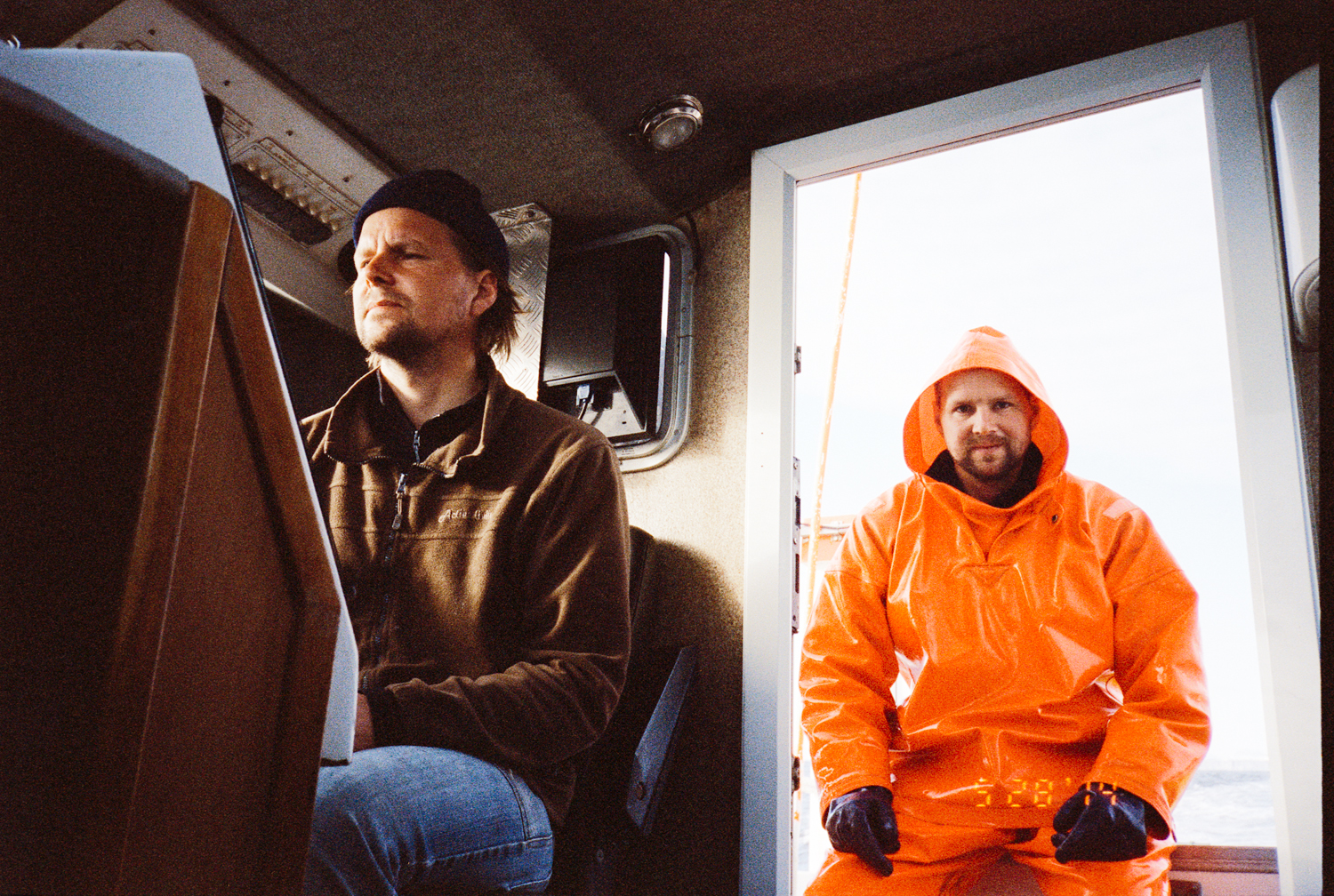
To encourage interest and subscription, Latterly magazine, an on-line journal of stories from around the world,  run by the wizardly editor Ben Wolford, released as a “single” a marvelously rich and well-written, well-edited, and well-composed story about life north of the Arctic Circle, on an island off the coast of Iceland. It’s called The Lost Brother. It’s free, and it’s a journey into another world.

Grímsey had built a reputation as an oasis of the north — an island with endless supplies of fish in nearby waters, pleasant weather and peace (to date, there has been no recorded crime on Grímsey, nor has there ever been a local police force).

svafarbjarn-1447264281-45


Climate warriors in Vogue: Hindou Oumaro Ibrahim

A feature in Vogue focuses on thirteen “climate warriors” at the Paris climate conference (#COP21) from around the world. It’s beautiful — and the words of these women hit home.

VogueclimateIbrahim

HINDOU OUMAROU IBRAHIM
Hindou Oumarou Ibrahim is from the Sahel region of Chad, where devastating droughts and floods are now the norm. As cochair of the International Indigenous Peoples Forum on Climate Change, Ibrahim works to contain the humanitarian and ecological fallout from the vanishing of Lake Chad, a lifeline for an estimated 30 million people in Chad, Nigeria, Cameroon, and Niger.

“If women come together, they can have more impact than any agreement, than any negotiations,” says Ibrahim. “Because we know that the future—it’s coming from us.”

Chris Christie “doesn’t buy” climate change

As David Roberts of Grist/Vox has been saying for literally years now, the GOP base is batshit crazy, and as a result, Republican candidates have to compete to out-crazy each other when it comes to climate.

How low can they go? How uninformed, willfully ignorant, and flat-out irrational can they possibly be? It’s the most Through the Looking Glass performance available in American politics today, surely.

Chris Christie six months ago declared that climate change was “real,” and indicated that unlike the rest of the GOP presidential candidates he knew that humans contributed, and got the reputation as a moderate.

Now he’s evidently trying to put his unsavory past as a climate change believer behind him, and today he scoffed at the very idea of climate disruption:

//platform.twitter.com/widgets.jsThe full transcript of the interview is astonishing  — more context just makes the aggressive ignorance plainer. ChristieScarboroughtranscript    //platform.twitter.com/widgets.js

No, of course not. Whew. Now that, that would be crazy.

Tennieldumdee

A day in Paris for the climate

Where does one start with the news from Paris, from COP21? With the speech from the President? Images from the fantastically imaginative demonstrations from the day before, in defiance of police authority, of shoes left in protest in the Place de la Republique?

shoedemonstration

Or with the fatalism of so many scientists, who agree that the agreements will not be enough to hold the planet to 2 degrees warmer Celsius — about three and a half degrees for Americans?

Probably with the Pope, who pollsters say brought about 10% of Americans to a position of belief in the factuality and seriousness of global warming — a huge shift.

“I can say to you ‘now or never’,” he told a group of reporters aboard the papal plane, en route home from Africa, according to Reuters. “Every year the problems are getting worse. We are at the limits. If I may use a strong word I would say that we are at the limits of suicide.”

The Pope, a climate activist! I still can’t fully believe that — but boy am I grateful.

The inevitability of warming: a matter of degrees

In Tales of a Warming Planet in today’s review section of the Sunday NYTimes, Curt Stager makes some central points about climate change well-known and accepted by climate scientists, but still new to most people:

Let me cite just three, in byte-sized form:

1) Roughly one-eighth of the carbon in your flesh, hair and bones recently emerged from smokestacks and tailpipes. We are not only a source of air pollution — we are air pollution.

2)This best-case [climate change] scenario is troubling, but Earth history shows us that the alternative is unacceptable. If we burn all remaining coal, oil and gas reserves within the next century or two, we could introduce a more extreme, longer-lasting hothouse much like one that occurred about 56 million years ago: the Paleocene-Eocene Thermal Maximum, or PETM

3)  A switch from finite fossil energy to cleaner, renewable energy sources is inevitable: We are only deciding how and when to do it.

One can look at the apocalypse and despair, or one can look at the risks and lead, as Jerry Brown has been doing in California, discussed in a nice piece by UCLA prof Jon Christiansen called:

The California Way: Sunny, with a chance of apocalypse

But in either case, it’s going to get warmer on this planet. The only question is a matter of degrees.

Climatewarmer-master675


Tips for Surviving Thanksgiving (aka “Compassion”)

Last Thanksgiving, the NYTimes published an unusually good op-ed on an unusually fraught subject: how to survive Thanksgiving with difficult relatives. Written by Henry Alford, it began something like this:

Like you, I have often wondered, “How might a hostage negotiator help the average American family get through Thanksgiving?”

I’ve had this thought not because of my own brood — we Alfords are a wholly agreeable lot, whose emotional vicissitudes take the form of a lot of muffled, Protestant sobbing — but rather because so many reports I receive of others’ holiday gatherings sound like football scrimmages subtitled by David Mamet. Surely these are matters for professionals who’ve received months of intensive training in crisis intervention?

“Just shut up and listen,” said Frederick J. Lanceley, the F.B.I.’s former senior negotiator and former principal director of its negotiation course, when asked how to get two parties who are at odds with each other to cooperate at the holiday dinner table. “People want to be heard. They want the attention.”

Mr. Lanceley said that during his 26 years with the F.B.I., his active listening skills caused perpetrators in various cases to confess, to ask if they could write him from jail or to even offer him a job. Mr. Lanceley advocated the following course of action: “Repeating what the other person says, we call that paraphrasing. ‘So what you’re telling me is that the F.B.I. screwed you over by doing this and that,’ and then you repeat back to him what he said. Also, emotional labeling: ‘You sound like you were hurt by that.’ ‘You sound like it must have been really annoying.’ Little verbal encouragements: ‘Unh-huh,’ ‘Mm-hmm.’ A nod of the head to let them know you’re there.”

Great column, highly recommended (despite a dull title): Crisis Negotiators Give Thanksgiving Tips

Thanksgiving

I was so impressed I wrote in, mentioning a poem (and song) on my mind at the time, and to my startlement, the paper went on to publish the letter at the head of a column of responses.

Kit Stolz

Upper Ojai CA 23 November 2014

Fascinating — some of the ideas (such as addressing first “presenting” and then “underlying” emotions) reminds me very much of a theory of communication to surmount conflicts known as “Non-Violent Communication.”

Also reminds me of a poem by Miller Williams, recently recast into song by his daughter Lucinda, which begins: “Have compassion for everyone you meet/even if they don’t want it/what seems like conceit, bad manners, or cynicism is always a sign/no ears have heard, no eyes have seen…”

So, on this day of sharing, let me share my admiration for that great poem again. Here’s Lucinda’s version:


Be grateful, but stay away from the Permagrin

In the NYTimes, the estimable Arthur Brooks — the rare research-oriented conservative writer — makes a case for expressing gratitude this season, even if we do not feel it.

This Thanksgiving, don’t express gratitude only when you feel it. Give thanks especially when you don’t feel it. Rebel against the emotional “authenticity” that holds you back from your bliss. As for me, I am taking my own advice and updating my gratitude list. It includes my family, faith, friends and work. But also the dappled complexion of my bread-packed bird. And it includes you, for reading this column.

That’s the conclusion of the column. Does that mean that inauthenticity is central to the conservative movement, if the President and thought leader of the American Enterprise Institute is calling for more of it?

Weird thought. Sorry. Anyhow.

Here’s another angle on a similar question. According to a wonderful story in Marketplace called Don’t Worry Be Happy or Else You’re Fired, the forced cheer one sees in retail sales has an emotional cost.

Cara O’Regan’s former job will probably sound pretty familiar to a lot of people. “We were encouraged to be positive and put a positive spin on things whenever possible,” she said.  O’Regan worked in retail sales. [edit] She faked a positive attitude to do her job. More accurately, faking it was her job. “You know, always with a smile on your face — a lot of clapping involved,” she said. “Clapping for the customers, clapping for our co-workers — any excuse to applaud anyone.”

There’s a term for this kind of faking it: emotional labor.

“Emotional labor,” according to Alicia Grandey, professor of industrial organizational psychology at Penn State University, “is a type of work where instead of physical labor where you’re using your muscles to perform the work, you’re using your emotions to perform the work.”

What’s the difference between these two states of inauthenticity? In one case the inauthenticity is bought and paid for, in the other it’s chosen.

Yet the first is said to make for bliss, and the second for disease.

Grandey has done research suggesting faking happiness all day long is emotionally taxing. Faking it, she argues, creates a sense of dissonance between internal and external states over long periods of time “and that’s been shown to create physical tension which can build up and create health issues, and over time result in job burnout.”

Brooks quotes neuroscience, which is a much weaker evidence than it might appear, while Grandey’s research looks at bodily questions through a social science lens.

Neither story uses the wonderful word I have often heard attached to “emotional labor” — the Permagrin (TM). Maybe it’s time for scientists to look at the question through that lens.


Reporter brings science to politics of climate

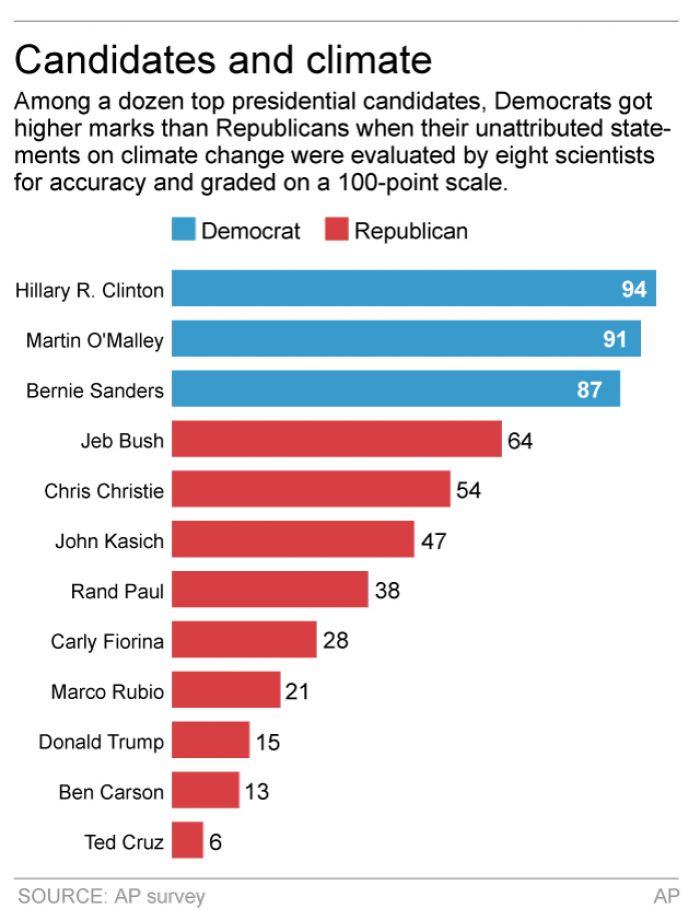
Reporters can fall into ruts and become predictable and dull, like anyone else, so it’s worth noting when a veteran reporter tries a new trick. Such was the case this past week, as the Associated Press’s Seth Borenstein, a veteran reporter who continues to cover big daily stories, tried something original with the political candidates’ views on climate change.

Instead of going out and interviewing the candidates and grading them on accuracy himself, which would of course make him a judge of their views, he gathered statements from debates and speeches, stripped their names off the statements, and ran them by a panel of eight scientists.

The results were predictable, but still striking. Here it is in tabular form:

ClimateAPscience

Note that Bernie Sanders was dinged for stating that the earth could become “uninhabitable” within the next two generations. Yes, it’s serious, but it’s not that hopeless.

The scientist’s opinions were often all too revealing. Donald Trump, for example, spouted this:

“It could be warming and it’s going to start to cool at some point,” Trump said in a September radio interview. “And you know in the 1920s people talked about global cooling. I don’t know if you know that or not. They thought the Earth was cooling. Now it’s global warming. Actually, we’ve had times where the weather wasn’t working out so they changed it to extreme weather and they have all different names, you know, so that it fits the bill.”

The scientists were not impressed with his meandering.

McCarthy, a former president of the American Association for the Advancement of Science, called Trump’s comments “nonsense,” while Emmanuel Vincent, a climate scientist at the University of California, Merced, said, “the candidate does not appear to have any commitment to accuracy.”

Borenstein called this a “fact check,” which is true enough, and suggests that facts are important, and we should be paying attention. Rebecca Leber, writing for the New Republic, puts it much more bluntly:

For now, though, electing a Republican—any Republican—is as good as saying America welcomes a world of 4 degrees Celsius or more of warming.

Scary that it’s that important, but Leber makes a strong case for this election as an inflection point. Her story’s headline?

The planet’s worse nightmare: Republican White House
The hazardous truth: Santa Clara Waste Water

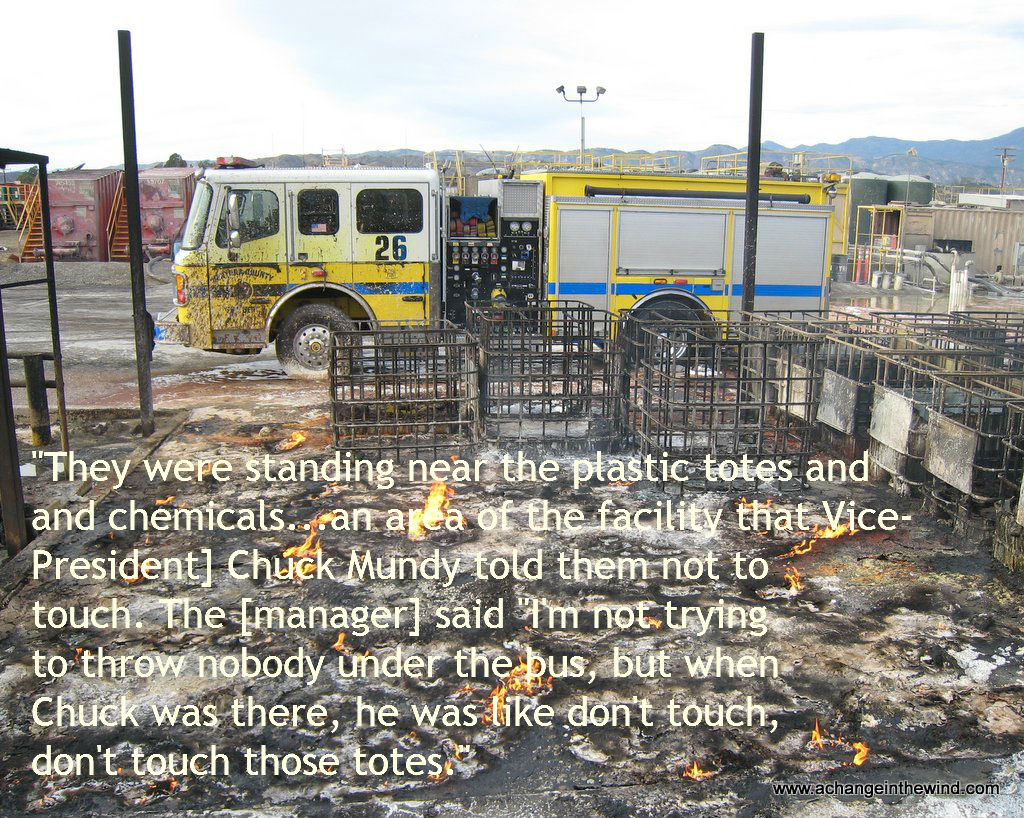
My old friends at the Ventura County Reporter ran my latest obsession/story, which I’ve been working on for the last six months or so, off and on, and did a nice job with the lay-out, may I say. Here’s the crux of the matter:

What really happened when Santa Clara Waste Water (in Santa Paula area) blew up? Why is the entire management of the company facing trial on 71 felony charges?

For answers, see here:

SCWWfirepic2