Abrupt Climate Change Drowns Land in North Sea

An English friend, Oliver Butcher, alerts me to a fascinating/alarming story that came out of the University of Birmingham in the UK last month. Turns out that about 8,000 years ago, global warming induced sea levels to rise, swallowing up a prehistoric culture that lived on land that is today beneath the North Sea.

Research Vince Gaffney, using new seismographic techniques, has mapped that vast area. He told the BBC that it was like finding another country. He also said the discovery foreshadows the "scale of impact" we face with global warming, because homelands could disappear quickly, he said:

At times this change would have been insidious and slow – but at times, it could have been terrifyingly fast. It would have been very traumatic for these people. It would be a mistake to think that these people were unsophisticated or without culture… they would have had names for the rivers and hills and spiritual associations – it would have been a catastrophic loss.

In 10,000 BC, hunter-gatherers were living on the land in the middle of the North Sea. By 6,000 BC, Britain was an island. The area we have mapped was wiped out in the space of 4,000 years.

For more, see the story in the BBC. Here’s a map of what this land looked like. Kinda different…

Britain_in_10000_bc

“A Friend Acting Strangely” — Smithsonian Exhibit on Arctic Changes Avoids Global Warming

Someday we will look back on this Bush administration era of global warming denialism in Washington and shake our heads and ask: What were we thinking? How could we let that happen?

Except that some writers don’t have to look back. Some noticed when it was happening.

This week a former Smithsonian museum offical, Robert Sullivan, said the natural history museum in an exhibit last year on climate changes in the Arctic self-censored the exhibit. This came as no surprise to super-popular reporter and blogger Joel Achenbach of the Washington Post, who reviewed the exhibit with his usual sharp humor, pointing out how badly it was named ("Arctic: A Friend Acting Strangely") and how mindlessly the facts were presented.

For example, here’s the opening from the overview, which is still available on line:

The Arctic’s climate has been changing. Spring thaws are earlier. Fall freeze-ups are later. Sea ice is shrinking. Unfamiliar species of plants and animals are appearing. Intense storms are more frequent.

Notice anything missing? Perhaps some context? A reason why we’re seeing these changes?

To exhibit the changes in the Arctic today without talking about global warming is a little like showing the changes in San Francisco in l906 without talking about the earthquake.

But that was the plan. According to an AP story:

William Fitzhugh, a museum anthropologist and co-curator of the project, said the exhibit achieved what was intended — to show the impact of climate change on Arctic cultures. It did not, however, discuss the link between the heat-trapping gas carbon dioxide and global warming.

Or, as Achenbach put it:

Is there any controversy about climate change? Not at the Smithsonian! The National Museum of Natural History has found a way to open two new climate change exhibits, starting Friday, without a single smithereen of contentiousness. We get just the facts: Planet’s getting warmer, arctic ice is melting, Inuit are out of sorts, Siberia is thawing. The future? "Models predict different outcomes," a sign says.

Right. No connection between atmospheric change and Arctic changes. No reason to worry. Or think.

The Internet version of the exhibition reveals other efforts to soft-pedal climate change. For instance, for a discussion of how global warming will affect the Northeast, the first line of the exhibit reads:

Warm weather sports, like hiking, increase; cold weather sports, like skiing, decrease.

So why worry, right? Hiking can be just as much fun as skiing.

Or, try out this new metaphor for global warming…ride the climate rollercoaster! Woo-hoo! Must be THIS TALL to ride! Have fun now!

Climate_rollercoaster_at_smithson_2

Gary Snyder: James Lovelock’s Arguments for Nuclear Power “Demented”

This past weekend the Ojai Poetry Festival featured the great American poet Gary Snyder, who read to a large crowd of listeners mostly from work written this century, especially his 2004 book of haibun called "Danger on Peaks." (Haibun, we learned, is a mix of prose and haiku: Japanese professor Nobuyaki Yuasa has described it as having a relationship "like that between the moon and the earth: each makes the other more beautiful.”)

Snyder read poems linking the destruction of the Buddhas of Bamiyan in March 2001 by the Taliban to the destruction of the Twin Towers, as well as an indelible recent poem called "No Shadow." He concluded with his classic "For All," the ending to which was recited by all the poets and the crowd.

Snyder2_via_ucdavis_3

He then went away from poetry for one moment to warn of a recent trend towards nuclear energy.

"Some people who should know better," he said, mentioning Stewart Brand, were calling for the construction of new nuclear power plants to hold down carbon emissions. Snyder objected vociferously, arguing that climate change would not destroy life on earth, though it might things difficult for humans for a few hundred years, and he specifically went after the famous British scientist James Lovelock, the man who first formulated the concept of Gaia, for saying nuclear waste is overly feared as a pollutant.

To dramatize the point, in his recent book "The Revenge of Gaia" Lovelock has personally agreed to dispose of a nuclear power plant’s waste:

I have offered in public to accept all of the high-level waste produced in a year from a nuclear power station for deposit on my small plot of land; it would occupy a space about a cubic metre in size and fit safely into a concrete pit, and I would use the heat from its decaying radioactive elements to heat my home. It would be a waste not to use it. More important, it would be no danger to me, my family, or the wildlife.

Snyder argued to the contrary that nuclear waste remains a serious threat, and further, that any move towards nuclear energy and the large-scale enrichment of uranium would surely increase the risk of the spread of nuclear weapons. He bluntly called Lovelock’s plea for more nukes "demented," and warned the crowd:

Keep your eyes peeled for trick arguments trying to lead us back to nuclear power.

Just this week on these pages Joseph Romm brought up an argument against nuclear power I hadn’t heard before, that rising temperatures in cooling water sources will make it more dangerous and less practical than in the past. Perhaps so. I am no expert on the subject, but Lovelock makes a strong case. For those interested in hearing more "trick arguments" from one of the leading scientists of our time, read on…and I for one will be interested to hear from those able to put them to rest.

James_lovelock_with_gaia_3

Looking for a New Climate Change Metaphor: Canaries Exhausted

While on a book tour recently, Bill McKibben made an interesting point in an appearance in Santa Barbara. McKibben–a former New Yorker writer who wrote his first book on climate change back in l989–in an aside told the crowd that to expect the Sierra Club and traditional conservationists to take on global warming with "the grammar of wildness" that John Muir drew from his life in the Yosemite Valley back in the 1860’s was impractical and unfair.

He suggested that "we’re all looking for the next metaphor" for global warming. 

Yesterday Southwestern reporter John Fleck posted a good example of why: a list of stories published in recent months employing the "canary in a coal mine" metaphor. Many of these stories were terrific, including the very first one, from Corie Brown at the LATimes, which also had a spectacular map of the changes in temperatures projected along the West Coast in years to come, courtesy of Southern Oregon University (see below).

But it’s clear: the canary metaphor is exhausted, perhaps dead. We need a new one. Suggestions, anyone?

Global_warming_and_western_wine_reg

CO2 Worry of the Week

Nicely put WSJ headline: Next CO2 Worry: Less Absorption

The ability of the world’s southern oceans to absorb carbon dioxide isn’t keeping pace with the rate of emissions due to human activity, which means that future concentrations of the gas in the atmosphere may be higher than what current projections suggest, a new study finds.

So writes Gautam Naik, based on this Science study.

As Andrew Dressler wisely pointed out in a post called Uh-Oh in Grist, the conservative nature of science in general and the IPCC in particular virtually guarantees that warming estimates will be exceeded, an unfortunate truth that has yet to reach the general public.

Sea Monsters and Scientists

For the first time in at least a month, I just came across an environmental and scientific news story that includes not just the data gathered, but how the scientists gathered it, more or less, and a little bit on who they are and how they feel about it.

So refreshing. I’m grateful to D.K. McCutcheon, and a little envious too, for having written and updated his Whale Winds piece, which to me read like a classic, and comes to us via the hard-working Identity Theory.

Highly recommended. Just take a look at this.

I suddenly know where the odd sea-monster drawings in the museums come from. I see these creatures that I am just beginning to recognize as individuals—Mauveen and Knottyhead, Kleenex, Punctuation, and the high-spirited Admiral our tail-stirrer—and they’ve turned into incomprehensible beings simply by opening their mouths.

…"Now I know why their tails are so big!" Marilyn says softly, "They have to be incredibly powerful to push that mass of water forward, like dragging a bucket over the side when the boat is moving."

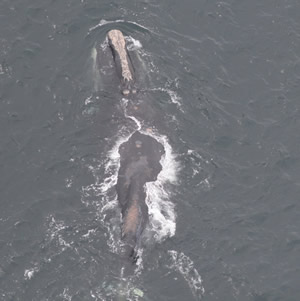
And here’s a recent picture of Admiral, the right whale matriarch of Maine waters. it’s dated last April 7th, and is the last known picture of her.

Whales_admiral

NPR Answers Questions on Climate Change

NPR science correspondents take questions from listeners on climate change — an excellent idea.

One question they answer I heard asked to Bill McKibben just two weeks ago, about the effect of population on global carbon emissions. McKibben made a strong point that NPR glosses over in their answer.

Most of the population growth in the world is occuring in the third world. Nations that emit a lot of carbon–such as ours–are growing relatively slowly. McKibben pointed out that in places like Tanzania, folks emit very little carbon; in fact, he said, the average American emits more in two days than most folks in Africa emit over the course of an entire year. So the real danger is not so much population growth, but that other peoples will emulate our way of life.

But here’s another contrarian question that comes up a lot:

And my question is what is the advantage to trading in my car and buying a hybrid, since someone else will be driving my car, and since there is a lot of energy expended in building a hybrid – a lot of carbon dioxide emissions, I would assume.

— Celeste Budwitt-Hunter of Houston —

Robert Siegel: Now, Jennifer, as you’ve told us, that factory that is making the hybrid back in Japan is using up a lot of energy and is sending up a lot of emissions. So how does the equation work out?

Jennifer Layke: Well, actually, from the perspective of a life cycle of emissions for an automobile, the majority of the emissions actually occur in the use phase, so it makes a big difference what you decide to drive.

So an average car in the United States, if you look at an average car for a sports utility vehicle, for example, you emit a ton of CO2 when you drive about 1,300 miles – that’s 1,300 miles; we drive about 12,000-14,000 miles a year. An average hybrid will emit one ton if you drive 6,000 miles, so it’s quite a significant difference in terms of your annual driving.

Try to Praise the Mutilated World

A Ventura County poet, Mary Kay Rummel, sends along the following spectacular poem from the great Polish poet Adam Zagajewski. It’s called Try to Praise the Mutilated World:

Try to praise the mutilated world.

Remember June’s long days,
and wild strawberries,
drops of wine, the dew.

The nettles that methodically overgrow

the abandoned homesteads of exiles.

You must praise the mutilated world.

You watched the stylish yachts and ships;

one of them had a long trip ahead of it,

while salty oblivion awaited others.

You’ve seen the refugees heading nowhere,

you’ve heard the executioners sing joyfully.

You should praise the mutilated world.

Remember the moments when we were together

in a white room and the curtain fluttered.

Return in thought to the concert where music flared.

You gathered acorns in the park in autumn

and leaves eddied over the earth’s scars.

Praise the mutilated world

and the grey feather a thrush lost,

and the gentle light that strays and vanishes

and returns.

(Translated by Renata Gorczynski)