Global Warming: NYTimes Editorial and LATimes News Disagree

The New York Times editorial board:

the world’s most authoritative voice on climate change asserts that significant progress toward stabilizing and reducing global warming emissions can be achieved at a relatively low cost using known technologies.

The Los Angeles Times front-page story:

A United Nations panel on Friday released its most comprehensive strategy to avoid the catastrophic effects of global warming, but experts said political and economic realities likely doom it to failure.

Hope vs. Experience? Propaganda vs. Fact?

I must say, the idea that reducing the very real and escalating risks of climate change will be easy seems to me to be fatuous. Is it wrong to say so? (That’s not what the NYTimes editorial actually says, to be fair, and the risks of the do-nothing policy the U.S. is following at present are huge, but the implication remains.)

For those of us who believe in facing facts, this conflict (between the low chances for real action and the apparent need to claim real action won’t be difficult) will not go away.

Then (by Gary Snyder)

April was poetry month. I didn’t take enough advantage. Here’s one for May. From Gary Snyder, and his book of uncollected poems called Left Out in the Rain: New Poems 1947-l985

THEN

When everybody in the world has a car
and nobody knows the smell
people will be amazed at our carpentry
all the deer in zoos
they’ll remember wild animals and trees
call their housecats "tiger"
dream of the days
when men were poor and dirty–
it was great–
beggars, the wine-red saris
of outcaste Indian girls
lean hunger in the rain
–we were
alive, then

Alexander Cockburn: Leftist Writer…and Denier

Alexander Cockburn, whom I grew up reading in the Village Voice decades ago, is a leftist, a Nader supporter, and a clever rhetorician, but–judging by this slab of denialism–a poor reporter.

He takes one metaphor, which is the idea of carbon trading as a practice comparable to the Papal indulgences of sin, and one source–an explosives expert named Martin Hertzberg–and from this concocts a bizarre piece arguing that "it is impossible to assert that the increase in atmospheric CO2 stems from human burning of fossil fuels."

Simply put, to sweep aside the work of hundreds of scientists and thousands of papers based on a single retired professor is not journalism. It’s arrogance.

Fortunately, a commentator on a real Real Climate post (#78) catches one of Cockburn’s mistakes. Cockburn writes, based on his professor’s work:

#78 "The two lines on that graph proclaim that a whopping 30 per cent cut in man-made CO2 emissions [because of the Depression] didn’t even cause a 1 ppm drop in the atmosphere’s CO2. Thus it is impossible to assert that the increase in atmospheric CO2 stems from human burning of fossil fuels.""

The commentator replies:

Cockburn is assuming the amount in the air is directly proportional to the input from the US. It isn’t. His 0.9 gigaton burn in 1933 was half absorbed by the ocean, and has to be compared to the 600 GT or so then in the air. To expect a 33% drop or increase is asinine. The man doesn’t understand the difference between total ambient CO2 and added CO2. Like saying if there’s 15 gallons in your car’s fuel tank, and you put in 2 extra gallons, then only one, the amount of gas in your car should suddenly be cut in half.

Comment by Barton Paul Levenson — 29 Apr 2007 @ 2:06 pm

But one could also point out that in his single-minded focus on the atmosphere, Cockburn completely ignores the fact that 84% of the warming of the earth due to the greenhouse effect is stored in the oceans, according to a ten-year study, involving thousands of buoys measuring temperatures at various depths. Might that warming not have some effect on the climate in years to come, Mr. Cockburn?

Radiant_energy_balance

Global Warming May Increase Atlantic Wind Shear: Break Up Hurricanes, Reports Study

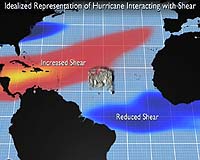
"April 18:  Climate model simulations for the 21st century indicate a robust increase in wind shear in the tropical Atlantic due to global warming, which may inhibit hurricane development and intensification. Historically, increased wind shear has been associated with reduced hurricane activity and intensity."

So reports Gabriel Vecchi and Brian Sobel in the Geophysical Research Letters for April 18th. Potential good news, by God, complete with a helpful graphic from TerraDaily (via NOAA/GFDL) under the headline "A Change in the Wind." Still too model-based to hang your hat on, but worth reporting.

Hurricaneincreasedwindsheareffectat

A Thoughtful Conservative (really!) Contemplates an Environmental/Political Realignment

Rod Dreher, who edits the Dallas Morning News opinion page, and who last year published a wonderful book called Crunchy Cons, today posts a characteristically long, thoughtful, passionate discussion of how voters concerned about the environment may be in a mood to punish the Republican party. He’s not surprised and thinks such punishment may well be deserved. To wit:

…conservatives have got to engage in a genuine, non-cynical way with environmentalism, not only to bring a balanced perspective to the policy debate, but also to stay relevant to younger voters. We have got to get beyond knee-jerk sneering at environmental concerns. Of course the green left goes too far at times, but that doesn’t make environmentalism itself a nonsense issue. The frustrating thing to me as a conservative is that there’s so much unthinking hostility to environmentalism among right-wing opinion leaders. It’s often considered a litmus test of conservative authenticity: if you don’t reflexively mock environmentalism, your conservative credentials are suspect.

I disagree with Dreher on many important points, but his blog is an outpouring of awesome proportions, quite capable of changing minds and challenging all sorts of set opinions. Thank God for that.

Why Can’t American Forecasters Be This Frank?

The New York Times reports record high temperatures in Europe:

PARIS, April 30 — The month of April was so warm and so dry across Western Europe that it rewrote the weather record books in country after country, national weather services said today, as hot air masses from Africa and the effects of a changing climate combined to drive up temperatures and drive away rain.

April 2007 was the eighth consecutive month of higher-than-normal temperatures in Germany, and the 13th straight month of unusually warm conditions in France.

Reporter James Kanter then quotes a French forecaster, who declares bluntly:

“The sustained period of above-average temperatures across a number of countries is undoubtedly linked to global warming,” said Patrick Galois, a forecaster at Metéo France. May, June and July are also expected to be unseasonably warm, Mr. Galois said.

Why can’t American forecasters speak so plainly? When we had a three-week heat wave in California last summer, with temperatures reaching 118 degrees in the San Fernando Valley, forecasters were uniformly loathe to say anything more than the usual "this is not inconsistent with global warming, but of course we had a 117 reading back in l953, so blah blah blah– "

Yesterday yours truly had the chance to see Bill McKibben speak on his new book, Deep Economy. I asked him a question–essentially, is global warming made in the USA?–and he said yes, it is. He added Europe accepted global warming ten years ago, while we here in America are still struggling with ExxonMobil.

The unwillingness of American forecasters to make the connection between heat waves and global warming is a good example of ExxonMobile’s success and our unwillingness to face the facts.

Here’s Heat_wave_baby_photo_2
 how one European feels about summer in April:

The Power of Beauty: Sunday Morning on the Planet

This month Sierra magazine features a photographer named Elizabeth Carmel. She’s a little different from the usual nature photographer, in that she uses digital technology, and freely works "to make images that match her memories."

Some of her images are so spectacular they seem a little unreal, or "dreamlike," as the story puts it, but they’re mighty hard to resist, and I treasure a quote she has on one of her sites:

"Beauty reminds us there is hope. Beauty sustains us. Beauty restores us.
The world is extraordinarily beautiful."   
John Paul Caponigro

Elizabeth_carmel_stream_photo


The Precarity

Half the people I know don’t have real jobs, or don’t have real jobs most of the time. Maybe it’s even more than half, as most of the people I know are writers, journalists, readers, artists, that sort of folk. I have been fortunate to have a real job reading scripts, but how much longer it will last, I have begun to doubt.

It’s been hard on me.

But last week I came across a nice story in the LAWeekly about a folk singer named Peter Case. Case has been living as a freelancer–mostly on the road–his whole life. He has a book out, numerous records, and he’s moderately famous. (You can hear a full sample of the wonderful Zero Hour from his Plimsouls garage band era on MySpace, but he’s a Mississippi John Hurt-influenced folkie these days, and a good one: check out his guitar playing on "When the Catfish is in Bloom" on iTunes.)

He has a way to describe living the expressive life without a real job: he calls it "The Precarity."

There’s a new word for the freelance life now — it’s called precarity. And what it refers to is that people who are freelance, they can’t tell if they’re working 24/7, or if they’re unemployed. What we’re up against now is an era where everybody’s time is completely dominated, and everybody’s working for free.

There’s a lot more to the piece. Take a look at the interview by Dave Schulman. Here’s Peter Case:
Peter_case_by_greg_allen_2005_2


Bush Administration “Flipping the Bird to the World,” says Former EPA Chief

That’s according to Christine Todd Whitman, the first EPA head for the Bush administration, who like European nations and many other fundamentallly decent folks, believed the Prez when he said on the campaign trail in 2000 that he would reduce CO2 emissions to control global warming.

She blames Dick Cheney.

On a tough-minded Frontline program called Hot Politics that is already making waves for its relentless interview with Republican pollster and strategist Frank Luntz, Whitman says that the Bush administration was surprised that its abrupt, unilateral about face on CO2 emissions caused so much controversy. But she adds that they didn’t much care, either.

I’m not sure they understood how big a reaction it was going to be, and I’m not sure it would have made much of a difference if they had… The way it happened was the equivalent to flipping the bird, frankly, to the world, about an issue about which (the world) felt so deeply.

She points the finger at Cheney, as did Bush’s first Treasury Secretary Paul O’Neill, who says in "The Price of Loyalty" that Cheney spiked his efforts to launch an anti-CO2 initiative within the administration.

"Flipping the bird to the world." Sounds like Cheney speaking to Pat Leahy on the Senate floor, doesn’t it? More soon as I see the program.

(HT:    Dateline Earth)