Newsweek Blesses Richard Lindzen, Ignores Pay-Offs from Western Fuels

Tomorrow Newsweek will publish an op-ed by well-known climate-change contrarian Richard Lindzen, in which he argues that global warming is nothing to worry about and may even be a good thing.

"Why So Gloomy?" he wonders, adding "a warmer climate could be more beneficial than the one we have now." Reminds me of Voltaire’s famous idiot Pangloss, who insisted that "It is proved that things cannot be other than they are, for since everything is made for a purpose, it follows that everything is made for the best purpose."

But enough philosophizing. For more–and a truly first rate discussion exposing this guy in detail–please see my post on Grist.

And thanks David, for the tip!

Dumb, Dishonest Deniers

The sharp-eyed Glenn Greenwald finds the right riposte for deniers who claim that storms–especially storms in the Northeast–disprove global warming. Well put, Mr. Greenwald!

clipped from www.salon.com

(5) Although it is a heated competition, I think the single dumbest and most intellectually dishonest rhetorical tactic — wielded most prominently by Drudge but with plenty of followers doing the same — is from those who cite cold weather conditions on a given day in order to impliedly discredit the worldwide consensus of climatologists and other scientists on global warming. It would be as if someone constantly linked to individual obituaries as proof that world population is not really growing. It is that dumb and dishonest.

  powered by clipmarks blog it

Real Hurricane to Hit New York on Tax Day?

That’s what Dr. Jeff Masters, a forecaster’s forecaster, is suggesting. Category 1, mind you, but still!

If the worst case scenarios of the models come true, the Tax Day Storm of 2007 could cause extensive moderate to severe coastal flooding, costing hundreds of millions of dollars. The areas at highest risk appear to be New Jersey, New York (especially New York City), Connecticut, Rhode Island, and Massachusetts. Heavy snow is not expected along the coast, but heavy rains may cause flooding problems. As usual, there is considerable uncertainty about the exact track and intensity of the storm, and we’ll have a better idea Friday what might be in store for New England. However, I believe there is a greater than 50% chance that this Nor’easter will be strong enough to cause significant storm surge flooding along the New England coast. Damages of at least $100 million are likely.

(My italics. GFS  model results for this Monday.)

Storm_forecast_for_tax_day_by_gfs_m

The Taxing Solution to Global Warming

A carbon tax is not a new idea; heck, The Economist proposed a carbon tax to reduce greenhouse gas emissions in l998. But the fact that a few idealistic conservatives (yes, the species still exists) are backing a carbon tax now is news. Especially since just two years ago Andrew Sullivan, the leader of the pack, was actively doubting the threat of climate change.

Better late than never, I say.

Among enviros, the consensus is that any tax actually able to reduce emissions substantially would be politlcally impossible to enact. I’m not so sure. I’m no expert, but I like the transparency of the idea, and its potential to change public attitudes from the bottom up.

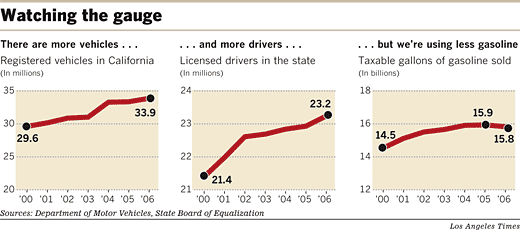
An example: in California, where we love our cars, and where public transportation is reserved mostly for the poor and the young, the rise in gas prices has resulted in a leveling off of gas consumption since 2000…despite millions more drivers and vehicles. They said it wasn’t possible, but it is!

[graphic from the aforementioned LATimes story, drawn from state statistics]

Gas_consumption_in_california_2000_

NO MORE WATER: Scientists, Oak Trees Predict Drought

Oak_tree_in_drought_4

After an unusually dry winter, experts in climate and weather are predicting drought for Ventura County and Southern California.
   
    Southern California experienced the driest fall and winter in over a century, according to the National Oceanographic and Atrmospheric Administration, and the drought is expected to continue and widen across the region.
    “The outlook for any significant drought improvement from now through spring looks grim for not only southern California but for much of the Southwest as well,” said Douglas LeComte, who forecasts drought for NOAA from his office in Maryland.
   
    Equally bleak but more colorful is Bill Patzert, who works at the Jet Propulsion Laboratory in Pasadena, and is known as "The Prophet of California Climate."
   
    "When in doubt," Patzert advises weather forecasters in Southern California, "vote for drought."
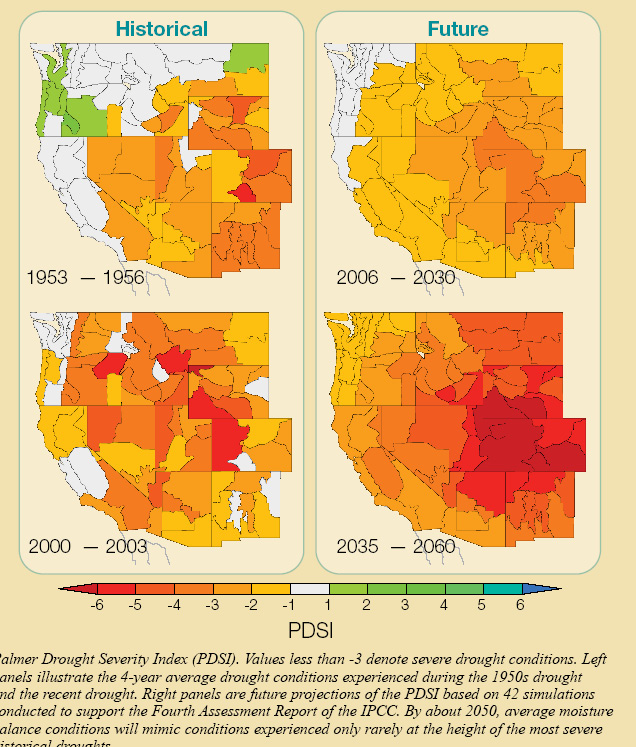
     Most alarming of all is the conclusion reached by NOAA researcher Martin Hoerling, who compiled climatological studies on the Southwest for the fourth  international scientific report on global warming, to be issued in full this year. Because drought is a measure of not only of rainfall but also of temperature and plant transpiration, and because temperatures are rising inexorably across the Southwest due to global warming, Hoerling in a paper (pdf) for Southwest Hydrology wrote that "a near perpetual state of drought will materialize in coming decades as a consequence of increasing temperature."

THE EXTREME MAKEOVER OF CALIFORNIA


    According to Henry Diaz, who has been researching meterological records in the West for NOAA since the l990s, temperatures in mountains across the Southwest have risen about two degrees Fahrenheit in the last 30 years. Snows in the high mountains are melting about two weeks earlier than in the past.  At lower elevations, such as in Ventura County, the temperature rise has been less, but Diaz says that the Southwest has been in a drought since l999.
   
    "We had a little bit of a reprieve in the last couple of years, which brought us closer to normal," he said from his office in Colorado, speaking of the heavy rains of 2005 and the near-normal rainfall of 2006. "You know precipitation is going to go up and down, week by week, month by month, year by year. But because of the warmer temperatures we have been observing in the Southwest over the last thirty years, we expect higher plant transpiration, with lower levels of soil moisture and recurring drought. This drought is consistent with that overall pattern of higher temperatures."
   
    Patzert looked at records from over 330 weather stations throughout California for the past thirty years for Climate Research and found temperatures had risen nearly two degrees Fahrenheit in the last thirty years, and much faster in urban areas, with Southern California rising fastest of all.
   
    "It’s definitely warmer in L.A.," he said. "Since May it’s been almost five degrees warmer Fahrenheit, versus a thirty-year historical average. We’ve had a lot of unusual Santa Ana conditions, and we’re now in an all-year fire season. I had one of my students look at extreme heat days, which means more than 90 degrees, and he found that we have on average 22 more extreme heating days than a hundred years ago. Our heat waves used to last three or four or five days. Now they can last two weeks. In the last one 180 people died. We’ve had less rain, more extreme heating days, and longer heat waves. I call it the Extreme Makeover of California."   
    Terry Schaeffer, a meterologist who has been advising Ventura County farmers on weather conditions since the l970s, hasn’t seen the same degree of heat change in Ventura County. But to explain the current drought conditions, he points to an oceanic trend called the Pacific Decadal Oscillation. This ocean trend can cause longer-lasting La Niña episodes (which usually bring drier winter conditions) and shorter El Niño episodes (which usually bring wetter winters).
    “The theory is that we’re going into a 25- to 40-year drought cycle,” he said. “Not every year will be a drought year, but the majority will.”

IS VENTURA COUNTY PREPARED?


    To citrus rancher Jim Coultas of Ojai, global warming means rising costs.
   
    "I’m in agriculture. I depend on a well and a hookup to Casitas reservoir, which costs about 10% more a year," he said. "As the level in the aquifer drops, you get less water out of the soil, and as the temperature goes up, you have to irrigate more. Absolutely that concerns me."
 
    Richard Handley, who serves on the board of the Casitas water district in Ojai, points out that from l910 to 2000, spring run-off from the Sierras decreased 10%. Since the Sierran snowpack supplies much of the state’s water, including about 40% of Ventura County’s needs, he thinks we will all have to make some changes.   
   
    "Global warming is only just now something that people are accepting as fact," he said. "It’s sort of like flying by night without radar."
   
    Handley is encouraged by some recent developments, including the removal of water-guzzling exotic species such as arundo dorax from streambeds. He points out that Ventura County survived a seven-year drought in the late 80’s and early 90’s with conservation measures.
   
    Russ Baggerly, also a water district official, thinks the time has come to rethink some of the conservation plans developed at that time.
 
    "Everybody works hard at dealing with water," he said. "The problem is that a lot of the thinking is out of the past and perpetuated into the future. We need to find a way to get a lot of different water companies to work together appropriately so that during a drought we don’t run out."

A DRY SUMMER–BUT NOT A HOT ONE?


    Although Patzert flatly predicts the hottest summer ever in Southern California, the next couple of months in Ventura will likely remain cool and foggy, thanks to the influence of the Pacific Ocean.
    "L.A. was drier than ever this year, and we were dry in Ventura County, too," said Kent Field, an air quality control meterologist for Ventura County. "But does that portend a long, hot summer? We could have low clouds and fog all summer, like "the summer that never was" we had here back in the l990’s."
        Schaeffer points out that "as the pendulum swings into a La Nina period, with cool ocean waters, that is likely to enhance our fog in May and June."
    
    But why should we listen to climatologists and meterologists? Aren’t these experts the same people who this past fall predicted an El Nino condition, with the likelyhood of significant rainfall?
   
    NOAA did predict an El Nino year this past fall, based on ocean observations, with an expectation of above-average rain and snow. Historically, for our coastal region, El Nino years average about 125% of precipitation.

    Yet not all NOAA employees–including Patzert and LeComte–had confidence in the consensus prediction. LeComte said he was "nervous" about the rainfall projections, because for his work as a drought forecaster he looks at a variety of forecasting tools, some based on soil moisture levels, and the soil moisture numbers were not corresponding with the predictions based on ocean studies.
 
   Patzert had a more personal reason to doubt the forecast. In his backyard he has an old oak tree, and for years he has noticed that the tree seemed to drop far more acorns before wet years than dry years.
     This past fall his tree produced virtually no acorns.
   
   Could an oak tree foresee a weather pattern that scientists couldn’t?

NATURE KNOWS THE SIGNS

    Patzert wasn’t the only Southern Californian to notice the lack of acorns this fall. Dave White, who worked for several years as a tree-trimmer in Ojai while becoming a science teacher, also noticed a connection between acorn drop in the fall and rain in the winter.
 
    "Two years ago it was uncanny," White said, "The trees produced a huge amount of acorns before we had those big rains. I asked my tree-trimming buddies about it, and they noticed the same thing. This year I could hardly find an acorn and so I thought, okay, we’re not going to get much rain."
   
    How could an oak tree predict rainfall? One possibility: a tree could sample the level of moisture in the soil over the course of a year and use that trend to guesstimate rainfall over the course of an upcoming season. Statisticians for NOAA and other forecasting agencies have been compiling historical measurements of soil moisture, called "constructed soil analogues," which match soil moisture records at given locations and time periods with rainfall and temperature records. The resulting outlooks are purely statistical, based on past experience, and available on the web. Although not yet approved for public use, LeComte says they are about as reliable as traditional methods for drought forecasts.
    "Forecasting skill is fairly modest for all our products," he said. "But when I’m forecasting, I give the statistical models about equal weight with the ocean models. I think their performance is pretty close, and I think in the future we’re going to need to work with more than one kind of forecasting tool."
   
     Patzert is blunter.
    "Well, my tree was certainly right this year," he said. "It was more prophetic than NOAA. 1500 civil servants could not compete with one hundred-year-old oak tree."

(This is the linked version of the story: for slightly edited unlinked version, see the Ventura County Reporter.)

Our_future_drought

Kurt Vonnegut: The Master Who Insisted on Modesty

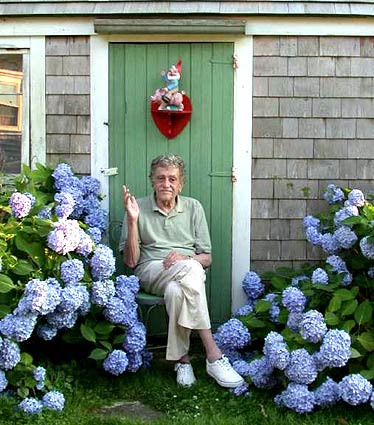
Kurt Vonnegut, perhaps the most-taken-for-granted of all our writers, died this week. No one has yet captured his unique blend of free thinking and self-deprecation, I think, although Tom Watson comes close for newcritics. For me, Vonnegut’s greatness came out of an unblinking insistence on the foolishness of arrogance, be it personal, military, or planetary.

A couple of quotes not to be forgotten; the first, from David Ulin‘s appreciation this morning in the LATimes:

"The good Earth — we could have saved it, but we were too damn cheap and lazy."

And from an interview last year in Rolling Stone:

"I’m Jeremiah, and I’m not talking about God being mad at us. I’m talking about us killing the planet as a life-support system with gasoline. What’s going to happen is, very soon, we’re going to run out of petroleum, and everything depends on petroleum. And there go the school buses. There go the fire engines. The food trucks will come to a halt. This is the end of the world. We’ve become far too dependent on hydrocarbons, and it’s going to suddenly dry up. You talk about the gluttonous Roaring Twenties. That was nothing. We’re crazy, going crazy, about petroleum. It’s a drug like crack cocaine. Of course, the lunatic fringe of Christianity is welcoming the end of the world as the rapture. So I’m Jeremiah. It’s going to have to stop. I’m sorry."

Also from the LATimes, this lovely picture taken by his daughter Edie last year:

Kurt_vonnegut_by_edie_vonnegut_vi_2

Conservatives Bicker over Global Warming: Businessmen Lead

It’s the strangest thing: conservatives, Republicans, and partisans on the right continue to squabble over global warming–is it real, should we act?–even as huge corporations call for exactly the sort of emissions-reductions measures that Al Gore and countless other Democrats want to see enacted.

The latest example is the third-largest American oil company, now known as ConocoPhillips, once known as Union 76. After years of doubting the science, this week they called in Washington for legislation to reduce greenhouse gas emissions, preferably a "cap-and-trade" program. CEO Jim Mulva told the Toronto Globe and Mail and other newspapers in a conference call that they want to be regulated:

"At our company, we believe that the science is quite compelling and that climate change is certainly attributed to human activity and to the substantial use of fossil fuels in terms of emissions. We believe quite strongly that now is the time we need a national, mandated framework to handle and deal with climate change."

The Wall Street Journal [$] cast a somewhat jaundiced eye on this conversion, noting:

Companies like ConocoPhillips that are endorsing a federal global-warming cap are doing so largely in the belief that they can shape it to minimize the cost to them. Many companies, eyeing the proliferation of differing global-warming rules in places such as California and the Northeast, are concluding that a single nationwide cap will be less onerous than a patchwork of state rules.

A U.S. policy, they figure, would be easier to integrate into global-warming regulations being implemented in other countries where U.S.-based multinationals like ConocoPhillips also do business.

That integration would make it easier for companies to satisfy any U.S. obligation by buying cheaper emission "credits" from the developing world, where the cost of projects to reduce or offset fossil-fuel emissions is lower. ConocoPhillips’s Mr. Mulva stressed that his company wants a U.S. cap to "have linkages" to policies in other countries.

Nonetheless, the fact that huge corporations are on board for regulation of greenhouse gas emissions cannot be stated too many times, in this reporter’s view. When George Will claims that those who would reduce emissions to preserve our climate are fuzzy in their thinking, he never mentions corporations like ConocoPhillips, Caterpillar, Alcoa, Duke Energy, and the countless other corporations that are working with environmental groups to reduce emissions as part of USCAP.

Gee, I wonder why not? Could it be that it’s easier to incite right-wingers against Al Gore than against GE?

The Red Reef Trail

Plenty of climate change news today: John Kerry (who has run for President) and Newt Gingrich (who likely will) debated the issue live for two hours in D.C. Planet Gore-ites on the far right aren’t happy with Newt’s performance, so it must have gone well for Kerry, who for all his flaws as a candidate, has shown he’s a pretty decent debater.

But let’s spend a moment with the land. Specifically, with the Los Padres National Forest in Southern California, as seen in a painting by Robert Wassell. This painting, called "Red Reef 4/06," was painted on the trail long before the huge Day Fire. The land looks little like this now, I bet. But it’s worth remembering how it was for this artist…and I love the way he painted those clouds. It’s as if you can see the spin of the earth in the sky above.

Red_reef_trail_406_by_robert_wassel

Tracking the Biological Signal: Dr. Camille Parmesan

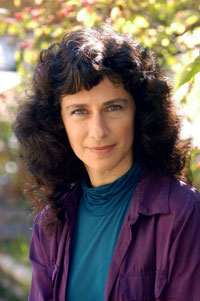
In the early l990’s, Camille Parmesan began studying an obscure butterfly named Edith’s checkerspot. Suspecting that it was responding to higher temperatures in California by shifting its range northward, Parmesan applied to NASA for a grant to study the butterfly’s response to global warming.

"So I devised a project to look for response to global climate change by looking at the whole species range all the way from Mexico to Canada and asking the really simple question, ‘Are we seeing it shifting its range?’ And NASA said, ‘Sure, go for it.’ And gave me three years funding to do this.”

Since then Parmesan has become an internationally recognized authority on the biological response to climate change. Now for the wonderful science program Earth and Sky, she writes a post on the latest work in the field.

We are seeing impacts of current warming on every continent and in every ocean. We’re also seeing very similar responses in very different types of organisms – from butterflies in Finland to fish in the North Sea, from foxes in Canada to trees in Sweden, from birds in Antarctica to starfish in Monterey Bay, California.

Forty-percent of wild species are showing changes in their distributions – shifting their ranges north and south towards the poles and up mountains. An astonishing 62% are showing changes in their seasonal timing: spring is earlier and fall is later. Birds arriving for their spring migration, butterflies emerging from overwintering, trees leafing out after winter dormancy and the first blooms of flowers are all about two weeks earlier than they were 30 years ago across the northern hemisphere.

Although some writers–notably Elizabeth Kolbert for The New Yorker–have brought up this aspect of climate change, in this commentator’s opinion it’s often overlooked. Perhaps that’s because we think  that butterflies can adapt to climate change, and glaciers can’t. But it’s my suspicion that we as animals ourselves find it easier to identify with living, breathing, fluttering creatures than bodies of ice, and might pay more attention if we looked more at the "signal" through the eyes of our fellow mortals…

Camille_parmesan_2

A Technical Note for Bookmarkers

If you’ve been so kind to bookmark me, thank you, but in order to see my new and improved site, you must do a little housekeeping. It’s easy and safe and, in fact, recommended on a routine basis.

Go to the "Tools" section of your browser, and clear out your cache. (Keep your cookies, your bookmarks, etc., of course.) Clearing out your cache will allow your browser to see this site anew.

Thank you…and please let me know if you have any problems.