Bee News and Views

A couple of weeks ago, based on a small study (pdf) at Landau University in Germany, it was widely reported that cellphones were causing disorientation among bees and a collapse of bee colonies.

The collapse of a high percentage of bee colonies around the country is real, but not unprecedented, and today–based on research right here in California–it’s being reported in the LATimes that the culprit is not cellphones, but a fungus.

Still, the truth is, the experts aren’t sure of the cause, and–to their credit–are willing to say so.

Researchers have been struggling for months to explain the disorder, and the new findings provide the first solid evidence pointing to a potential cause.

But the results are "highly preliminary" and are from only a few hives from Le Grand in Merced County, UCSF biochemist Joe DeRisi said. "We don’t want to give anybody the impression that this thing has been solved."

Other researchers said Wednesday that they too had found the fungus, a single-celled parasite called Nosema ceranae, in affected hives from around the country — as well as in some hives where bees had survived. Those researchers have also found two other fungi and half a dozen viruses in the dead bees.

The invaluable newspaper also runs a nice long story from Joe Robinson on bees in the garden. The story points out that living with bees is not difficult or dangerous, which is certainly our experience. We have plenty of all sorts of bees and wasps around, and have been stung only a handful of times in sixteen years, and almost always by wasps, not bees. Robinson talks to experts who offer tips on how to attract the three main species of inoffensive wild bees (bumblebees, wood-nesting bees, and solitary bees, which nest in the ground) to your garden. Mostly this means making sure they have flowers they like, such as lilacs. But also:

"If you can find a corner of your yard that can strategically be made messy, that works very well," entomologist Mace Vaughn suggested. "That helps provide nest sites for bumblebees. They need places where the ground’s not being turned over year after year. In my yard all I have to do is clear away some grass."

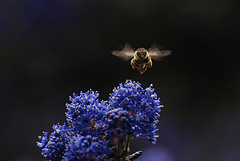
Need a messy place in the yard? Not a problem. Come on over, Mr. Pollen Pants.

UPDATE:    Onion Radio News has an announcement from the President about "those bees who are no longer with us."
Mr_pollen_pants_2

Rock and Roll Will Never Die–Even on a Warming Globe

Here’s some good news. The wonderfully un-great Spinal Tap will do a reunion gig as part of Al Gore’s rock concert series to raise money and consciousness against global warming.

"They’re not that environmentally conscious, but they’ve heard of global warming," [explained their number one fan Rob Reiner.] "Nigel thought it was just because he was wearing too much clothing – that if he just took his jacket off it would be cooler."

Rock on, Nigel!

Nigel_tufnel_of_spinal_tap

Global Warming Extinction: One Species Takes Note

Does Toles know something the rest of us don’t?

As far as I can tell, the GOP has little interest in global warming, and no interest in preventing the extinction of vast numbers of our fellow mortals. Despite the fact that numerous anecdotal accounts suggest that the younger generation is turning against the GOP, mostly that seems based on the war in Iraq. But Tom Toles, the Wa-Po editorial cartoonist might know more…I’ll search the Wa-Po site and see what I can find.

Toles_on_the_extinction_of_species

Happy Birthday, John

Here it is April 21st, John Muir’s birthday, and here is a quote from Muir’s notebooks about another great Scot’s birthday, Robert Burns. Like nearly all Scots, Muir was a huge admirer of Burns, and on his birthday in l906, wrote a long appreciation of him. Here’s the part I want to highlight, from the great "John of the Mountains," his unpublished journals, put out by biography Linnie Wolfe in l938:

The man of science, the naturalist, too often loses sight of the essential oneness of all living beings in seeking to classify them in kingdoms, orders, families, genera, species, etc., taking note of the kind and arrangement of limbs, teeth, toes, scales, hair, feathers, etc., measured and set forth in meters, centimenters, and millimeters, while the eye of the Poet, the Seer, never closes on the kindship of all God’s creatures, and his heart ever beats in sympathy with great and small alike as "earth-born companions and fellow mortals" equally dependent on Heaven’s eternal love.

And that’s the glory of Muir, who despite his remarkable scientific achievements, never lost sight of the "wee, helpless things," including the field mouse; the sheep, the cattle, the wounded hare, the "unfortunate daisy." The vastness of his love became the vastness of the landscape he loved, as in this picture of the Muir Pass from Yodod, looking back towards Lake MacDermand. Still miss you, Johnny.

Muir_pass_from_yodods_photostream

Rain! Snow? Rain! Okay, We’ll Take Anything

A couple of months ago, the last time we had any real rain, I was dreaming of enough precipitation to get the creeks flowing again. Didn’t happen. This morning we’re getting what may be the biggest rain of the year to date…in late April!

Chances of it starting the creeks in Ventura County (which takes about 10 inches, total) aren’t great, but here’s hoping…and thanks to my meterologist friend Brad for sending along a gorgeously colored picture from the NWS:

Snow_in_april

Environmentalism: What We Really Think

In New York magazine, Kurt Andersen has an excellent look at the state of environmentalism, based on a Gallup Poll that came out this week. The poll, in all frankness, doesn’t seem to have gotten much below the surface. It does indicate that a vast majority of Americans (89%) recycle, and a substantial majority have endeavored to reduce their energy use this past year (85%). But it doesn’t get into specifics, so it’s impossible to tell how serious these respondents really are about their stated beliefs.

Anderson’s analysis goes past the sketchy statistics, making two points that deserve to be remembered, even if the data to support them can’t be shown:

Americans have also come to take climate change seriously, I think, partly as a result of George Bush’s strenuous discounting of the problem. Since his administration’s main claims about Iraq have proved spectacularly false—the 9/11 connection, WMDs, Mission Accomplished, the insurgency’s “last throes”—an intuitive syllogism has naturally taken hold among Americans: If Bush asserts something, no matter how sincerely, then probably the opposite is true.

This goes along with Michael Tomasky’s theory (by way of Heraclitus) about Obama’s popularity: he’s the Anti-Bush. Makes sense to me.

Anderson also notices a strange similarity between two numbers:

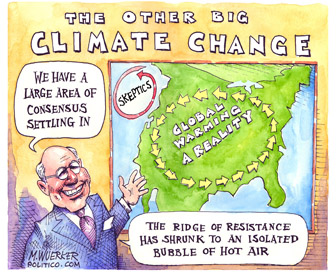
There is still a minority of dead-enders, those 27 percent of Americans who insist to Gallup that global warming is nothing to worry about now—a number strikingly similar to the fraction who approve of the job Bush is doing.

He concludes:

As a political matter, we probably have a decade to lock into place new regimes of regulation and market incentives. Which happens to be the same do-or-die time frame that a lot of scientists believe we have to start getting gassy modern life back in balance with the Earth’s natural systems. Not to put too fine a point on it, but this looks to be the ultimate test of our national character: Do we fat, spoiled 21st-century Americans have the requisite gumption and discipline to be born again, and then do what’s necessary to try to keep the planet from going off the rails? I’d say the odds are 50-50.

Consensus_settling_in_by_matt_wuerk

Farts vs. CO2: An Accounting

For years, Republicans have brought up farts to mock the concept of global warming. (For instance, this year in Congress, in response to testimony by four climatologists, Dana Rohrabacker of Orange County claimed that "Global warming could be the result of dinosaur flatulence.")

Now at last, Brian Beutler goes to the EPA statistics to weigh the comparative contribution. The stats on the post are a little hard to read, but:

For CO2, mostly from fossil fuels:             6,089,990 Gg,
(up from a little over 5,000,000 in l990)
For "entertic fermentation,: or cowfarts:  5,340 Gg
(down from 5,540 Gg in l990)

It’s not a one-to-one correspondence–raw methane-like emissions contribute more to the greenhouse gas effect in the short term–but nonetheless, we can with total confidence  say: enough with the b.s.! Compared to the burning of fossil fuels, cow farts are trivial!

And if you don’t believe me, take it from this guy. Or else.

Cow_by_felix63

The Ultimate Working Class

Gary Snyder just published a surprisingly charming book of essays called Back on the Fire. (I’d link to the excellent review by Thomas Curwen in the LATimes, but their freaking search engine can’t find it.)

Anyhow! In a characteristically tough-minded essay called "Writers and the War Against Nature," Snyder articulates a thought yours truly has long believed, but never stated so clearly.

In the Abrahamic religions, "Thou shalt not kill applies only to human beings. In Socialist thought as well, human beings are all-important, and with the "labor theory of value" it is as though organic nature contributes nothing of worth. Later it came to me, green plants doing photosynthesis are the ultimate working class.

Today in the NYTimes, Natalie Angier gives us a journalistic version of the same idea, along with a useful phrase to describe it: "plant blindness." Really, how blind can we be, not to see the likes of
this? (From approximately 619,000 examples available on Flickr.)

Flower_from_wuschl_on_flickr