Now the Chief Executive enters; the press conference begins: First the President lies about the date the Appalachian Mountains rose. Then he lies about the population of Chicago, then he lies about the weight of the adult eagle, then about the acreage of the Everglades He lies about the number of fish taken every year in the Arctic, he has private information about which city is the capital of Wyoming, he lies about the birthplace of Attila the Hun. He lies about the composition of the amniotic fluid, and he insists that Luther was never a German, and that only the Protestants sold indulgences, That Pope Leo X zuanted to reform the church, but the “liberal elements” prevented him, that the Peasants’ War was fomented by Italians from the North. And the Attorney General lies about the time the sun sets.
From 1973. Could he have described the tone of presidential address today more accurately? I doubt it.
Siddartha Mukherjee, who won the Pulitzer Prize for the magisterial “The Emperor of All Maladies,” a history of cancer, wrote in The New Yorker last month about the history of our ability to control infectious disease. The answer for one plague came came from the East, from an era before doctors and medical science. It’s a remarkable story. Mukherjee, an oncologist, explains:
As early as 1100, medical healers in China had realized that those who survived smallpox did not catch the illness again (survivors of the disease were enlisted to take care of new victims), and inferred that the exposure of the body to an illness protected it from future instances of that illness. Chinese doctors would grind smallpox scabs into a powder and insufflate it into a child’s nostril with a long silver pipe.
Vaccination with live virus was a tightrope walk: if the amount of viral inoculum in the powder was too great, the child would succumb to a full-fledged version of the disease—a disaster that occurred perhaps one in a hundred times. If all went well, the child would have a mild experience of the disease, and be immunized for life. By the seventeen-hundreds, the practice had spread throughout the Arab world. In the seventeen-sixties, women in Sudan practiced tishteree el jidderee (“buying the pox”): one mother haggling with another over how many of a sick child’s ripe pustules she would buy for her own son or daughter. It was an exquisitely measured art: the most astute traditional healers recognized the lesions that were likely to yield just enough viral material, but not too much. […]
Lady Mary Wortley Montagu, the wife of the British Ambassador to Constantinople, had herself been stricken by the disease, in 1715, leaving her perfect skin pitted with scars. Later, in the Turkish countryside, she witnessed the practice of [inoculation against smallpox] and wrote to her friends in wonder, describing the work of one specialist: “The old woman comes with a nut-shell full of the matter of the best sort of small-pox, and asks what vein you please to have opened,” whereupon she “puts into the vein as much matter as can lie upon the head of her needle.” Patients retired to bed for a couple of days with a fever, and, Lady Montagu noted, emerged remarkably unscathed. “They have very rarely above twenty or thirty [pox] in their faces, which never mark; and in eight days’ time they are as well as before their illness.”
She reported that thousands safely underwent the operation every year, and that the disease had largely been contained in the region. “You may believe I am well satisfied of the safety of this experiment,” she added, “since I intend to try it on my dear little son.” Her son never got the pox.
In short, long before what we know today as ‘Western medicine,” clever humans discovered the power of inoculation, by which our immune system is given the tools to recognize and target a particular pathogen. This method, standardized and updated scientifically, is the means by which we humans eliminated smallpox from the earth. A great achievement that has saved countless lives. It’s the same basic method — without using risky live viruses — by which medicine today hopes to foil COVID-19.
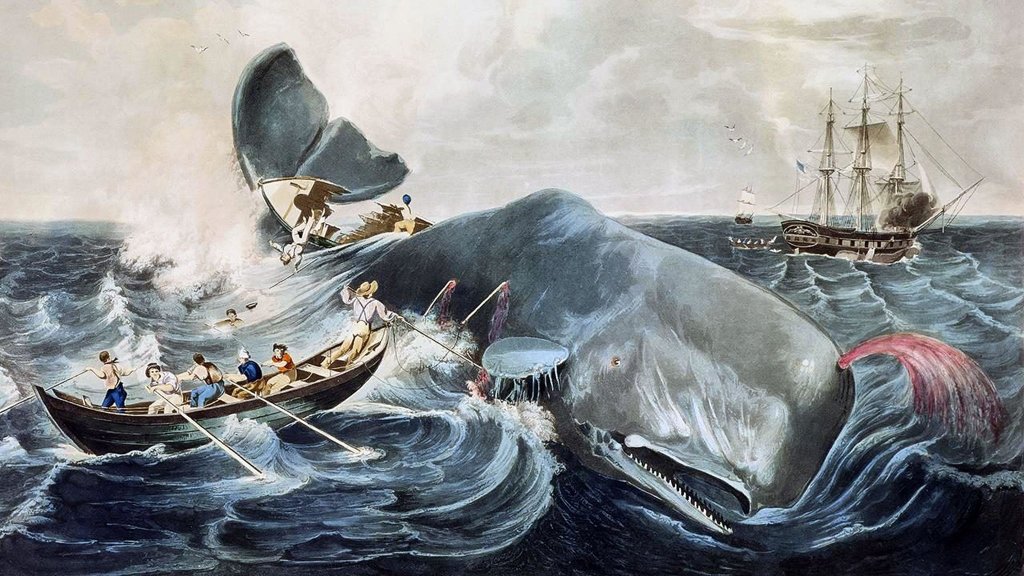
In a dazzling essay on the true story behind “Moby Dick,” Carl Safina reminds us of the opening of that great novel, in which the seafarer Ishmael meets Queequeg, a sailor of “cannibalistic” heritage. They are thrown into bed together, much to Ishmael’s discomfort, but he ends up respecting Queequeg all the more, after sleeping with him. It’s as great an introduction of a character as I can recall in American literature.
When Ishmael finds himself compelled to share a blanket at the sold-out Spouter Inn, he declares, “No man prefers to sleep two in a bed.” But he settles in, waiting for his mysterious South Seas roommate who, he’s informed, is peddling a shrunken head on the streets of New Bedford. Queequeg’s appearance terrifies Ishmael mute. But after things equilibrate, Ishmael reconsiders: “For all his tattooings he was on the whole a clean, comely looking cannibal … a human being just as I am. … Better sleep with a sober cannibal than a drunken Christian.”
In the morning Ishmael wakes to find Queequeg’s arm “thrown over me in the most loving and affectionate manner. You had almost thought I had been his wife.” Now there’s no panic. Eventually Queequeg rouses and, by signs and sounds, makes Ishmael understand that he’ll dress and leave. “The truth is, these savages have an innate sense of delicacy,” Ishmael editorializes. “It is marvelous how essentially polite they are. … So much civility and consideration, while I was guilty of great rudeness.” Reflecting on Queequeg’s tatted visage, he concludes: “Savage though he was, and hideously marred about the face — at least to my taste — his countenance yet had a something in it which was by no means disagreeable. You cannot hide the soul. … Queequeg was George Washington cannibalistically developed.”
“Just before midnight on March 22nd, the President of the United States prepared to tweet. Millions of Americans, in the hope of safeguarding their health and fighting the rapidly escalating spread of covid-19, had already begun to follow the sober recommendation of Anthony S. Fauci, the country’s leading expert on infectious disease. Fauci had warned Americans to “hunker down significantly more than we as a country are doing.”
Donald Trump disagreed. “we cannot let the cure be worse than the problem itself,” he tweeted.”
Today, May 11, 2020, let me post an update. This evening Dr. Fauci revealed in a New York Times story that he intends to warn that opening up the country now would cost lives and court disaster.
“The major message that I wish to convey to the Senate HLP committee tomorrow is the danger of trying to open the country prematurely,” he wrote. “If we skip over the checkpoints in the guidelines to: ‘Open America Again,’ then we risk the danger of multiple outbreaks throughout the country. This will not only result in needless suffering and death, but would actually set us back on our quest to return to normal.”
Dr. Fauci was referring to a three-phase White House plan, Opening Up America Again, that lays out guidelines for state officials considering reopening their economies. Among its recommendations: states should have a “downward trajectory of positive tests” or a “downward trajectory of documented cases” of coronavirus over two weeks, while conducting robust contact tracing and “sentinel surveillance” testing of asymptomatic people in vulnerable populations, such as nursing homes.
But many states are reopening without meeting those guidelines, seeking to ease the pain as millions of working people and small-business owners are facing economic ruin while sheltering at home.” (said the Times story)
Of course Fauci has called bullshit on Trump statements (such as calling testing “a failure”) before. One wonders if there’s a reason this statement was published the night before his testimony with three other experts before the Senate Health Education, Labor and Pensions Committee.
And from the President of the United States, we have this extraordinary inability to answer any question asked by a woman in the White House press corps.
How any American women can support this man? I cannot imagine. Ignore the commentary below if you like and focus on the well-staged president vs press confrontation. This clip is classic late capitalism:
Wow!! Trump ended today’s Press Conference with the obligatory nasty question comment, some Racism, some Sexism, A Tantrum, and finished with a special dash of Asshole.#TrumpDeathToll81Kpic.twitter.com/vj5EXAPnyF
Willie Nelson’s first-ever hit, now a classic country song. Performed here by Willie himself on Colbert, with his sons Micah and Lukas. Finale slightly rewritten for the moment:
We got to all stick together Or else we’ll lose our minds I got a feeling — we’re going to be here A long long time.
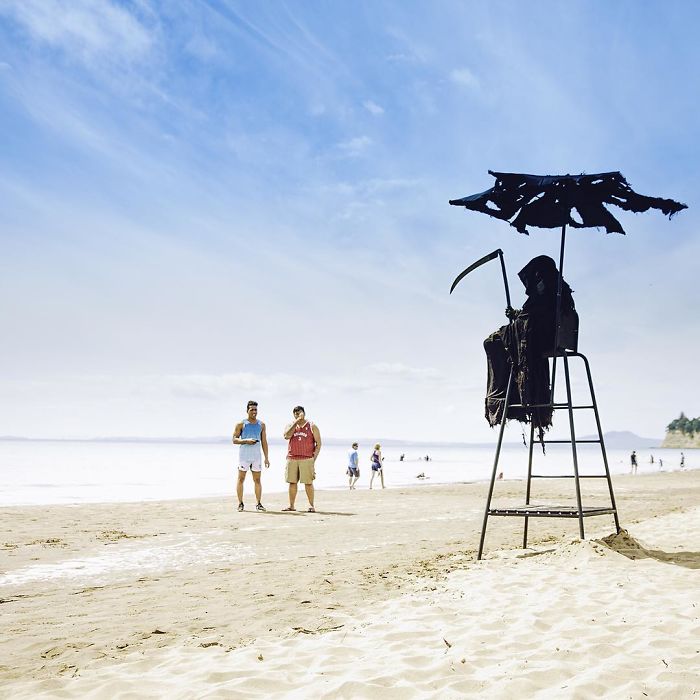
Inspired apparently by a 2017 anti-drowning public health campaign in New Zealand, an attorney and comic in Florida has launched a campaign for social distancing on Florida beaches. The particular and phenomenal work of living art above comes from the New Zealand campaign, but the similarly themed Grim Reaper tour is on now in Florida, and has raised over $5k so far for Democratic candidates.
Tbh, I think there is reason to open some beaches and parks, with health requirements, even in the midst of a pandemic, assuming a) a low level of disease in circulation, and b) confidence about that low level, c) public sanity. Plus, there is evidence that the virus is much less communicative outside. People need to be active to be healthy, as Public Health Officer Dr. Levin told me for a story on Covid in Ventura County today for VC Reporter.
“This is a time to control your co-morbidities, to get out there and walk and exercise and bicycle and do stuff and be active. Don’t use this quarantine to catch up on all the TV shows you’ve missed over the years.”
Ventura County Public Health Officer Rob Levin
Though many have criticized the county for this decision, to open Ventura county beaches for walking on a warm and beautiful day strikes me as an act of compassion and generosity. We are fortunate here. Let us share.
Yesterday I posted an interesting chart showing Ventura County at the bottom of a list of top 20 or so California counties for COVID-19 incidence and fatality rate. Today as a reporter I had the opportunity to speak to the designer of the web app, Dr. Chris Barker of UC Davis, about these numbers. He cautioned me on a couple of points, pointing out that for display reasons that chart was limited to the top 22 counties in California, so that Ventura County was certainly not at the bottom of the list of the state’s 57 counties.
I think you can see that more moderate assessment of the county’s success at suppressing the virus in this chart I found on the LA Times coronavirus data page.
At a glance, it’s clear from this graph that Ventura County is flattening the curve, reducing the rate of incidence. The rate of doubling is now 11.2 days, according to this same LA times web app. That is much better than for example Los Angeles, which is doubling every 7.8 days, and Santa Barbara. at every 8.3 days. Not to mention other Southern California counties such as Riverside, Orange, and San Diego. Hope to find a story here.
Okay, this is interesting. A new database tracking COVID-19 data in CA from UC Davis shows Ventura County at the bottom of the chart of a comparison of the incidence of COVID-19 in the top 22 counties in the state.
“Our point of departure was, we’re at an inflection point. The future isn’t some place ahead of us; we’re living in the future at this moment.”
So said Tim Sexton, describing the process of writing the 2006 movie Children of Men with director Alfonso Cuaron, explaining the harsh realism of tone that Cuaron went for. (Though not a success in its time, it’s now considered”a dystopian masterpiece,” and quite rightly so.)
I bring this seemingly random example up because, first of all, this is not the first time a prominent thought leader has said to me in recent months that “we’re living in the future now.” But mostly it’s this idea itself that resonates.
“Living in the future now” seems more real than ever, now that we find ourselves living in a sci-fi movie called COVID-19.
“Children of Men” goes on to offer a moment from the future that quite neatly matches one of our own this month. The difference is that the movie’s vision of this ghastly idea has allure and enticement. The conversation in our public square about it — a kind of self-euthanasia for the sake of the economy — seems crude by comparison.
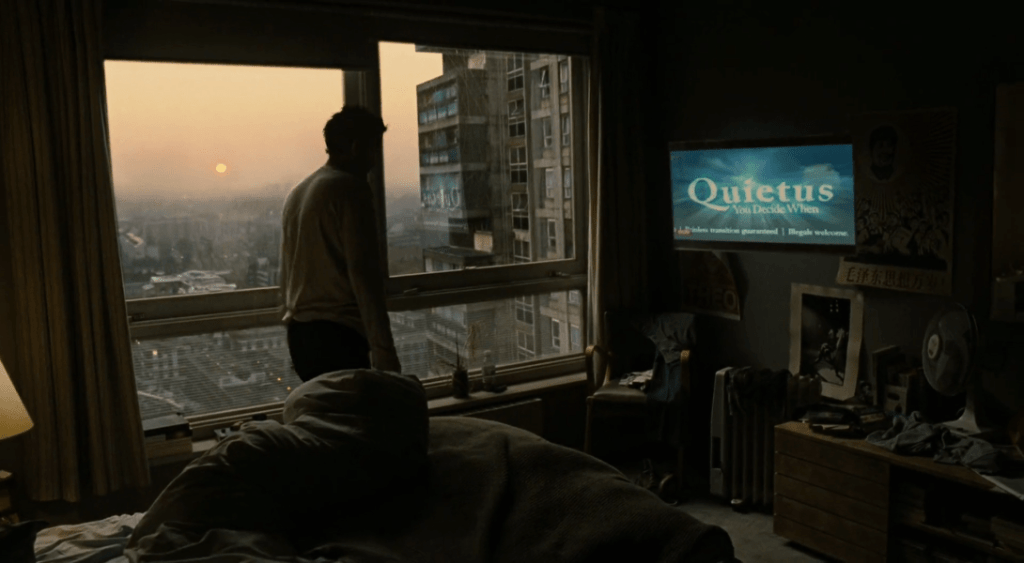
In the movie, we occasionally glimpse and are made aware of by advertising in the story a serenity-inducing product called Quietus, which in time turns out to be a package offering a painless suicide with benefits. A euthanasia for people without much purpose in life, in need of a graceful exit. This is what the ad looks like in the movie, courtesy of scifiinterfaces:
An advertisement for a self-euthanasia product from “Children of Men.”
It’s topical because just days ago the Lt. Governor of one of the largest states in the country blithely said that old people such as himself would be more than willing to risk their health for the prosperity of “the country.” ,
“Dan Patrick, Texas’ Republican lieutenant governor, on Monday night suggested that he and other grandparents would be willing to risk their health and even lives in order for the United States to “get back to work” amid the coronavirus pandemic.
“Those of us who are 70 plus, we’ll take care of ourselves. But don’t sacrifice the country,” Patrick said on Fox News’ “Tucker Carlson Tonight.'”
At least with the advertised Quietus, the seniors who chose that fate were guaranteed a painless exit and a substantial-if-not-enormous-sum given to the heirs. Funeral arrangements were also part of the deal, I think.
Dignity was the offer. As opposed to a boot out the door.
In other words, the bluntly dystopian science fiction future of “Children of Men” is much kinder and gentler than the Republican Party of 2020, at least as we hear spoken by the Lt. Gov. of Texas. Think of that!
The Ojai Valley News encouraged me while at a scientific conference in San Francisco last December to pursue a story about rainfall variability in Ojai and Southern California: here it begins.
“Last month was one of the driest Februaries ever in the recorded history of Southern California, according to the National Weather Service, with one-tenth of one inch of rain recorded for the entire month at the weather station in Ojai.”
Because all but that first sentence is behind a paywall that will exclude most of my readers, let me take the liberty of posting this story — an important one I think — and images in this post. Here it begins:
OJAI RAINFALL TURNS EXTREME — AND DRY
Last month was one of the driest Februaries ever in the recorded history of Southern California, according to the National Weather Service, with one-tenth of one inch of rain recorded for the entire month at the weather station in Ojai.
A vast ridge of high pressure across the breadth of the northern Pacific last month blocked storms systems from the north from reaching California. For the first time since 1864, no rain in February at all was recorded in the city of San Francisco.
Because February is usually the wettest time of the year, that means chances of locations such as Ojai in Southern California recording an average amount of rain this year has fallen to about 10%, according to projections compiled by hydrologist Mike Dettinger of UC San Diego and the Scripps Institute of Oceanography.
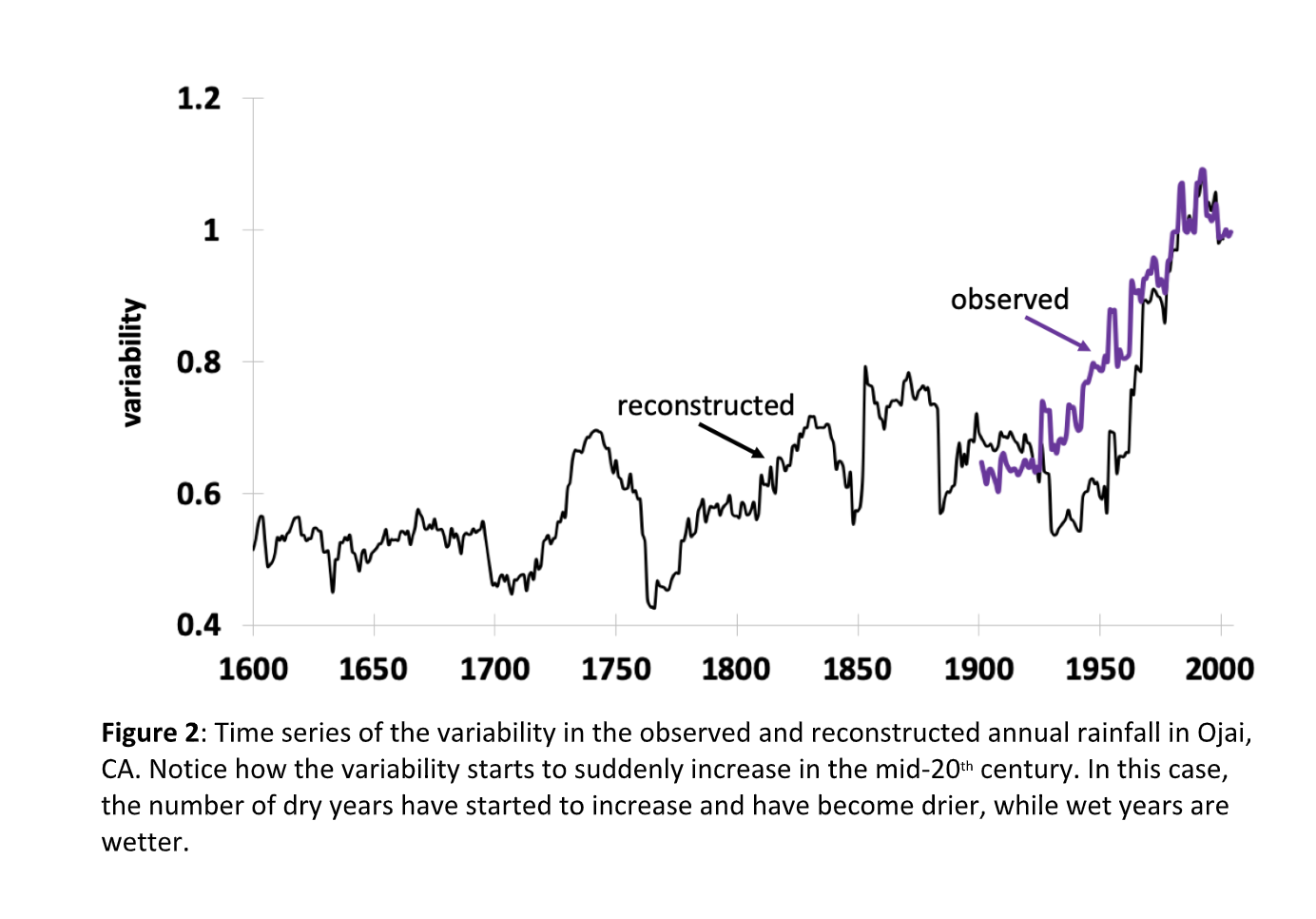
The plunge from a rainy December to a dry January, followed by a parched February, fits a pattern of extreme highs and lows that has been developing over the past sixtyyears, according to research into tree ring records from the University of Arizona that included tree ring research from the Pine Mountain area north of Ojai.
“These reconstructions [of annual rainfall using tree ring records] show that the recent increase in precipitation variability is unprecedented over the past 430 years,” wrote hydrologist Diana Zamora-Reyes in the abstract for her work presented at a scientific conference in December in San Francisco.
Diana Zamora-Reyes presented her tree ring research at the AGU conference in San Francisco.
“Water resources managers will need to incorporate this increased volatility into their planning for public and agricultural water supply, while being aware of the higher risks for wildfires and floods,” she added.
This research did not surprise water managers at Casitas Municipal Water District, given the severe drought suffered in the Ojai watershed from 2012-2016. “‘We had a major spike in drought this decade,” said General Manager Michael Flood. “Basically we did not have a whole lot of rainfall until this last year.”
Zamora-Reyes’ research incorporated other research from the University of Arizona’s well-known Laboratory of Tree-Ring Research, which was funded in part by the California Department of Water Resources (DWR). Dave Meko, another researcher at the lab, said that big cone Douglas Firs in the Mt Pinos region provide especially good records of droughts dating back to the 1580’s.
“In Southern California, a number of the reconstructions indicate that the 2012-2016 drought was the worst 5-year drought in the past six centuries, as measured by the percent of average annual precipitation or streamflow,” he wrote in a study prepared for the DWR at the end of 2017.
Scott Holder, a hydrologist with the Ventura County Watershed Protection District, pointed out that his district’s own records show the same volatility in precipitation in recent decades.
“The data we have, which dates back to a little before 1900, show that we have had the wettest years and the driest years in our record in the last twenty years or so,,” he said. “Our wettest year [in the Ojai region] was 1998, with 49.23 inches of rainfall, but our driest year was 2007, with just 7.43 inches. 2013 was the sixth-driest year on record, and 2014 was the seventh-driest year on record, but 2005 was the fifth-wettest year on record.”
Holder said that climate change is believed to play a role in the swing towards extremes in precipitation in Southern and Central California.
“There’s no conclusive evidence, but there’s a strong indication that climate change is at least somewhat responsible,” he said, adding that the amount of rainfall in Ojai to date this water year — about eight inches — says little about the total amount of rain to expect this year.
That point was echoed by members of the Board of Directors at Casitas.
“I was born in the Oxnard plain hundreds of years ago and if I’ve learned anything it’s that you can’t predict the rest of the year based on the rain you’ve received by January,” said Angelo Spandrio. “I don’t think that what we’ve seen so far is any indicator. We could have beautiful spring rains and we could get nothing. I’ve seen both.”
Michael Flood, the general manager, said that the district is preparing a new comprehensive water resources plan, incorporating the 2012-2016 drought, to be released probably at the end of this quarter. He said that the plan recognizes climate change as a factor to be incorporated in planning.
Russ Baggerly, who serves on the board of directors at Casitas and at the Ojai Basin Groundwater Management Agency, stressed the uncertainty water managers face.
“I’ve been to many seminars where scientists were talking about climate change,” he said. “The question is how things are going to change for us, and the answer is: nobody knows. The ultimate statement I took away from these presentations is that “Stationarity Is Dead,” meaning that we can’t rely on the weather repeating itself in some sort of past predictable fashion. Nobody knows what climate change will bring us. Some say that the rainy periods will be stronger and more violent, and some say they will be followed by droughts and wildfires that plague us forever.”
Daniel Swain, a leading research climatologist, said that climate modeling shows an increasing tendency towards divergent extremes of both wet and dry in Southern California. Though the total amount of rainfall is not expected to change substantially, it is expected to come increasingly often in bursts of hard rain.
“We’re living in the future now,” he said. “In California we do expect to see more dry days, and more dry days even in the wet season. We also have a projected increase in the wettest of wet days, but right now we’re seeing increased aridification during dry periods, and a later onset of the rainy season.”





 Kit Stolz