Being with the Trees (Sunday Morning on the Planet)

A commentator on a previous post asked for more poems about trees…here’s one I just found, courtesy of The Atlantic, by somebody named Robert Frost. This one seeps into a person, like its subject….

The Sound of Trees


I wonder about the trees:
Why do we wish to bear
Forever the noise of these
More than another noise
So close to our dwelling place?
We suffer them by the day
Till we lose all measure of pace
And fixity in our joys,
And acquire a listening air.
They are that that talks of going
But never gets away;
And that talks no less for knowing,
As it grows wiser and older,
That now it means to stay.
My feet tug at the floor
And my head sways to my shoulder
Sometimes when I watch trees sway
From the window or the door.
I shall set forth for somewhere,
I shall make the reckless choice,
Some day when they are in voice
And tossing so as to scare
The white clouds over them on.
I shall have less to say,
But I shall be gone.

=-Robert Frost

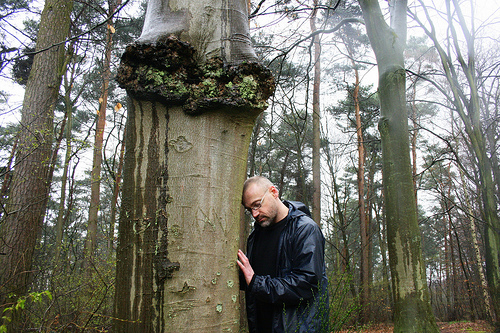
(photo from Luc de Leeuw, a Belgian photographer on Flickr)

Treefriend

ABC News: Planet Less Important Than Flag Pin

Today The New York Times introduces a new columnist, and a new idea of a columnist — a graphics columnist. And Charles Blow lives up to the billing by succinctly making an important point that his far-better-paid media peers at ABC and other television networks cannot seem to grasp. (Perhaps living in TV land makes a person think that the real world is made out of pixels.) Blow writes:

The League of Conservation Voters, an environmental watchdog group,
reports that in the debates in which five Sunday-morning television
anchors — George Stephanopoulos,Tim Russert, Wolf Blitzer, Chris Wallace, and Bob Schieffer — have participated (17
in total) and in their major interviews with the candidates (176 in
total) only eight of the 2,372 questions asked have mentioned global warming or climate change.

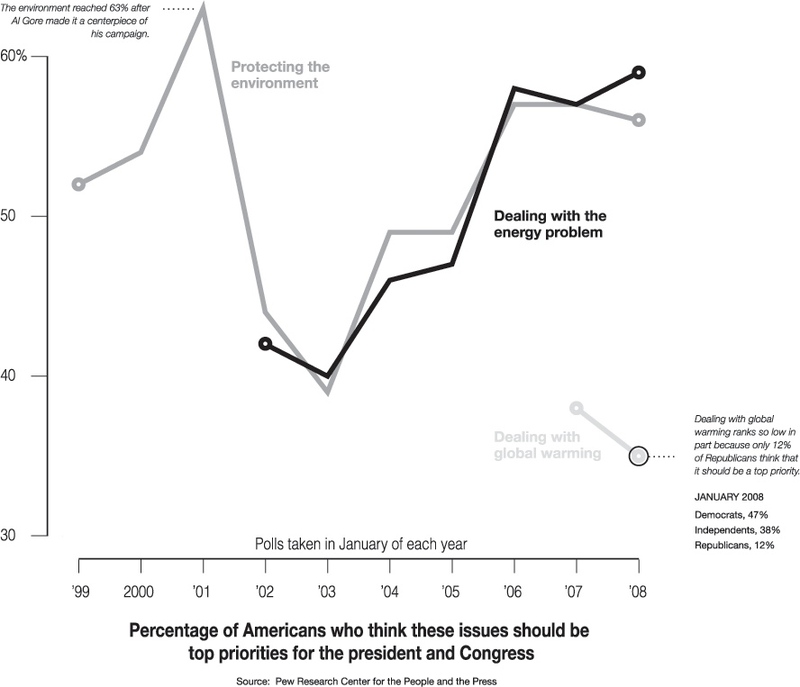
That omission is baffling because the environment has become a big issue for Americans. Nearly 6 in 10 people responding to a Pew Research Center poll in January said that protecting the environment and dealing with energy problems should be top priorities.

Americans
have awakened to some simple and frightening realities. The earth is
getting hotter. The world’s ice is melting. The sea level is rising,
and will continue to do so. How much? That’s the question. The answer
may largely depend on the course America takes, since we have been the
most egregious at treating the air like a sewer for carbon emissions.

Apparently, the moderators didn’t get the message. Instead they revived
a more trivial issue, allowing a question that called Mr. Obama’s
patriotism into question for not wearing a flag pin on his lapel.
Better to have tied patriotism to the environment and ask whose global
warming plan will best ensure that no one will ever have to go to Lower Manhattan and point to the spot in the water where ground zero used to be.

Globalwarmingimportancepoll

Fakes Right, Goes Left: Obama’s Favorite Move

Barack Obama became obsessed with basketball at one point in his life, not as a high schooler, surprisingly, but in law school.

You can see that love and skill in action if you watch the Bryant Gumbel special below on his game.

In the segment, for the first time on television since he was a kid, Obama plays. He wears a t-shirt and modest sweat pants. He plays in a funky gym with some servicemen and women, and helps win a game.

The move with which he wins the game is well-practiced, complex, and aggressive (but not hostile). He wins a game on a fake right, go left, spin back into the lane, bank-shot.

Take a look. Enjoy.

How natural Obama is; how much he obviously loves the game, how easily he becomes part of the flow.  He’s not a jump shooter, he’s a fast break guy, a get to the hoop guy. Your usual aggressive American.

Yet somehow he is unpatriotic, because he went to Harvard and taught at Chicago and lived in Hyde Park and served on a board with a man who in the 60’s was a radical.

It’s a "That’s not America" claim, and it’s bogus. No game is more American that basketball, invented in this country for something to do on cold Midwestern nights, Basketball, more than baseball, more that football, both of whom have root in English games, was born in the USA. And it’s a game that found a new identity, and a powerful one, when black men were allowed to play, and changed everything.

I recall teaching a class as a young man in story analysis, being attacked by a student angry about a bad grade I had given out, and because I was attacked unfairly, by sheer luck won the sympathy of the class.

Up until that point the class had been respectful but not especially involved. Suddenly they began to listen to what I had to say. I think this preposterous "debate," in which ABC attacked Obama for all the trivial issues it could think of for as long as it could, will make Obama a more sympathetic figure, not less.

Here’s hoping. And here’s Barack on the court:

When a Nobel Prize on the Mantle Is Really Useful

When is a Nobel Prize truly useful?

When you’re confronted in your field by something you don’t understand, and need to say: I don’t get it.

Recently a famous economist named Martin Weitzman of Harvard released a paper on "the economics of catastrophic climate change" that has experts around the world scratching their head in puzzlement.

Much discussion has ensued, but our understanding of the economic risk of climate change does not seem greatly advanced. It’s generally agreed that sudden, irreversible climate change has the potential to devastate our way of life, but no consensus has emerged on how to assess that risk. No one has experience with it, except perhaps some insurance companies.

Certainly major reinssurance companies such as the venerable Munich: Re are alarmed by global warming, and have made substantial investments in research into mitigation and other means by which we can protect against climate risk. In a statement issued two years ago they declared:

The extremely pronounced warming that has been observed
particularly in the past three decades cannot be explained simply by
natural influences. The scientists of Munich Re’s Geo Risks Research
Department are therefore certain that this global warming is man-made
and that it will have massive repercussions.
      

A survey of the years 1950-2005 reveals a massive
increase in major weather-related natural catastrophes during that
time. Between 1994 and 2005 there were almost three times as many
weather-related natural catastrophes as in the 1960s.
      

The trend is even more
distinct with regard to losses. Economic losses increased by a factor
of 5.3 in the same period, insured losses by a factor of no less than
9.6. The main causes in both cases were floods and windstorms. The
majority of fatalities, more than three-quarters, were caused by "wet
storms".

Weitzman’s paper begins with the admission by the IPCC that changes in the climate by greater than the consensus figures cannot be narrowed to the vanishing point.

To put it another way: it is generally agreed that global warming will melt the ice caps, but as leading expert Richard Alley put it at the last AGU meeting in December, the timing is still estimated in centuries, not decades. 

Weitzman asks the question: What if those changes were not as far away as we thought? 

In this paper I am mostly concerned with the roughly 15% of those "values substantially higher than 4.5C" which "cannot be excluded" [according to IPCC analysis].

In other words, there is a perhaps one in six or seven chance that global warming could be substantially worse than is usually estimated with a doubling of CO2 in the atmosphere: perhaps as much as 6-7 degrees Fahrenheit of warming averaged globally.

Sounds worth some thought, wouldn’t you say? But when Wietzman presented his paper, according to observer Common Tragedies, "Nobel prize winner Tom Schelling, one of the discussants at the
event, noted that he read the paper 5 or 6 times without ever feeling
that he was sure what it was saying."

It’s a difficult paper mostly written mathematically, with concepts about the bounding of the risk of catatrophic change difficult to absorb. (Find it here: On Modeling and Interpreting the Economics of Catastrophic Climate Change.)

Occasionally it does break into blunt, apparently understandable English:

I can’t know precisely what these tail [remote] probabilities [of disaster] are, of course, but no one can — and that is the point here. To paraphrase again the overarching theme of this example: the moral of the story does not depend on the exact numbers or specifications in this drastic oversimplification, and if anything it is enhanced by the fantastic uncertainty of such estimates.

Or, as phrased/translated by Paul Klemperer of Oxford:

…if our understanding of climate systems is flawed, our best guess about
the dangers we face may be less pessimistic, but extreme outcomes are
more likely.

Next question: What economists have worked with insurance industry figures on risk estimation, and what have they learned, if anything?
The Massive Courage of Sam I Am

From The Boston-Herald, a story about Sam Cassell as a Celtic: 

The Celtics still aren’t quite sure what to make of Sam Cassell. ‘Oh,
Sam’s crazy,’ coach Doc Rivers said. ‘No,’ Paul Pierce said through a
wide smile, ‘he’s only borderline crazy.’ Watching the 38-year-old
point guard strut and gesture — and score 15 of his 20 points — in
the fourth quarter of Saturday’s win in Atlanta, the rest of the C’s
were laughing with Cassell, not at him. The regulars were howling on
the bench when he drilled a pair of late 3-pointers to humble the
Hawks. They doubled over when he signaled toward his lower region to
emphasize his massive … uh, courage."

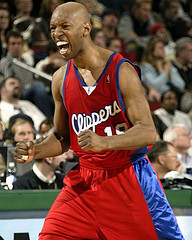
[Picture from Flickr user H.S. Hsiao of Sam Cassell:  ]

Samcassell

“Waves of Extinction” Forecast From Global Warming

From a speech given by John Holdren, the director of the Woods Hole Institute, one of the premier ocean and climate study groups in the world today. In an hour-long talk he called on scientists to tithe 10% of their work to solving the energy/climate problem and warned that if we do not change course:

By 2100, he said, some projections say global temperatures could rival
those of the Eocene epoch some 35 million years ago, a time of dramatic
global warming that caused dramatic disruptions—waves of extinction—in
Earth’s ecosystem. He quoted a colleague who envisioned “crocodiles off
of Greenland and palm trees in Wyoming.”

But the warming temperatures don’t simply make the weather
warmer—they destabilize the weather and generate more extremes, Holdren
said. Some areas are getting wetter; others are experiencing unusual
long-term droughts. Cyclones are becoming more powerful. Between 1950
and 2000, the number of major floods and wildfires has increased
dramatically in almost every region of the world.

Holdren suggested that addressing such challenges effectively to
improve the overall well-being of humanity will require a radical
reconfiguration of policy and economies—and daily life—on a global
scale. World leaders would have to cooperate as never before. Such
cooperation would have to yield new commitments and strategies to
resolve the crushing poverty that affects perhaps 2 billion people.
And, he said, a cap on carbon emissions or a “carbon tax” to encourage
use of alternative fuels is “desperately needed."…

The widely-admired Holdren gave this speech to hundreds of scientists in San Francisco well over a year ago, in January 2007. (click here)

I regret not bringing this to your attention sooner.

(h/t: Stoat)

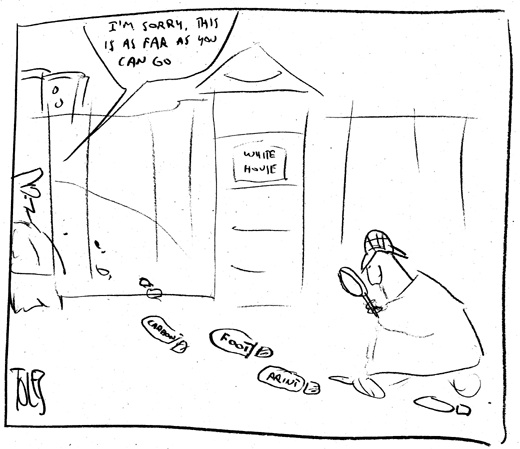
White House Officials Choreograph Torture Sessions

Political playwrights around the world sat up and paid attention this evening — or should have — as for the first time details about how the Bush administration "choreographed" the torture of Al Qaeda suspects became public.

According to ABC NEWS, via TPM, a group called The Principals gathered in the White House to discuss in great detail how suspects would be slapped, pushed, deprived of sleep, waterboarded, or subjected to other "harsh interrogation techniques." 

The Principals are the usual suspects: Cheney, Rumsfeld, Rice, Powell, Tenet, and Ashcroft.

The story doesn’t put Bush in those meetings, but implies the final decision was his to make. The kicker is that Attorney General John Ashcroft, despite approving the practice in principle, knew these discussions were wrong and said so.

Then-Attorney General Ashcroft was troubled by the discussions. He
agreed with the general policy decision to allow aggressive tactics and
had repeatedly advised that they were legal. But he argued that senior
White House advisers should not be involved in the grim details of
interrogations, sources said.

According to a top official, Ashcroft asked aloud after one meeting:
"Why are we talking about this in the White House? History will not
judge this kindly."

If Howard Baker were with us still, we know what he would ask. He would be polite but insistent, and in the end we would find out. What tortures did the President approve? When did he approve them?

Global Warming: Republicans For It Still

If actions speak louder than words, then Republicans still want more global warming.

That’s the message of an entertaining but hard-hitting column by the great Jonathan Chait in this week’s issue of The New Republic. He states the ideological case wittily up front:

Republicans are no longer denying the scientific basis for global
warming. That’s good news for those of us who have grown accustomed to
the continued existence of things like polar sea ice, various forms of
life, and Miami. The bad news is that Republicans, having seen the
light, have fallen back on the possibly even more annoying stance of
simply refusing to do anything about the problem.

But this is not just politics: it’s also about a tax break for the oil companies, which — amazingly — the GOP is still fighting for tooth-and-nail, despite shockingly-high gas prices, astounding oil company profits, and an unpopular war fought, in part, over oil. Read it all: it’s worth every word, and the magazine has made this "green" issue free on the web, for which they deserve attention and praise.

Personally, this GOP-backed tax break for oil companies screams election issue to me. But of course, I’m a hopeless idealist, a wonk, and a believer in global warming, so likely out of step with the electorate.