The Upside of Global Warming

Some winners, according to the Associated Press:

GHENT, N.Y. — It’s not in Al Gore’s PowerPoint presentation, but there are some upsides to global warming.

Northern homes could save on heating fuel. Rust Belt cities might stop losing snowbirds to the South. Canadian farmers could harvest bumper crops. Greenland may become awash in cod and oil riches. Shippers could count on an Arctic shortcut between the Atlantic and Pacific. Forests may expand. Mongolia could see a go-go economy.

Special Report

Read complete Post coverage on the science and politics surrounding the threat of human-induced climate change.

This is all speculative, even a little facetious, and any gains are not likely to make up for predicted frightening upheavals elsewhere.

This is based on a study out of the Yale School of Forestry and Environmental Studies, which has recently been put into a fascinating on-line map form…take a look. I will read the 2003 study, on which the dynamimc map is based, and hope to have a chance to follow up with the authors Robert Mendelsohn and Larry Williams.

“A Disgrace Disguised as an Achievement”

The headline is Al Gore’s description of the agreement that came out of the G-8 conference. He added:

"The eight most powerful nations gathered and were unable to do anything except to say ‘We had good conversations and we agreed that we will have more conversations, and we will even have conversations about the possibility of doing something in the future on a voluntary basis perhaps."’

Bet his description is the one that sticks. Who else said anything memorable?

Against Cap-and-Trade, for a Carbon Tax: Let’s Get Specific

The powerful World Wildfire Federation comes out unabashedly against cap-and-trade, issues harshly critical report entitled Emission Impossible:

Emission Impossible looks at the carbon reduction plans of nine EU member states (UK, Germany, Poland, Ireland, France, Spain, Netherlands, Portugal and Italy) and estimates that 88-100% of these countries’ combined emissions reductions targets under the scheme could be met by buying credits from outside the EU.

Dr Keith Allott, head of WWF-UK’s Climate Change Programme said: "There is a real danger that this will lock the EU in to high carbon investments and soaring emissions for many years to come. If the ETS is to fulfil its potential, we must ensure it leads to real carbon emission reductions within Europe. Climate change is an urgent priority, and we can’t afford to waste another five years before we get Europe’s emissions on a downward path."

And Time’s Joe Klein, author of the book that became the movie Primary Colors, crunches the numbers offered by Al Gore and comes up with what the proposal would look like in real life as a carbon tax…or, more likely, as a cap-and-trade proposal:

In his March congressional testimony, Gore laid out a comprehensive series of proposals to combat global warming. With the help of Robert Socolow, a Princeton professor of mechanical and aerospace engineering who is a carbon-emissions expert, I’ve made Gore’s general policy prescriptions specific:

— A $30-per-ton tax on carbon dioxide emissions (which comes to 25 cents per gal. of gasoline and 2 cents per kW-h of electricity), with the proceeds going to payroll-tax relief.
— Higher fuel-efficiency standards for auto manufacturers. Socolow’s goal is 60 m.p.g. by 2056.

— A $45-per-bbl. floor on petroleum, in order to ensure alternative-energy providers with a stable market.

— A moratorium on new coal-fired power plants, at least until new carbon-scrubbing techniques are perfected.

— A cap-and-trade system of controlling carbon emissions, in which major carbon producers—oil companies, public utilities—would have to pay for the right to pollute above a certain level. Those that reduced their pollution below their quota would be able to sell their excess capacity to companies that exceeded their quotas. The amount of pollution permitted would gradually be reduced over time.

Of this wish list, the cap-and-trade idea and the $45-per-bbl. price for oil are the most likely to succeed politically. All Democrats running for President, several Republicans and even some major industries, including Duke Energy and General Motors, favor a serious cap-and-trade program. The days of $45-per-bbl. oil are probably over, in any case.

But buyer beware: the higher energy prices likely to result from these programs will be passed along to you, with alacrity, by the energy companies.

Global warming is, of course, global. But it will be difficult to persuade countries like China and India to do anything about the problem if the U.S. doesn’t practice some benign unilateralism and take the first step. In 2008 no Presidential candidate should get away with stumping for "energy independence" without addressing both the carrots and, specifically, the sticks that will be needed.

According to a recent Time poll, that will take some courage: only 35% of the public says it is willing to pay higher taxes to fight global warming.

Ah, I love the smell of new statistics in the morning…

Carbon_from_smokestacks_in_europe

Bad and Good at the LA Times

The Los Angeles Times recently lost one of its best science reporters, Robert Lee Hotz, to The Wall Street Journal. For those of us in SoCal, it’s a shame: Hotz had been doing a first-rate job reporting on climate change issues, from places like Greenland, on the front page. Now he’s doing a first-rate job for the WSJ, reporting (as in this story) on how global warming is encouraging the spread of fire ants in Brazil. Here’s hoping the LATimes doesn’t lose more good people, such as environmental reporter Julie Cart, whose by-line I haven’t seen for a while.

But the good news is that the paper has launched an editorial series, called A Warming World, and has written some of the best editorials seen in this country on the subject. Here’s an excerpt from the latest, on how best fo follow Kyoto:

What’s needed is a new, improved version of Kyoto that brings India and China onboard and commits them to "grow green," but still leaves the tougher cuts up to those nations better able to make them, such as the U.S., Canada, Japan and Europe. A better treaty would scrap the unworkable carbon-trading scheme and instead impose new taxes on carbon-based fuels. As recently explained in the first installment of this series, carbon taxes avoid many of the pitfalls of carbon trading. They would produce an equal incentive for every nation to clean up without relying on arbitrary dates or caps, or transferring money from one nation to another. They’re also much less subject to corruption because they give governments an incentive to monitor and crack down on polluters (the tax money goes to the government, so the government wins by keeping polluters honest).

Of course, China and India would be no more eager to accept carbon taxes than carbon caps. But the free market has a way of accomplishing what no amount of international pressure can.

As clean-power technologies and alternative fuels become more widely available, which a carbon tax would encourage, they will get cheaper. China and India both care more about raising standards of living than about pollution or global warming, but that doesn’t mean they don’t care at all. Waterways are becoming badly polluted in both countries, and the air in many big Chinese cities is nearly unbreathable. Coal is abundant and cheap in China, but if the price of renewable power were competitive, the Chinese would buy it. Yet green power will never reach this price unless the U.S. and other industrialized nations crack down much harder on carbon.

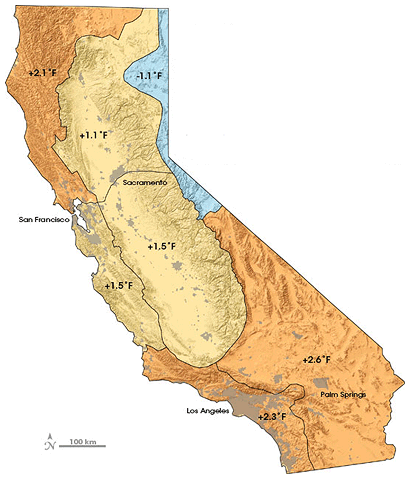
And, as an example of "A Warming World," here’s a great map, originating in Bill Patzert’s shop at JPL/Cal Tech, showing how California is warming already…ahead of most of the U.S.

[Update: this comes from the aforementioned WSJ story, and shows the temp rise since  l950.]

California_warming

130-year-old Bowhead Whale Hunted in Alaska

After surviving an explosive attack by whalers back in the 19th century, a bowhead whale lived through the Great War, the Depression, WWII, the Red Scare, the Cold War, the 60’s, disco, Ronald Reagan, Internet time, and most of Bush Jr.,  before succumbing to another attack, last month off the coast of Alaska.

It’s an amazing story. According to the AP account (which for some reason comes across best when published in the UK) marine biologists have long suspected the bowhead could live for a century, and possibly even two, but were unable to prove it. Now, when a chainsawer recovered a bomb lance tip from the whale last month, they were able to date the weapon with confidence, and know that the whale was first attacked about 1890, for crying out loud.

We take so much of this astounding world around us for granted! Sorry, I can’t get over it. Here’s a picture of the bomb fragment recovered from the whale. The marks were made by the chainsaw.

Spearhead1ap_468x258

Consensus Comes out of Catastrophe, Unfortunately

In The New York Times, John Broder makes a simple point that deserves repeating:

It sometimes seems that it takes a catastrophe to create consensus. The Great Depression, Pearl Harbor and Sept. 11 all shattered partisan divisions and led, at least for a time, to enhanced presidential power and a rush of bipartisan lawmaking (some of which political leaders later came to regret). Today, however, the partisan chasm in Washington is deeper than it has been in 100 years, according to some academic studies, as moderate blocs in both parties have all but vanished.

“Remember,” said Thomas E. Mann, a senior fellow at the Brookings Institution, “these are really big problems and they’re really tough. Solving them is going to involve some major changes in the way we live, the way we tax ourselves, the way we get our health care and the way we transport ourselves.”

[cut]

Even the relatively new issue of global warming has been batted around since 1988, when Al Gore began talking about its potentially dire effects. Now, despite a foot-high stack of proposed legislation on the subject, virtually nothing has been done.

Mr. Gore said it was extremely difficult to move the political system when it is paralyzed by partisan passion and beset by well-financed and well-organized interests. He refers to the combination of the oil, coal and automobile industries as the “carbon lobby,” which he said is very difficult to defeat.

Washington, he said, has also failed to act on global warming for much the same reason that it has not tackled the possible future insolvency of Social Security or the problem of 45 million Americans who lack health insurance. “There’s just garden-variety denial,” he said. “It’s unpleasant to think about and easy to push it off.”

So, unfortunately, this set of facts argues that we must see a climate change catastrophe before we will see real action to reduce the risks of global warming. I wish it were otherwise, but I think this is the truth. What kind of catastrophe will it take, is the next obvious question…

Cutting CO2 Emissions by Saving Tropical Forests: World Bank Steps Up

A superb story in the WSJ by Tom Wright (which I think is available) reveals that the World Bank is moving to reduce CO2 emissions by saving tropical forests, especially in Indonesia.

The global effort to stem climate change could soon include paying countries in the tropical belt to not cut down their rain forests, beginning with a World Bank pilot project.

The World Bank is planning to start a $250 million investment fund to reward countries such as Indonesia, Brazil and Congo for "avoided deforestation."

Note that this effort is not yet funded. Because no binding targets for carbon emissions have been enacted internationally, this is exactly the sort of effort that has been stalled by inaction on Kyoto or another carbon-reducing initiative. Wright explains:

The prospect of addressing global warming by preserving trees is alluring. Amid intensifying global-warming regulations, it could give developed countries — and companies based there — a cheap way to offset their obligation to curb their own energy-related emissions at home. On the flip side, it could provide a source of foreign investment for developing countries, which don’t face emission caps.

But whether the World Bank’s fund will draw much investment is unclear. Under the Kyoto Protocol, saving existing trees doesn’t qualify as a means of generating emission "credits" on the international carbon market.

But $250 million to substanially reduce emissions sounds like a bargain. Interestingly, Wright also quotes the Stern report on the economic impact of climate change, which some on the right like to claim has been debunked. From from it, according to the WSJ:

The Stern Review on the Economics of Climate Change, commissioned by the British government, last year highlighted the urgent need to bring deforestation into efforts to fight global warming. In March, a report by the World Bank and Britain’s Department for International Development found that Indonesia was the world’s third-largest emitter of greenhouse gases after the U.S. and China. That conclusion — Indonesia’s economy is relatively small — stems from rampant deforestation caused by forest fires that sometimes envelop much of Southeast Asia in haze, emitting huge amounts of carbon dioxide.

The article also includes a fully illuminating graph, showing how much forest-burning in Indonesia is contributing to carbon emissions. Save a forest; help save the atmosphere. Sounds like a good idea!

Top_emitters_of_co2

Sunday Morning on the Planet: A New Bird, Maybe

We live at Oak Creek, in Ventura County, California, and usually this year when we step outside the sound we hear is the sound of the creek, Sisar Creek, on its long journey down from the Topa Topa range, at 6400 feet, to the sea.

This year we never did get the ten inches of rain it takes to get the creek flowing.

I miss the water. But in its absence, I have heard a sound I never heard before.

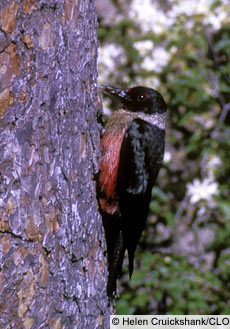
I heard it first a few weeks ago, when after finishing the week’s labors I went outside, exhausted, and simply sat in the sun for a time. I heard a little warbly flutter in the trees, watery and quick, briefly up and down the scale of a little wind instrument. I looked for the bird, but couldn’t find it. Today outside I happened to hear a bird pecking lightly but persistently at a high branch, and heard the little sound again, and found its maker.

Although from my angle I didn’t see the pinkish breast described here, its wings were entirely black, which the USGS says distinguishes it from every other woodpecker in the U.S. And I heard it clearly, and you can too, thanks to the amazing site maintained by the Cornell Lab of Ornithology.

I think it’s the Lewis’s Woodpecker, named after Meriwether Lewis, of Lewis and Clark fame. It’s on Audubon’s endangered Watchlist.

Lewiss_woodpecker

Not Everyone Liked Reagan

In comparison to the confused blundering of the Current Occupant of the White House, the political skills of his right-wing idol Ronald Reagan look good in hindsight.

When things went badly with troops in the Middle East, Reagan cut and ran. When tax cuts early in his term turned out to be ruinous, he agreed to raise taxes. When his advisers screwed up attempting to fight terrorists, he changed tack and recruited Beltway "wise men" to replace the ideologues.

His common sense in retrospect looks like sheer genius, and countless think pieces in recent years have highlighted his fence-building skills.

No doubt Reagan had charm, but he couldn’t seduce everyone. The President of the Heritage Foundation, Edwin Feuler, writes a piece based on the recently-released "Reagan Diares," using it to attack Reagan’s critics, but along the way he admits that in his time not everyone fell for Reagan.

Reagan occasionally failed. In 1983, he requested a meeting with photographer Ansel Adams. "He has expressed hatred for me because of my supposed stand on the environment." Reagan couldn’t bring Adams around. "I’m afraid I was talking to ears that refused to hear," he wrote.

Way to stand up for your beliefs and the planet, Ansel.

Update: Interestingly, a book on Reagan called "Reagan: A Life in Letters" reports what Adams said after he met the President in l983. In a footnote, the authors quote a letter he wrote to a photographer friend, saying talking to Reagan about the environment was "very discouraging…like confronting a stone wall." He left with "a sinking feeling this country is in very poor hands."

Ansel_adams_l960_by_nancy_newhall