Will publish a story on the Scenes from an Explosion story I have been recently slightly obsessed with soon, but for now:

A Change in the Wind
Will publish a story on the Scenes from an Explosion story I have been recently slightly obsessed with soon, but for now:
Mark Grossi, a California reporter of long standing, recently retired, and his paper republished some of his best work, notably this recounting of a stretch on the John Muir Trail, walked in memory of Gross’s late father.
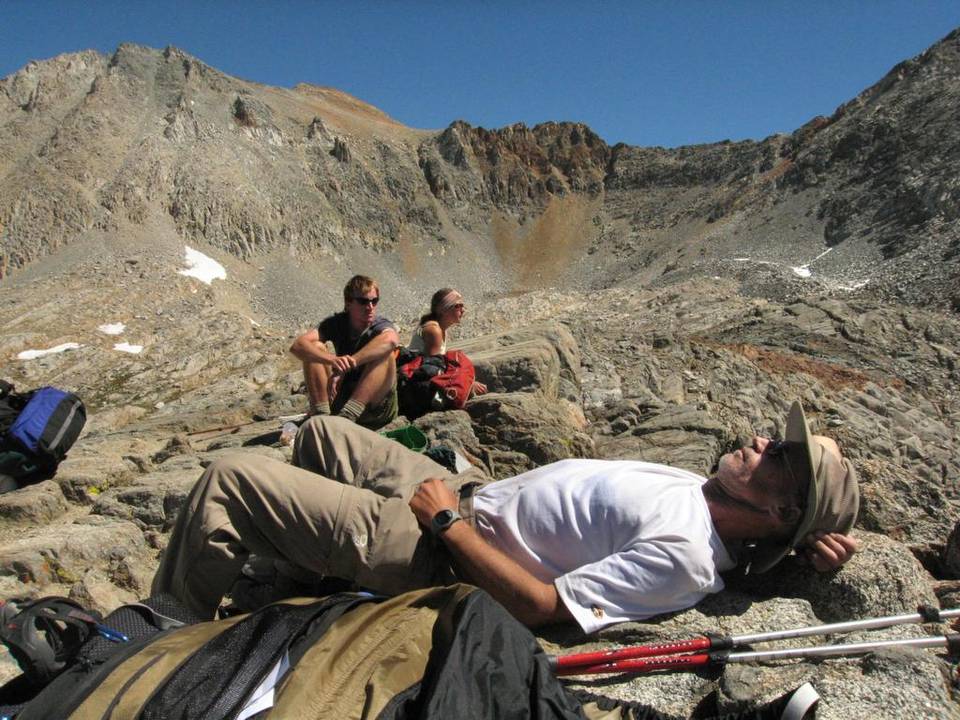
Mount Mendel’s jagged profile turned a surreal pink at sunset. Staring at the spectacle — it’s called alpenglow — I fiddled with a blister on my hand, and I couldn’t get my father out of my mind.
Cancer had just killed him. He died five days before I arrived here.
I am in my early 50s, but I was feeling like a 7-year-old without my dad. I had come to the High Sierra to hike and write about a section of the John Muir Trail. The trip would become a rite of mourning in a breathtaking outdoor cathedral.
It’s a wonderful story, and a reminder that the blunt style of newspaper reporting can be turned sometimes to storytelling purposes, if the writer has a grip on what is happening emotionally around the facts of the story.
I loved the honesty of this passage, about the pain that overtook him, thinking of his loss:
I woke up filled with regret at Colby Meadow on Wednesday morning. I realized I had made a terrible mistake coming up here.
My angst came to a head at Wanda Lake later that day. I wanted to hike faster to numb my racing mind: How is my mother? What will I say in the eulogy? Should I have skipped this trip and gone straight to Maui so they could schedule the service immediately?
That’s when Mike Nickau, 51, of Riverside strolled by camp. Nickau chatted with my partner Crosse. He mentioned he had just quit a great-paying job as a chef to hike the trail. Crosse asked him why.
“I just got done with cancer about nine months ago — Hodgkin’s lymphoma. I’m clean, ” he said. “I say, if you have the opportunity to do something like this hike, do it and stop worrying about everything else.”
It was like a bolt. My father seemed to be speaking to me through this cancer survivor.
Crosse sensed the moment, snapping photographs. I tried to interview Nickau further, but he waved me off.
“People don’t want to read about me, ” he said, sounding remarkably like my dad.
I didn’t need the interview. With a few words, Nickau had changed the whole trip. Suddenly it was better. Not good. But better.
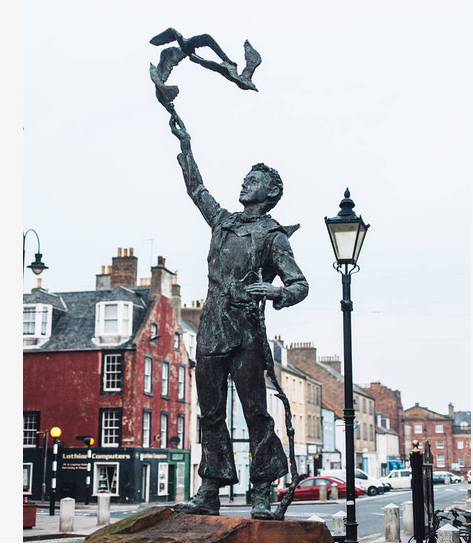
Here in his homeland, however, Mr. Muir remains surprisingly little-known. Until recently there was not much to mark his memory apart from this statue and the small, white, pebble-dashed house across the road, where he was born in 1838 and which today houses the John Muir’s Birthplace museum.
Last year, Scotland inaugurated the John Muir Way, a new walking route that traverses the country west-to-east for 134 miles between the Firth of Forth and the Firth of Clyde. It was conceived both to resurrect Mr. Muir in the Scottish consciousness and, as environmentalist Keith Geddes, one of the Way’s architects, explained, to “help today’s young Scots develop a relationship with the countryside around them.”
The trail takes a few days, and has industrial and architectural parts as well as wild parts. But walking on past Loch Lomond, the first and most famous of Scottish national parks, Henry Wismayer finds a certain peace.
Throughout the afternoon we rarely saw another walker. And if we looked in the right direction at the right moment even here, 30 miles from Glasgow, we could glimpse the pre-human innocence Mr. Muir coveted, away from what he called the “tyranny of man.”
Perhaps, I thought, as we rolled down toward the Way’s end in coastal Helensburgh, the intrepid nature-lover, who described himself as “hopelessly and forever a mountaineer,” might have selected a trickier route through these hills.
But accessibility is what the Way is all about: coaxing people to dust off their boots, pack a bag and set out to explore the many colors of Scotland’s coastline and countryside. And that is no doubt a mission that Mr. Muir would have commended.
From the story, here’s a new statue of Muir stood up in his hometown, ancient Dunbar.
Yesterday the Wall Street Journal joined the chorus of media outlets scrutinizing Ben Carson’s past (as detailed in his memoir). Like CNN and the Washington Post, they discovered it’s a lot less colorful than Carson and his co-writer claimed. The WSJ concludes:
One reason that Mr. Carson’s stories are difficult to check is that he navigated the turbulent times of his young adulthood without leaving much of a trace. He arrived as a scholarship student at Yale University in 1969 to a campus engulfed in protests but said he avoided them.
“A lot of those students who were doing the protesting were also students who were involved in a lot of things that I didn’t believe in,” he told the Journal. “Drugs, premarital sex, free love, alcohol. And it just wasn’t the crowd that I particularly wanted to get involved with.”
Mr. Carson was assigned to Davenport College, a four-story brick dormitory with a gothic facade where future Baltimore Mayor Kurt Schmoke invited anti-war speakers. Yet, when other students discussed politics and their changing world over meals in the cafeteria, Mr. Carson rarely spoke up, according to interviews with more than 50 Davenport College dorm residents of that era.
“He made no impression on you at all, other than a cheerful smile and a ‘Hello,’” said Ron Taylor, one of seven black students in the Davenport class of 1973.
Those acquainted with Mr. Carson said he was a serious student, typically wearing a pocket protector and toting a reddish-brown briefcase.
“He would go to bed at like 9 p.m. and get up at 4 a.m. or 5 a.m. and put on a suit, a tie and a jacket and a button-down shirt and study in the early morning,” said Thomas Noonan, an actor and Mr. Carson’s roommate their sophomore year.
How curious that this is what Carson feels compelled to cover up, his “A” student tendencies.

Another paper published my FORECAST: GODZILLA story, which includes an amusing history of the “meme” from the weather reporter’s friend at JPL/NASA, Bill Patzert.
Don’t usually repost my reporting, but I really like this story, and this paper used my headline.
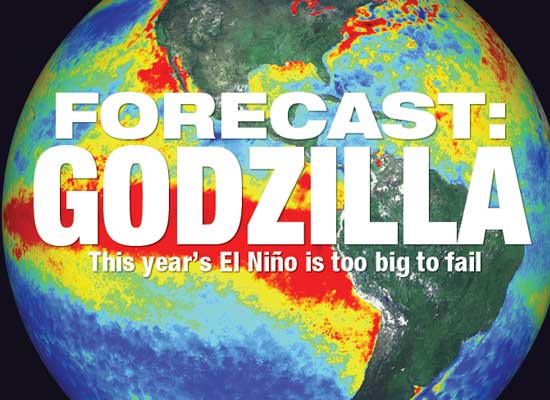
They didn’t use the image that launched the concept, however (see below). Guess the monster lurking in the data may not be as visible to others as it is to me.
Have been struggling a bit with climate “overwhelm” — the volume of bad news is drowning out my efforts to keep up and post, even my own thoughts. I sympathize with a JPL/NASA scientist and publicist named Laura Faye Tenenbaum:
The energy it takes to make honest, interesting and informative content for NASA’s climate website, the energy it takes to not let the daily deluge of Internet trolls and nasty comments get to me, all while facing the reality of GLOBAL WARMING, is exhausting.
I try to make a difference, to keep encouraging myself, to lift myself out of despair. We’re supposed to keep our noses to the do-something-meaningful-with-your-life grindstone and keep chugging endlessly uphill, just like The Little Engine That Could, while repeating some mindless positive slogans of encouragement to keep our heads up.
I try to find a way to cope with these enormous problems without turning away, without downing a pint of ice cream, without watching the stupidest reality TV show I can find. For to be so disconnected from the world as to be capable of polluting it, is to be disconnected from life. And connection is the one thing I refuse to let go of.
True, maybe you really should crawl under your desk and your little engine should pull over to the side of the road for a break. But you’re here, just like I am, pushing through because it’s somehow better to stay connected even if it hurts.
Doesn’t help that the public sees the reality, but shrugs off its seriousness. From an AP poll just out today:
Most Americans know the climate is changing, but they say they are just not that worried about it, according to a new poll by The Associated Press–NORC Center for Public Affairs Research. And that is keeping the American public from demanding and getting the changes that are necessary to prevent global warming from reaching a crisis, according to climate and social scientists.
As top-level international negotiations to try to limit greenhouse gas emissions start later this month in Paris, the AP-NORC poll taken in mid-October shows about two out of three Americans accept global warming and the vast majority of those say human activities are at least part of the cause.
However, fewer than one in four Americans are extremely or very worried about it, according the poll of 1,058 people. About one out of three Americans are moderately worried and the highest percentage of those polled — 38 percent — were not too worried or not at all worried.
Despite high profile preaching by Pope Francis, only 36 percent of Americans see global warming as a moral issue and only a quarter of those asked see it as a fairness issue, according to the poll which has a margin of error of plus or minus 3.7 percentage points.
“The big deal is that climate has not been a voting issue of the American population,” said Dana Fisher, director of the Program for Society and the Environment at the University of Maryland. “If the American population were left to lead on the issue of climate, it’s just not going to happen.”
Friends and hard-working activists keep me from despair — but I have my moments.

Are we all living in a bubble?
Apparently Clinton as a killer is “a thing” as they say in pop culture.

Turns out that the artist, Sarah Sole, has been “obsessed” with Hillary for years. She told the New York Times a year or two ago that she “bankrupted” herself painting these quasi-Warholish images of Clinton, including sexual images, when no one cared.
Now a left-wing writer for Harper’s, Doug Henwood, has written a critical book about Clinton, called My Turn: Hillary Clinton Targets the White House, and the artist allowed him to use the picture as its cover.
To me this speaks to a turning point in the culture: Clinton, long hated by the right, has learned how to give as good as she gets, and critics on right and left now understand that. The cover stirred up controversy: some thought it “disgusting,” according to a Politico story.
To the artist, however, the picture comes “from a place of love.”
“I love Hillary Clinton, I support Hillary Clinton, I very much want her to be president. I will certainly vote for her,” she told the International Business Times.
As a former analyst for the movie industry, I believe her. To be a killer is to demand respect in our pop culture. For good or ill.
Don’t see Mad magazine much anymore but I think this is freaking hilarious:

Regardless of your affiliation, you get the point. Don’t mess with the Hill, that’s all.
About eleven months ago, I ran into a couple of thru-hikers as I approached Kennedy Meadows on the PCT. I was coming off the end of a super-hot section of the Mojave with little or no water, and they were south-bound.
In SoCal, mostly hiking earlier in the year, heading north I hadn’t met many southbounders, hadn’t seen hikers that experienced: these two looked ready for the Sahara. Or anything.
We stopped for a minute and I asked a question or two and Dormouse plopped down on the trail without a second’s hesitation to dig something out of her pack as I learned her name and her husband Dirt Stew’s. They seemed as comfortable in the raw desert wilderness as if it were their living room. I was pretty amazed by these two — sort of an exotic species for me. They made an impression and I asked a question or two.
About a month ago I ran across an excellent story about their journey that Dormouse wrote up for the PCTA Association: much of it sticks in my memory still. For instance, in Oregon for a week or two they passed hordes of northbounders. Dormouse wrote:
To them, we were a rare sighting, but to us, they seemed like an endless parade. There is something funny about the moment when a northbounder and a southbounder cross paths. Together we have completed an entire thru-hike and yet we do not have a single shared experience of the trail. It makes for both helpful and frustrating conversations. I think hikers have selective memories, and a lot of the information we got from northbound hikers was false.
True. You have to consider the source, and realistically, on the trail you rarely can with any certainty.
Reading this put me on to their blog, which includes good journaling about their trip. Well, turns out my questions and curiousity awoke something in themselves as well, which they wrote up!
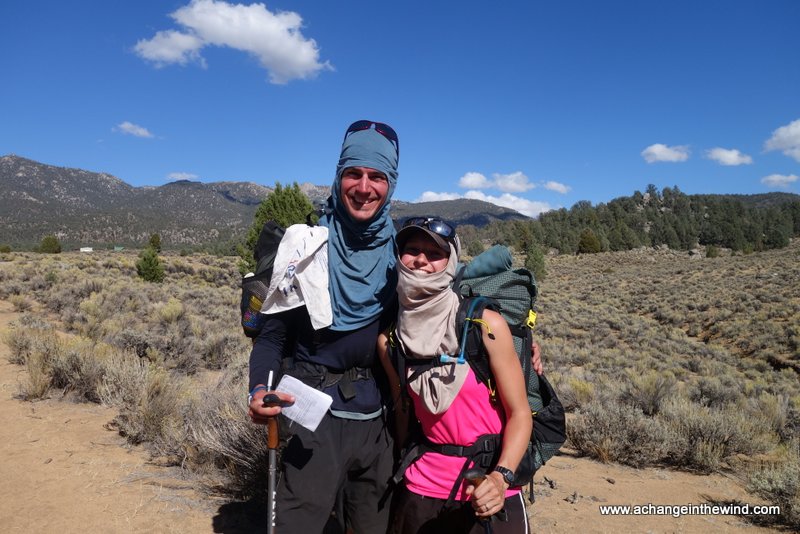
We hiked out in full ninja-hiker gear with shirts around our faces in order to protect ourselves from the sun and wind, and ran into a northbound section hiker who said “you guys must be thru-hikers”. “How’d you guess?” we asked. “Well, you look like you’ve walked almost 2000 miles!” He replied. “Can I take your picture?”. “Sure!” We answered. As he left I said to Dirt Stew: “Let’s take a picture of ourselves! It’s the first time someone’s told us we look like we’re thru-hikers who’ve hiked 2000 miles!” We snapped a picture at arm’s length and looked at ourselves on the little screen. We looked a lot like we did only 100 miles in. We were covered from head to toe so as not to get sun burned.
Here’s the picture I took of them:
At Lake Aloha, mile TK on the PCT, I saw a sight the likes of which I’ve never been so privileged. A ballet of bats, so to speak, dancing over the still waters of Lake Aloha, chasing I think big fat whitish moths that unaccountably flutter around the water there (or so I’ve seen).
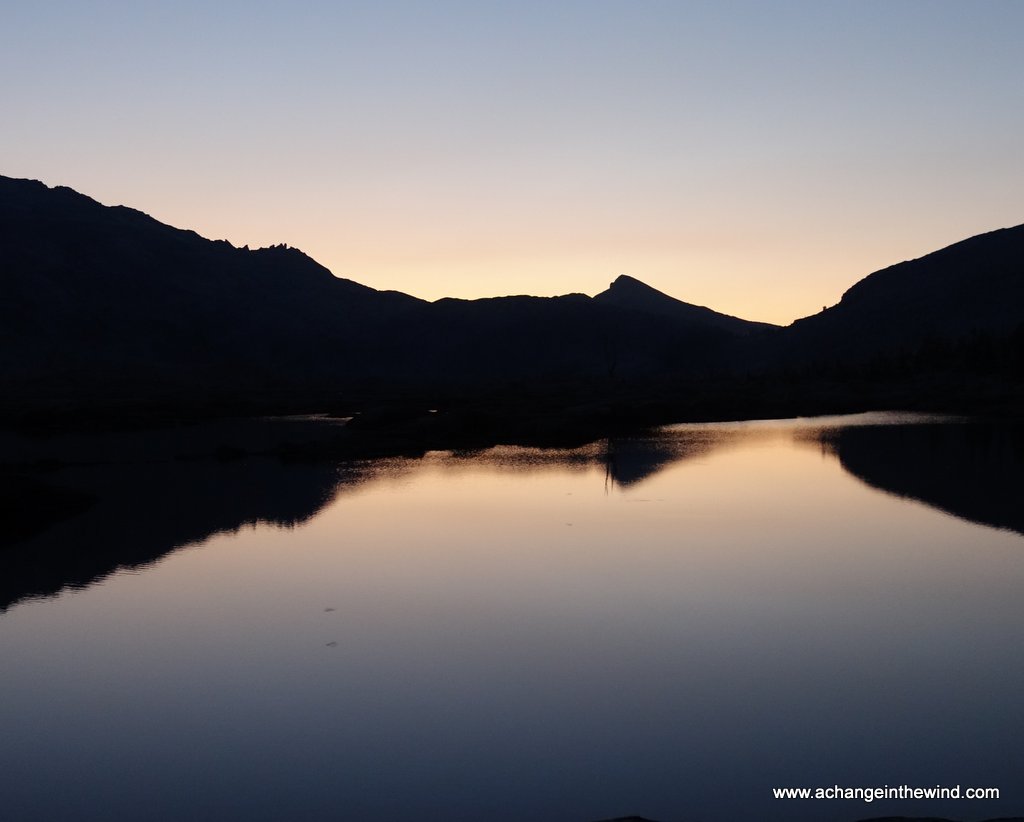
The picture cannot approach the experience, but it can evidence the existence of these extraordinarily gifted flyers, and their dance over the waters, just touching now and again.
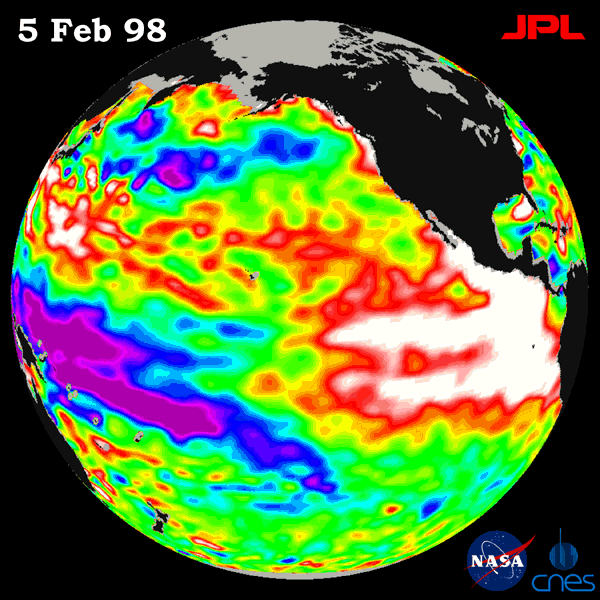
Here’s the image that inspired scientist Bill Patzert to call a particularly epic El Niño “Godzilla.”

See that monster lurking off Central America? With the jagged jaws and the beady little green eye?
Here’s the story that explains why that’s relevant to today. In a sentence, because 2015-2016 is looking a lot like 1997-l998. For more, see here.

 Kit Stolz