Save the groundfish: the great Sand Dab supper

It's rare to see a professional cook write an op-ed for a newspaper such as the Los Angeles Times, but Kelly Whitaker makes a plea for a fishery which I second from the bottom of my heart. I have made sand dabs for supper countless times because yes, they're irresistible. Please don't let them go away.

Help these fish survive by supporting this effort to bring them back, and enjoy a fine guilt-free dinner to boot:

West Coast groundfish are bottom-dwelling fish, including species such as Pacific Dover sole, ling cod, hake, Pacific sand dabs and dozens of rockfish species. They're usually caught as far as 200 miles off the coast of California, Oregon and Washington.

In 2000, this fishery was an economic and environmental disaster. Overfishing, coupled with trawling methods, so devastated the ocean floor that groundfish couldn't replenish their populations. Faced with losing this vital fishery, fishermen, regulators and conservationists came together to find a solution. In just 14 years with new management methods, including putting federal observers on every fishing vessel, the ecosystem has recovered. Using new technology and fishing practices, fishermen have learned how to protect the most vulnerable species.

Today West Coast groundfish are classified as “sustainable” seafood choices by the Monterey Bay Aquarium's Seafood Watch or the Marine Stewardship Council. So what's the problem?

While the fishery may have recovered environmentally, it hasn't economically.

Here's my experience, and my attempt to coax you into trying what might be a new recipe.

First, find some Sand Dabs. This may be as easy as going to your local fishmonger, of any sort, because this fish freezes very well and unfreezes easily, so it need not be perfectly fresh, to be truthful, although of course it's great if possible.

Then let me bring Alice Waters into the conversation, and quote her simple but effective version of fried fish for home cooking from The Art of Simple Food

It's a marvel. You don't even need lemon. But let me recommend a ground-fish in particular, California sand dabs, which are much like Dover sole, but even lighter, fresher, sweeter. And in most cases cheaper, because it's a less known variety.

4 fillets, about 5 ounces each

SanddabsBeat together
    1 egg
    1 tablespoon water

Spread in a shallow bowl
    2 cups fresh breadcrumbs, processed fine [yes, you can cheat on this item]
Dredge the fillets in:

    Flour

Shake off the excess flour, then slip in the egg mixture and finely roll or pat in the breadcrumbs. Refrigerate the breaded fillets for 1 hour until dry. Don't let the fillets touch each while drying.

Heat in a heavy iron pan:

    clarified butter, or oil and butter, 1/2 inch deep

When hot but not smoking, add the fish fillets and cook until brown and crisp, about 3 minutes. turn and cook until the other side is brown and crisp. Remove from the pan and drain on an absorbent towel or paper. Serve immediately.

(W/lots of options, such as adding herbs before breading. Cayenne or paprika in the flour. Lemon zest with the breading. Cornmeal instead of gluten. Oysters instead of fish. Fresh tartar sauce.)

Sometimes the simple things are the best.

A weekend on the PCT with pinyons and snow: 2015

Having just fallen in love, so to speak, with the pinyon pine, I'm distressed to learn that the species may fall prey to "forest mortality" in the Southwest (as discussed a few weeks back here).

What can be done — if anything? Are these forests doomed, or — ?

With my young nephew Eli Huscher went back to the Walker Pass area of the PCT this past week to explore this question. I'm not a scientist and have no answers as of yet, but I think it's an important question. 

I'll begin with a picture of the tree that inspired this new-found devotion. (The pinyon's not the most spectacular of trees — but in the harsh desert landscape of the Mojave, it's a hero.)

Pinyonpine

Okay, the rest of the pics I'll put below the fold — please enjoy!

Here's Eli, myself, and my old truck as we headed out.

1-DSC02003

Here's a photo of some of these trees near Walker Pass, in the mountains at about 5000, fifty or so miles northwest of the town of Mojave. A lot of them near the pass do not look well.

1-DSC02030

Heading south from Walker Pass, at about mile 645, the trail comes up to a mesa at 7000 feet, and tracks with a road used by motorcycles and ATVs. It's pretty bleak.

1-DSC02039

Eli found a couple of flags lying in the road — don't try to take these Americans' guns!

1-DSC02042

Sharing the road with the motorized — who were actually pretty considerate.

1-DSC02043

After five miles, at 641, the trail turns off the track and into a pinyon forest. At a higher elevation, and with a northern exposure, this forest looks a lot better than the pinyons near Walker Pass.

1-DSC02047

Really a lovely forest, lovely trail. Not as spectacular as a forest of redwoods, but no less loveable in the high desert environment. 

1-DSC02051</

And then a little higher — snow!

1-DSC02052

We camped at about 7000 feet — cold but clear.

1-DSC02062

In the morning — not so clear, a lot colder. Poles literally frozen in the ground.

1-DSC02067

Then it began to snow, which was great. Interestingly, all the pines on this substantial slope, at a higher elevation, with lots of snow, looked just fine. Could this be a refuge for the pinyon?

1-DSC02078

Snow and pinyon health: a connection?

1-DSC02111

Let me leave you with a haiku or two on walking in the snow in the high desert:

inhaling whiteness
the creak and crunch of cold new snow
winter Walker Pass

a cloud comes to earth
in spinning nests of crystal ice
flakeing the PCT

Reporter: In defense of the gotcha question

Somebody had to defend the much-despised "gotcha" question. 

Ron Fournier, veteran reporter, digs into the legend and finds all kinds of juicy examples. Writes it up with great depth and precision. 

For example, where did the phrase "gotcha" come from? Fournier agrees with another reporter, and suggests that Bill Clinton might have introduced it into the political conversation. 

In a brief history of the gotcha question, Washington Post reporter Colby Itkowitz recalls that Bill Clinton called queries about his fidelity "a game of gotcha." Obama dismissed as "gotcha games" the controversy over comments about Pennsylvanians clinging to guns and religion. Bush griped about "gotcha" questions when reporters asked about whether he'd used cocaine. Sarah Palin dismissed any question she fumbled as "a gotcha."

Clinton objected because it wasn't a policy question, but Fournier argues that even if it's not a question about policy, it's fair to test political leaders on simpler grounds. Do they have any common sense?

Years ago, an Arkansas governor named Bill Clinton walked into the state Capitol media room at the end of a hectic legislative session and asked the journalists if we needed anything else from him.  We had asked Clinton questions all day. We were tired. We wanted him to shut up and go home.

So I said, "Yes, governor. I know you don't know much about baseball, but when there's a pop-up behind the third baseman, whose ball is it?" The other reporters snickered. Finally, they figured: a gotcha question Clinton wouldn't answer.

The governor bit his lower lip, lifted his eyes to the ceiling, and mulled. "Never played the game much," he finally replied, "but wouldn't the shortstop have the best angle on the ball?"

That innocuous exchange has stuck with me for nearly 30 years because it revealed much about Clinton as governor. He was ultra-accessible, intellectually fearless, and—more often than I liked to admit it—right.

An example: Another example: Fournier asked G.W. Bush at a big press conference with Vladimir Putin present if the Russian leader could be trusted — a throw-away, "gotcha" question, in a press conference with Bush and Putin both taking questions. 

I asked Bush the first question at a news conference in Slovenia with Russian President Vladimir Putin. "Is this a man that Americans can trust?" My editor and I had scripted a meatier two-part question about the U.S.-Russia relationship. This was a throwaway line, appended hastily to the end of the substantial stuff.

"Yes," Bush replied, before allowing Putin to answer a separate question. A few minutes later, the American president elaborated: "I looked the man in the eye. I found him to be very straightforward and trustworthy. We had a very good dialogue. I was able to get a sense of his soul, a man deeply committed to his country and the best interests of his country."

Bush told his staff later that I had caught him off guard. I had put him on the spot. Not wanting to openly question Putin's credibility, Bush nervously riffed his way into a quote that still reflects the tendency of U.S. officials to underestimate the Russian leader.

Asking good questions in pressurized situations means asking short questions that demand good answers. These are all good examples of short questions that open big topics.

Megadrought in SW by 2050: news shocks climatologist

Like many other Americans, I have had difficult absorbing the recently published news that megadroughts are scheduled into the future for the Southwest. Just did not want to hear that, read that, learn the details. But because I intend to go back to the Mojave this weekend, after being foiled last weekend, I forced myself to read up on the study released just a month ago.

For my readers sake, I tell myself.

Because yes, the news is bad. A cut-the-crap headline might read:

Endless drought in Southwest by 2050: Study

Think you can see it in a graph. Tell me if I'm wrong. Look at the fall-off in moisture in the lower chart.

Droughtprojections

Yes, this is a projection based on mathematical models that represent the atmosphere, and yes, the climatology is tied to soil moisture, and yes, it's a high-end (8.5 RCP) projection. But on the top panel you see it graphically compared to two other modeling systems, and they are in good agreement. A correlation of .86 in one case, and .85 in another. 

A couple of other notes from the paper: some of the models actually project somewhat wetter winters, but it turns out not to matter to the big picture. Still the region trends towards desiccation.

But forget about the science of drought. Think about the news, about forest mortality, about vast lands of trees, species and subspecies, drying out and dying off. It's difficult. I'm not sure I can.

Helpfully Ken Caldeira, of Stanford and many other institutions, steps in and helps us understand — no matter how difficult the news — in a letter to David Perlman at the SF Chronicle.

These model results are the most reliable model results available in the world today. The models have been tested again and again against a wide array of meteorological observations. 

KencaldeiraIf this was one model saying this, it might be a model artifact, but when nearly every model says more-or-less the same thing, you have to pay attention and believe it might be pointing to something real. 

I have looked at some of this model output before, but when you look at them as graphs of probability distribution functions it doesn’t really mean very much emotionally. 

When you stack these model projections against reconstructions of past climates, the results are so sobering that they have me ready to go out for a drink. 

I remember visiting ruins of American Indian civilizations in the desert southwest, places like Mesa Verde, where large civilizations flourished based on an agricultural foundation. It is thought that the rains dried up in year 1276, and a 23-year drought played a major role in causing this civilizations to fail, leaving us with the ruins we see today. 

If you look at the chart showing rain in the desert southwest (Figure 1), the drought of 1276 is like a little blip compared to what is in store for us. 

As a climate scientist, I sometimes think climate change is something we can just muddle through. I have been concerned about excessive alarmism, thinking that climate change might turn out to be not so bad for the average person after all.  These results have me questioning that complacent attitude.  

It looks like the droughts in store for us later this century will make the droughts that did in the Mesa Verde civilization look like child’s play. 

And after that? Let's just say, Caldeira doesn't perk up. Read the whole thing, if you dare.

To know yourself you must sometimes be by yourself

Last month Backpacker magazine ran a tough-minded Mark Jenkins essay on journeying alone called Go Solo. At its heart it goes something like this:

Ever since Aron Ralston got himself caught between a rock and a hard place in Utah’s Blue John Canyon, hung there for five days, and then amputated his right forearm to escape, going solo has gotten a bad rap. When his story comes up in conversation, someone inevitably proclaims that “Ralston was an idiot. Going alone is stupid.”

Such a person is someone who should not go alone into the wilderness. Ralston’s mistake, if he made one at all, was not that he went alone, but that he failed to leave word with someone of his likely whereabouts. I have gone out alone and told no one where I was going too many times to count. Is this behavior really reckless and irresponsible?

There was once a time when exploring the backcountry by yourself was seen as a primary path to understanding topography, both geographical and psychological. Our most cherished wilderness heroes—Thoreau and Muir, Leopold and Abbey—frequently went on solo adventures. Can you imagine free-spirited Muir leaving precise notes about where he planned to wander? In Walden, Thoreau’s manifesto about humankind’s relationship to nature, he writes, “I find it wholesome to be alone the greater part of the time. I never found the companion that was so companionable as solitude.” Leopold spent weeks alone on horseback in New Mexico’s Gila wilderness without a second thought. And Abbey! He would have pissed on a personal locator beacon.

What’s happened in the last few decades? It feels as if the weight of technology has ironically pushed us back into the Dark Ages, when the wilds were believed to be so treacherous and malevolent that they could not be assailed alone. The modern mantra is you must go with a partner, or better yet, a group. But does that really get you where you want to be?

“Distrusting our capacity to be alone, we too quickly look to others to save us, often from ourselves,” writes Sarvananda in Solitude and Loneliness: A Buddhist View. This seems to me to be a clarifying description of our hyper-social age.

Simple as it sounds, to actually know yourself you must sometimes be by yourself.

Jenkins thinks through our doubts about going alone, and thoroughly, ultimately making clear that although honest-to-God he treasures going solo, and has good reason to trust his capabilities, still he's often grateful for company. Which no doubt is true, but methinks he dismisses as irrelevant the shame and fear with which many contemplate solitude.

Not sure he's thought that part of solitude through, in other words, Yet thank God for a popular writer who will stand up and say that yes, solitude is a human right, and, in the crowded 21st century, a rare privilege.

1-IMG_5527

This weekend, with luck, will return to a pinyon pine I happened upon on in the Mojave last year and want to see again.

The photographer as fearless story teller

The highest compliment paid in the land of journalism, sez me, is to say that such-and-such a writer, Mike Royko in Chicago, say, or Carl Hiaasen in Miami, or Joseph Mitchell in New York, is/was "fearless."

Well, in the land of photography, no one in our time has been more fearless than Duane Michaels. (Not even Robert Mapplethorpe, who to my eye may have borrowed a bit from his predecessor.) Michaels dares to not just capture moments, but to portray his imaginings, even the silly ones, and yet never seems to lose that connection to his inner self, his yearning being. .

Now an exhibit of his work is on display at the Carnegie Museum in Pittsburgh. The New York Review of Books gives us just a taste of this in a delightful set of his slide shows, beautifully optimized for the web, called Midnight Movies for the Mind.

Since most of us won't make it to Pittsburgh in the next week or so, let me offer just a taste of Michaels' inimitable style, half-funny, half-sexy, always seemingly inspired.

Antleredcreature

This one from a show in l986 called The Bewitched Bee.

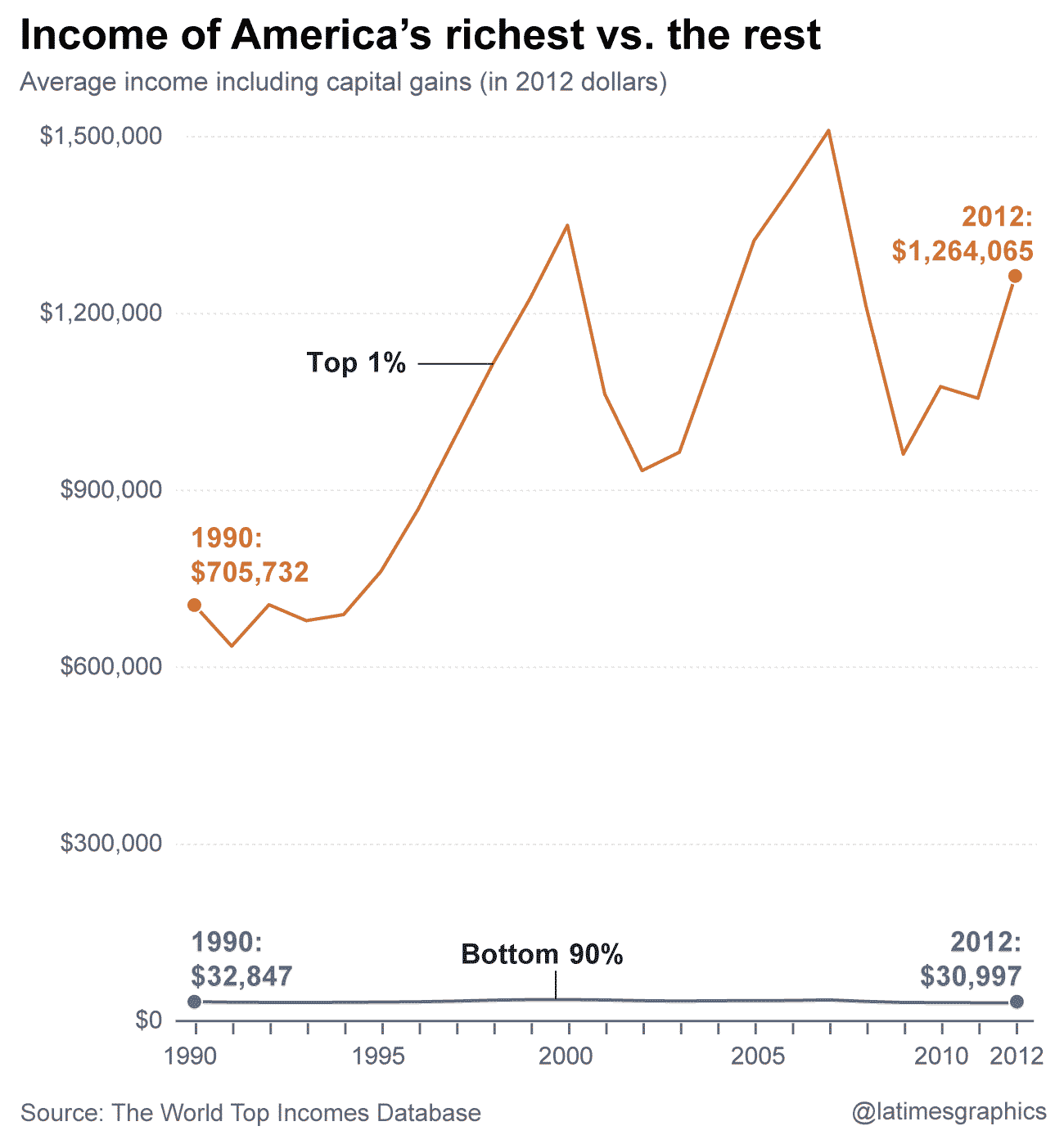
The soar into the stratosphere of the 1%

As one news organization after another has gotten on board the income inequality bandwagon, the graphics have gotten ever telling. Each seems to be competing to best tell the story graphically.

The WSJ had an especially good set of interactive graphics on Inequality in America lately.

But here's the simplest and perhaps the best to date, on the soaring wealth of the 1%.

This one comes from the Los Angeles Times — give credit where credit is due.

tenpercentvsninetypercent.png

Not getting enough sleep? Take a nap, research says

Washington, DC–A short nap can help relieve stress and bolster the immune systems of men who slept only two hours the previous night, according to a new study published in the Endocrine Society’s Journal of Clinical Endocrinology & Metabolism (JCEM).

A news release on napping from The Endocrine Society:

Washington, DC–A short nap can help relieve stress and bolster the immune systems of men who slept only two hours the previous night, according to a new study published in the Endocrine Society's Journal of Clinical Endocrinology & Metabolism (JCEM).

Lack of sleep is recognized as a public health problem. Insufficient sleep can contribute to reduced productivity as well as vehicle and industrial accidents, according to the U.S. Centers for Disease Control and Prevention. In addition, people who sleep too little are more likely to develop chronic diseases such as obesity, diabetes, high blood pressure and depression.

Nearly three in 10 adults reported they slept an average of six hours or less a night, according to the National Health Interview Survey.

"Our data suggests a 30-minute nap can reverse the hormonal impact of a night of poor sleep," said one of the JCEM study's authors, Brice Faraut, PhD, of the Université Paris Descartes-Sorbonne Paris Cité in Paris, France. "This is the first study that found napping could restore biomarkers of neuroendocrine and immune health to normal levels."

The researchers used a cross-over, randomized study design to examine the relationship between hormones and sleep in a group of 11 healthy men between the ages of 25 and 32. The men underwent two sessions of sleep testing in a laboratory, where meals and lighting were strictly controlled.

During one session, the men were limited to two hours of sleep for one night. For the other session, subjects were able to take two, 30-minute naps the day after their sleep was restricted to two hours. Each of the three-day sessions began with a night where subjects spent eight hours in bed and concluded with a recovery night of unlimited sleep.

Researchers analyzed the participants' urine and saliva to determine how restricted sleep and napping altered hormone levels. After a night of limited sleep, the men had a 2.5-fold increase in levels of norepinephrine, a hormone and neurotransmitter involved in the body's fight-or-flight response to stress. Norepinephrine increases the body's heart rate, blood pressure and blood sugar. Researchers found no change in norepinephrine levels when the men had napped following a night of limited sleep.

Lack of sleep also affected the levels of interleukin-6, a protein with antiviral properties, found in the subjects' saliva. The levels dropped after a night of restricted sleep, but remained normal when the subjects were allowed to nap. The changes suggest naps can be beneficial for the immune system.

"Napping may offer a way to counter the damaging effects of sleep restriction by helping the immune and neuroendocrine systems to recover," Faraut said. "The findings support the development of practical strategies for addressing chronically sleep-deprived populations, such as night and shift workers."

Other authors of the study include: Samir Nakib, Catherine Drogou, Maxime Elbaz, Fabien Sauvet, Jean-Pascal De Bandt and Damien Léger of the Université Paris Descartes-Sorbonne Paris Cité.

The study, "Napping Reverses the Salivary Interleukin-6 and Urinary Norepinephrine Changes Induced by Sleep Restriction," was published online, ahead of print.

An inequality graphic that’s not a chart but a cartoon

Take a glance at this depiction of the raging income inequality debate. It's refreshing, because on this subject there have been approximately 573 stories, studies, and graphs, graphs, graphs posted in the past 48 hours or so in the press, and this is about the only one that's been humorous.

It's incredible, the volume of this debate, and its implications, in a thousand realms beyond the purely economic.

We in the Ojai Chautauqua will be debating this issue later this year I expect, so I have been gathering inequality grist for the mill, and boy is there a lot. Endless. 

A Gallup poll found a recent improvement in economic outlook, for example, but still two-thirds of those polled this month said they were dissatisfied with the distribution of income in this country.

So, with your forbearance, let me post some notable inequality facts in graphic form in the next few weeks. I'll keep it succinct, and humorous if remotely possible, as in this example thanks to a friend and to The New Yorker.

Incomeinequalitycartoon

How the super-rich live: far above the rest of us

By sheer coincidence, this weekend both the L.A. Weekly and the New York Times ran stories on how representatives of the super-rich, are taking over the heights of the city.

Call it unaffordable housing — penthouses for the super-rich. Not the 1%, but the .01, the Thousandth Percent. Apartments that cost tens of millions of dollars. It's fascinating to see how these two publications put up the stories, and fascinating to see how far the world of the super-rich is from us.

For example, 64% of the Time Warner Center is owned by shell companies (LLCs) which use a loophole to pay a minimum of property taxes, for clients from around the world whose names are kept hidden — many of whom, it turns out, have been charged with environmental or financial crimes.

Timewarner-synopsis-topper-master1050

(The picture agove shows graphically how much of these newly constructed skyscrapers is owned by represented by LLCs and, credibly, the super-rich.)

Both stories break new ground, each in its own way. Attached with the L.A. Weekly piece by David Futch is footage taken by a drone that flew over a contested building site in West Hollywood, formerly occupied by Capitol Records, where a developer wants to build a skyscraper for the super-rich on top of a well-known earthquake fault.

Naturally, the developer has a different description of the fault: see the story here. The developer's geologists will challenge the state's earthquake maps and argue that a surface thrust fault — which breaks the surface — is not located below the site, and thus it's okay to build a skyscraper there. What's the motivation?

The profit potential is clear for Millennium owners Jeffries and Aarons: An owner recently listed a residential penthouse at their soaring New York City skyscraper, which is also dubbed Millennium Tower, for a headline-generating $34.5 million.

Meanwhile in New York, the Times finds that most of the multi-million dollar condos are being sold to foreigners, a fair number of whom have been accused of criminal activity in their home countries. And the prices they pay don't help New Yorkers so much as they help their fellow rich.

What is more, [economist] Mr. Parrott said, the skyrocketing prices of the pieds-à-terre are affecting the price of real estate in the city more broadly. “There’s a downside to having such pressure at the top. It pulls up the prices overall. When owners of $10 million condos see that there’s a big market for $95 million condos, they’re more likely to raise their prices,” he said. “Then the person at $2 million raises his prices, then the person at $1 million sees that and there aren’t any prices below $1 million.”

This was the complaint of the activists quoted in the Los Angeles story: that the city is selling out to the super-rich, leaving no place for ordinary people.

How the other Point Oh One Percent live: far far above the rest of us.