For the Ojai Quarterly [pdf], yours truly had the opportunity to talk to T.C. Boyle about the Thomas fire, debris flows, climate change, and other scary realities of the 21st Century. The interview also motivated me to catch up on some past works of Boyle’s, and boy was that worth the reading. Check it out:
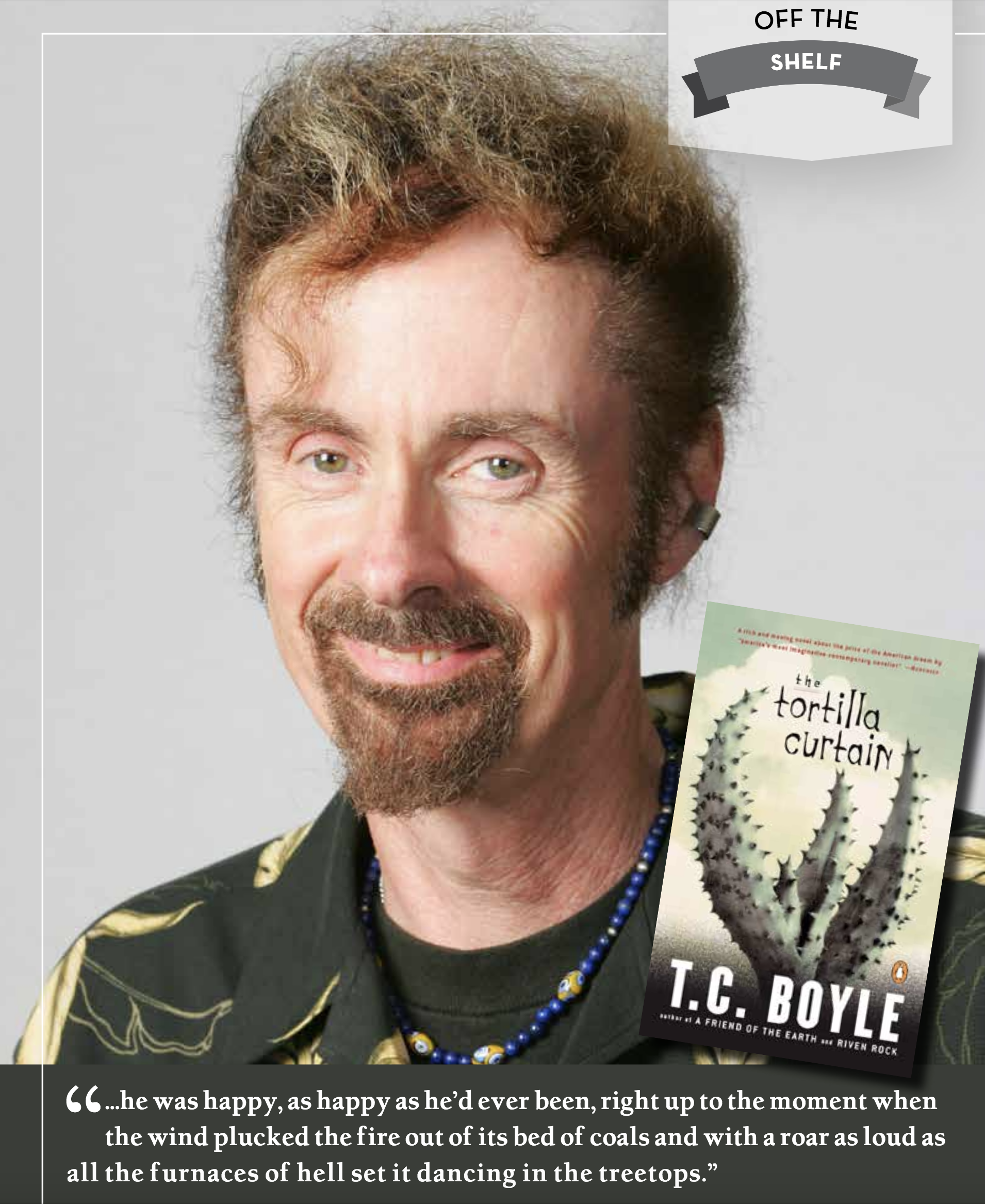
So begins the conclusion of T. Coraghessan Boyle’s most controversial novel, The Tortilla Curtain, which includes a wildfire followed by a mudslide — a potentially fatal disaster for all its central characters. The story begins with a twist of fate. An Anglo nature writer driving through Topanga Canyon inadvertently clips and injures a young Mexican man, who with his teenage mate is trying to find work in Southern California. Unable to afford rent, the immigrant Mexican couple camp out in the canyon and, later in the fall, try to cook a gift Thanksgiving turkey over the fire. Inadvertently they set off a wildfire that all but destroys the development in which the Anglo couple live.
Boyle, one of Southern California’s most prominent writers, and a distinguished professor at USC, has published fourteen novels and ten collections of short stories since the l970’s. After the Thomas Fire, Kit Stolz of OQ’s “Off the Shelf” asked to interview him, because he is a writer who has often focused on environmental topics, including wildfires, mudslides, and climate change. He graciously consented to do so by email, even though his own neighborhood in Montecito was nearly destroyed in the debris flows of January during the course of the interview.
OJAI QUARTERLY: What drew you to the story of “The Tortilla Curtain?” And why do you think it has stood up to the passage of time since the book was published, over twenty years ago?
T.C. BOYLE: I grew up in suburban New York and moved to California in l978 to teach at USC. This translocation is, I think, what gives me a unique outsider’s look at the issues and environment of California. The debate about illegal immigration at the time I was writing The Tortilla Curtain in the 1990’s wasn’t really a debate–it was yes or no, period. I took on the topic, presenting four points of view — those of an Anglo couple living in a gated community at the top of Topanga Canyon and of an immigrant Mexican couple living in the canyon itself, in order to broaden the debate.
Why has the book endured? Because of the hard sociological and environmental issues it takes on — and which remain unresolved. We are now seeing the effects of global warming, overpopulation, and the fight for resources globally. That’s not going to go away until our species is decimated by war, disease, and famine. We are all one and we are all equally subject to the laws of nature and we are in deep trouble.
STOLZ: How did you and yours fare in the Thomas Fire? And when you first heard of the fire in the Santa Paula area, could you imagine facing a threat to your home over a week later?
BOYLE: I’m fielding your question in the aftermath of yesterday’s debris flows that killed fifteen of my neighbors, while twenty-four are still missing. Let me say that the fire had me fully terrified and doubtful that our 109-year-old Frank Lloyd Wright house would survive. The rains? In relief — and oh, so short-sightedly — I welcomed them.
STOLZ: It’s apparent in Ojai and I expect in Montecito that we are not going to be “the same” anytime soon. Yet major disasters — fire, landslide, earthquake — made the dramatic landscape of Southern California. Santa Barbara, for example, is a city built on a landslide. Ojai has a history of monster fires. Is denial baked into our lifestyle? Are we dumb or freaking crazy — unable to see the amount of risk we live with?
BOYLE: See my story, “La Conchita,” about the disastrous mudslide in that community, which was first published in The New Yorker. Our memories are short. The sun shines. Nature smiles on us. Danger? What danger? When we evacuated in advance of the fire last month, I thought all Montecito would burn and knew how hard it would be to live anywhere else. I’ve lived in this house for twenty-five years now and I can’t imagine living anywhere else.
STOLZ: In the story, you describe a mudslide: “I don’t know if the average person really has much of an idea what a mudslide involves…maybe it was the fault of the term itself — mudslide. It sounded innocuous, almost cozy, as if it might be one of the new attractions at Magic Mountain, or vaguely sexy, like mud-wrestling…but that was thinking of a limited sort. A mudslide, as I know now, is nothing short of an avalanche, but instead of snow you’ve got 400,000 tons of liquefied dirt bristling with rocks and tree trunks coming at you with the force of a tsunami. And it moves fast, faster than you would think.”
It feels as if you’re trying to use your imagination to see beyond the obvious, and perhaps for that reason stories like “La Conchita” read almost like prescient visions of the future.
BOYLE: I must compliment you on choosing those apt quotes. Am I prescient? A little, I suppose — or maybe just ahead of the loop. As an environmentalist, I read widely about climate change, habitat loss, extinction — and the sustaining joys of nature itself.
Continue reading ““The fire had me fully terrified” — T.C. Boyle on the Thomas Fire (and more)”


![Jan 9, 2018 - Montecito, Santa Barbara County, California, U.S. - KERRY MANN navigates the large boulders and mudflow that destroyed the home of her friend in Montecito. The woman who lives in the home has not been seen since the early hours of Tuesday. At least 15 people died and thousands fled their homes in Southern California as a powerful rainstorm triggered flash floods and mudslides on slopes where a series of intense wildfires had burned off protective vegetation last month. (Newscom TagID: zumaamericasnineteen760940.jpg) [Photo via Newscom]](https://achangeinthewind.com/wp-content/uploads/2021/05/808a0-montecitodisaster.jpg)