McCain Bumper Stickers

The Kossacks go wild over a bumper sticker contest for McCain (here). Approaching 1,000 entries. Can’t blame ’em. The official McCain bumper sticker/slogan — Reform, Prosperity, and Peace — is not only an obvious advertising slogan without meaning, but instantly forgettable besides. 

Much more fun to imagine what it should be.

KOS opened the discussion with:

McCain: An American leader for American ready to lead Americans on Day One

A few others that stood out for me:

McCain: Got Fear?

McCain: What’s the Worst That Could Happen?

McCain: Bob Dole Without the Youthful Charisma

McCain: Angry. White. And Sort of Christian

McCain: Been There Since Day One

McCain: Get Off Of My Lawn

(my entry)

McCain: Anger You Can Believe In

The Wets Get Wetter, the Dries Get Drier

So says a new report — Weather and Climate Extremes in a Changing Climate — available at the U.S. Climate Change Science Program site. The title could be better, but it’s free.

The report points to wetter storms (especially in the Midwest) and more severe droughts (especially in the Southwest). For someone living in Southern California, it’s not great news. Here’s a graph that makes the point, in a quiet, understated sort of way. Keep in mind this is not modeling: this is observations.

Areas_of_us_in_extreme_drought

Understanding the Iowa Floods: Achenbach Helps

Finally, a reporter (Joel Achenbach, who also has a great and hugely popular blog) helps us understand what is happening in Iowa, instead of just reeling off a bunch of numbers about flood levels:

As the Cedar River
rose higher and higher, and as he stacked sandbags along the levee
protecting downtown Cedar Falls, Kamyar Enshayan, a college professor
and City Council member, kept asking himself the same question: "What
is going on?"

<!–
var rn = ( Math.round( Math.random()*10000000000 ) );
document.write('’) ;
// –>
http://www.washingtonpost.com/wp-dyn/content/article/2008/06/18/AR2008061803371_StoryJs.js?5572670877

The river would eventually rise six feet higher than any flood on
record. Farther downstream, in Cedar Rapids, the river would break the
record by more than 11 feet.

Enshayan, director of an environmental center at the University of Northern Iowa,
suspects that this natural disaster wasn’t really all that natural. He
points out that the heavy rains fell on a landscape radically
reengineered by humans. Plowed fields have replaced tallgrass prairies.
Fields have been meticulously drained with underground pipes. Streams
and creeks have been straightened. Most of the wetlands are gone. Flood
plains have been filled and developed.

"We’ve done numerous things to the landscape that took away these
water-absorbing functions," he said. "Agriculture must respect the
limits of nature."

Officials are still trying to understand all the factors that
contributed to Iowa’s flooding, and not everyone has the same
suspicions as Enshayan. For them, the cause was obvious: It rained
buckets and buckets for days on end. They say the changes in land use
were lesser factors in what was really just a case of meteorological
bad luck.

But some Iowans who study the environment suspect that changes in
the land, both recently and over the past century or so, have made
Iowa’s terrain not only highly profitable but also highly vulnerable to
flooding. They know it’s a hard case to prove, but they hope to get
Iowans thinking about how to reduce the chances of a repeat calamity.

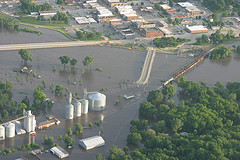
Here’s a photo of flood Cedar Falls, courtesy of Abrudtkuhl:

Floodedcedarfalls

Battle of the Pollsters

People say we shouldn’t pay attention to the polls, but in an election like this one, how can a guy resist?

Gallup

on June 16: Obama 46 — McCain 42.

FiveThirtyEight

projection for November on June 16:  Obama 51.5 — McCain 48.5 Obama wins 305 electoral votes. Landslide ahead. 

Pollster.com

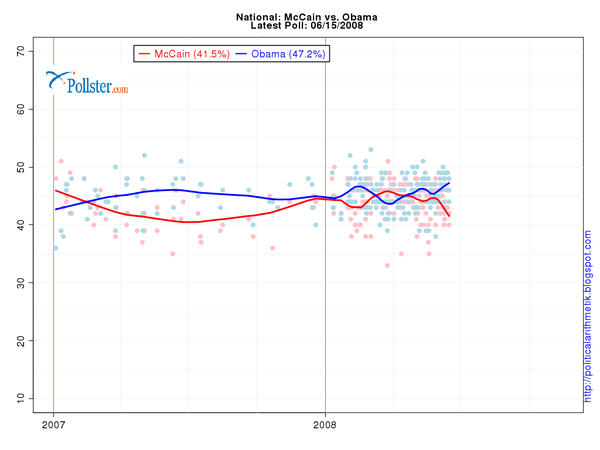
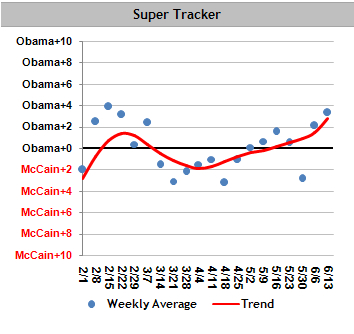
Their conglomeration of polls shows Obama at 47.2 and McCain at 41.5 but more interesting than Obama’s bounce, as Ezra Klein points out, is McCain’s dip:
 

It’s not Obama’s bounce that’s interesting. You’d expect that after he
won the primary. Its McCain’s dip. In other words, Obama isn’t just
getting independents and undecideds. He’s pulling support away from
McCain. This may show Clinton supporters who were naming McCain on
general election match-ups with Obama are coming back, or it could mean
McCain is just losing support as voters hear more about him.

It’s looking great for Obama — today.

June15poll

Iowa Floods: Another Reporter without a Clue

Crazy idealists such as myself, who want to preserve our traditional climate, wonder why reporters can’t even ask about what might be different about the latest flooding in the Midwest.

Before you jump down my throat, of course I know that "a climatology" is tracked over a thirty-year span, so we cannot link a single storm or a single season to global warming. A single data point, no matter how dramatic, isn’t all that meaningful: it’s the trend that matters.

But as Joe Romm at Gristmill points out (here) scientists already have found a trend towards extreme precipitation in the U.S. (Contemporary Changes of the Hydrological Cycle over the Contiguous United States; Trends). 

The authors of this 2004 study write:

These pictures and table indicate that, while mean precipitation increase was barely visible during the past century (and was statistically insignificant in the cold season), heavy and very heavy precipitation increased markedly as did the proportion of their totals attributed to these events.

Further, they found that the greatest areas of summer precipitation increase were in the Midwest and the Upper Midwest — precisely the areas feeding floodwaters into the Mississippi, the Cedar, and the Iowa rivers.

This trend towards extreme precipitation was also noted in the Nobel Prize-winning Climate Change 2007 report of the IPCC: "Similarly, for the continguous USA, Kunkel et al. (2003) and Groisman et al. (2004) confirmed earlier results and found statistically significant increases in heavy (upper 5%) and very heavy (upper 1%) precipitation of 14% and 20%, respectively." [pp302]

This trend towards heavy or extreme precipitiation is again echoed in the Climate Extremes Index, maintained by NOAA, the relevant example of which I will reproduce below.

Yet somehow even good reporters, such as PJ Huffstutter of the Los Angeles Times, can spend an entire day or more with a team of hydrologists in the Midwest (here), studying this record-breaking flood that has left most of Cedar Rapids underwater…and not bring up the possibility of a connection to climate change. Mr. Huffstutter has time to describe all sorts of arcane details about collecting flood data, but not to ask about the cause.

C’mon, PJ. Throw us a bone. Please ask these experts what they think about a link to global warming. If they doubt it, fine. But to pretend it doesn’t exist and doesn’t matter? You’re better than that.Usclimateextremesindex


The High Road to the White House: Why It Works

Today a couple of interesting data points came together on why taking the high road to the White House (inspiring voters with principle) is more likely to result in victory than the low road ("going negative").

First, from a recent Pew poll (here):

For Obama, one of the most striking positives in the survey is the
extent to which his supporters in the general election test say they
are voting for him rather than against McCain. Fully
three-quarters of Obama supporters view their vote as being for Obama,
while just 22% characterize their vote as anti-McCain. Four years ago,
John Kerry’s support was more anti-Bush (50%) than affirmative support
for Kerry (43%). Of McCain supporters, 64% say their vote is for him,
while 32% say it is a vote against Obama.

Obama has a clear advantage over McCain on several
major issues. In particular, voters say the Illinois Democrat could do
better in improving economic conditions, dealing with the nation’s
energy problems, and improving the healthcare system.

Second, a column by veteran politico Al Hunt, on the same topic (here):

Hope Over Fear

Overall, there is something else axiomatic about American
presidential politics: Hope or optimism, when conveyed
effectively, trump fear and despair. Every candidate offers a
steady diet of negative stuff about what a disaster his
opponent would be. Sometimes, when the opposition is flawed,
that’s sufficient — the Nixon landslide of 1972, for example.   
      

Usually, however, in big elections like those of Franklin
Roosevelt
and Reagan or small-ball ones like those of Bill
Clinton and George W. Bush, the victor is the one who seizes
the high road and offers a hopeful vision of where to lead the
country, capturing the can-do American spirit.   

That’s a terrible dilemma for McCain, 71, who, by nature,
is a can-do political figure. His only real hope of winning,
saddled as he is by his old adversary Bush, is fear; scaring
voters about Obama’s inexperience, or his associations or the
threat of terrorism.    
      

Obama, an Illinois senator, has to counter these charges
and convince voters he’s ready and resolute. If he can do that,
as he basically did against Hillary Clinton‘s formidable
challenge in the primaries, dial that expectations clock up
from a close win to a comfortable one.

And finally, a word of wisdom from a former Hillary supporter, via the LA Times (here) about how women for Hillary are lining up to now support Obama:

Authenreith, who was a respondent to a Times poll in February, said
there was no question now that Obama would better handle the economy
and, she hoped, overhaul the healthcare system.   

"I know if I vote a Republican in," she said, "it will never happen."

The Obama Wave Rebuilds

The hottest new pollster on the block goes by the name of Five Thirty Eight, has been profiled (here) by Newsweek, and knows more about statistics than I can even imagine. He’s famed for his ability to predict based on the work of polls published by others, which is a little like taking a test based on someone else’s notes, but the fact is — he’s good.

After forecasting a neck-and-neck race for weeks for the White House, just yesterday he ran a new model, and came out (here) with a landslide for Obama. He cautions (if you look down the posts) that polls at this stage have been misleading more often that not for the last few presidential elections, but still…after bittergate and Jeremiah Wright, the Obama wave has rebuilt.

Next question: When will the bandwagon effect kick in? And has any pollster tried to quantify that?

Obamawave

Stewart Brand on Why the Country Sucks

Short but fascinating Power Q & A with the great environmental activist Stewart Brand, courtesy of the revamped Mother Jones:

MJ: What is your favorite personal energy-saving trick?

SB: I live in a tugboat with 450 square feet. And living in a city
is bloody brilliant, especially in Manhattan, which has good public transit
and punishes you for driving.

MJ: That’s surprising, since the Whole Earth Catalog was so much
about—

SB: Right! Back-to-the-land. I did the catalog so I could help
[communes] without actually having to live on one. Partly that’s due to the
boredom of the remote countryside. You wind up in a very repetitive soap
opera, and that’s why everybody in the world is running to town as fast as
they can.

Young Enviro Activist Slams Street Theater

Blunt post from Rachel Barge (here) at the leading youth climate site, It’s Getting Hot in Here, on why environmental street theater is counter-productive. She writes:

I think there’s 3 major chain-reaction problems with using street theater as a means to build a movement:

1.    We look stupid
2.    People feel alienated

3.    It says, we’re different from you, therefore we’re against you

When was the last time you let a talking polar bear shift your views
on a political issue? Maybe you buy your car insurance because of what
a talking gecko tells you, but that’s a separate issue… The truth is, direct action street theater looks
totally stupid to the vast majority of people who witness it, and it
significantly undermines the credibility of the environmental movement.

The "talking polar bear" point reminds me of the infamous snowman question about global warming in the YouTube debate last year. That was (as you will see if you can stand to look at it) a moment when political street theater crossed over and made it into the national conversation about global warming.

But I think it’s generally agreed that was a low point in the discussion.

Certainly the question got no memorable answers out of any of the candidates, so whatever its value as entertainment, it failed as journalism.

Although Ms. Barge was roundly criticized by many fellow activists, I think her criticism is well paced.

I believe in drama, the word, and theater, but I don’t believe it can be imposed on people. If they don’t choose the experience, it’s not going to move them, won’t change their minds.

If thousands of activists did choose such an experience — as one suggests with a "million species march" on Washington; well, that might be different.

But snowmen asking questions on TV? Please: this is an important issue. Don’t turn it into a joke.

Anactivistdressedinpolarb

Republicans Have Lost Their Minds, part 97

A couple of years ago, the hugely famous and widely admired analyst Charles Barkley lowered the boom on the GOP, declaring — on a golf course, no less — "I used to be a Republican, until they lost their minds."

Little has gone right for the Grand Old Party in the last couple of years, but evidence indicates they have yet to come to their senses.

Two recent examples: first, according to a newish blog from the McClatchey group of newspapers, Hot Off the Trail, it was the GOP who moved to keep an impeachment vote before the House, to give GOP reps a chance to rail at Democrats "rather than working with Republicans to deal with real issues of importance to the American people." Steve Thomma notes:

When Republicans controlled the House, they did impeach President
Clinton. And many Republicans thought it so important that they didn’t
want to delay it even temporarily while the United States bombed Iraqi
dictator Saddam Hussein.

Hypocrisy much?

Second, once again this week the GOP moved to quash attempts to take huge tax breaks away from huge oil companies (see WSJ story here).

This has a way of looking bad to a public upset about high gas prices. At The Next Right site, blogger Josh Kane plaintively asks: How did the GOP get stuck "defending big oil" again?

He writes:

Every poll taken and every conversation with a
real person outside of DC shows gas prices as the number one issue in
the country… and today Senate Democrats schooled us on it.  “Republicans
Defend Big Oil” is the basic message we sent the country after the
energy debates in the Senate today, we’ll really win elections on that
one. Here’s the AP’s opening paragraph:

Saved by Senate Republicans, big oil
companies dodged an attempt Tuesday to slap them with a windfall
profits tax and take away billions of dollars in tax breaks in response
to the record gasoline prices that have the nation fuming.

Anything that even gives a reporter the excuse to write that is political insanity. 

Kane is absolutely right — and touchingly naive. It’s not coincidence that the GOP supports Big Oil. They got paid.

As documented (here) at Open Secrets, the oil and gas industries give the vast majority of their contributions to Republicans, about 75%, totaling over $160 million since l990.

Is that insanity? Maybe not. But it’s not nobility…

Oil_and_gas_contributions_to_gop_2