Whack a Climate Mole (killing the global cooling lie)

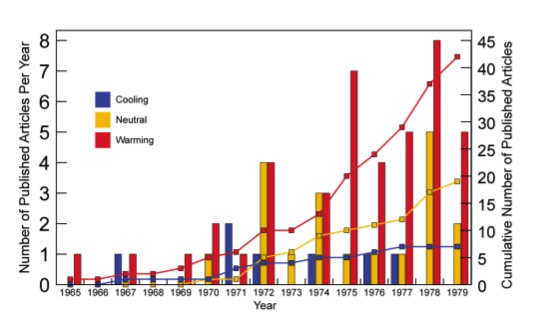
Two veterans of the climate wars, John Fleck (a reporter) and William Connolley (a scientist) team up for RealClimate to bring perspective — and data — to the endlessly misleading "How can we believe climate scientists about global warming today when back in the 1970s they told us an ice age was imminent?"

They write:

"Between 1965 and 1979 we found:

  • 7 articles predicting cooling
  • 44 predicting warming
  • 20 that were neutral

In other words, during the 1970s, when some would have you believe
scientists were predicting a coming ice age, they were doing no such
thing. The dominant view, even then, was that increasing levels of
greenhouse gases were likely to dominate any changes we might see in
climate on human time scales."

They even include a nice graph. For more, see the story in USA Today.

Snapshot_20080307_165219

“We’re in the Lead in Global Climate Change”

Addressing a renewable energy conference in Washington today, the Prez said:

"America is in
the lead when it comes to energy independence; we’re in the lead when
it comes to new technologies; we’re in the lead when it comes to global
climate change — and we’ll stay that way."

Bush threw out some big round numbers that "we" apparently have been spending on "alternative" fuels, although that list includes corn., which few experts in the field consider much help. The Prez heavily touted cellulosic ethanol fuel production, even though recently the USDA said that it will not be economically viable for years — not until 2013 at the earliest.

It’s enough to make you wonder if Bush includes CO2 emissions in the category of "being in the lead when it comes to global climate change."

But to be fair, I read the entire speech, and although it’s mostly misleading and forgettable nonsense with a few buzzwords ("biofuels," "clean," "renewable") thrown in, the Prez notably did not mention the hateful oxymoron "clean coal."

Maybe that’s because after spending close to $1.8 billion on a much-heralded "clean coal" plant in Texas, the Bush Administration Department of Energy has thrown in the towel on development of that technology, according to the Wall Street Journal.

Under the project, called FutureGen Industrial
Alliance Inc., the government was to support the construction of a
nearly pollution-free coal plant that would have turned coal into
hydrogen-rich synthetic gas for generating electricity while pumping
carbon dioxide underground for permanent storage. Carbon dioxide from
fossil-fuel combustion is a primary greenhouse gas linked to global
warming.

In recent years, however, the project’s estimated cost
has roughly doubled from an original level of $950 million, driven
partly by rising prices for certain materials like steel and equipment
and by higher-than-anticipated labor costs.

Some industry observers felt the eventual cost could
have exceeded $2 billion, which would have made it one of the most
costly power plants ever constructed, given its modest, 275-megawatt
size. One megawatt can power 500 to 1,000 homes. In a conference call
yesterday, Clay Sell, deputy secretary of the DOE, said department
officials concluded that the project’s costs were likely to rise even more.

To repeat, according to the paper, if actually built, it would have been "one of the most costly power plants ever constructed, given its modest, 275-megawatt size."

Another sterling Bush effort come to naught.


The Wheel Turns — Against Gasoline

Shocked by high gas prices? You’re not alone: according to the lead story in yesterday’s Los Angeles Times, prices are at a record high.

The gravity-defying price of oil shot through another barrier Monday by
briefly touching $103.95 a barrel in New York trading, the highest cost
ever for black gold even after adjusting for inflation.

But the experts say it’s not so much a rise in demand that is pushing up the cost, but a fall in the worth of the dollar.

"I don’t think it’s a coincidence that the price of oil hits an
all-time high around the time that the dollar hits an all-time low
against the euro," said Ken Medlock, an energy studies fellow at Rice
University’s Baker Institute. "The amount of dollars you have to give
up for a barrel of oil is going to increase because the dollar is
purchasing less and less."

In response, according to an excellent story in Monday’s Wall Street Journal, Americans have at last began to turn against gasoline.

The WSJ headline sounds almost epochal:

Americans Start to Curb Their Thirst for Gasoline

It’s the biggest drop in consumption in sixteen years.

Another probable non-coincidence: Inflation for most Americans took a huge jump last year — the highest in sixteen years.

Today, a weakening economy is intensifying the effects of high gasoline
prices, at the same time Americans are being pinched by broader
inflation. In January, consumer prices were up 4.3% from a year
earlier, a 16-year high, led by sharply rising food and energy costs.
Even stripping out food and energy, the so-called core inflation rate
was up 2.5% from the previous year, reflecting higher costs for
purchases such as education and medical care.

We are beginning to see how we must change our behavior to reduce gasoline consumption. And, according to the story, we are beginning to see how those changes could endure.

The longer gasoline prices remain high, the greater
the potential consumer response. A 10% rise in gasoline prices reduces
consumption by just 0.6% in the short term, but it can cut demand by
about 4% if sustained over 15 or so years, according to studies
compiled by the Congressional Budget Office.

As consumers make major spending decisions, such as
where to live and what kind of vehicle to drive, they are beginning to
factor in the cost of fuel. Some are choosing smaller cars or hybrids,
or are moving closer to their jobs to cut down on driving. Those
changes effectively lock in lower gasoline consumption rates for the
future, regardless of the state of the economy or the level of gasoline
prices.

Eventually, the price of gasoline will likely fall. Somewhat. But it hasn’t fallen below $2.70 a gallon since Katrina, according to the EIA, and the experts say the cost of driving will continue to climb this year. This news came as a big surprise to the Prez.

"That’s interesting…I hadn’t heard that," Bush said.

The former oilman then promised to veto a House bill to trim $18 billion in tax breaks to the oil industry.

To be fair to the Prez, this expectation of a continued steady rise in gas prices is new to the industry. Back in 2004 Daniel Yergin, an often-quoted expert on this subject who leads an energy think tank in Cambridge, predicted that prices would have fallen to the $38 range by now. In a story written under his influence, a business writer for Forbes painted a gee-whiz picture of the promised solution:

Answer: capitalism’s amazing resiliency. Oil
prices rise–oilmen become innovative. They work, they invest, they put
their heads to the task, they apply technology, and pretty soon they’ll
discover how to extract oil profitably from oil sand. Or open wells in
deeper water. Or scour the planet for new sources using scanners
thousands of miles in space.

Hmmm….the oil industry will use scanners in space to solve our energy problems.

Well, until that blessed day arrives, here’s a tip of the hat to one of the people who aren’t waiting for the oil industry, and are already looking for solutions down here on earth.

Anne Heedt, of Clovis, Calif., has been moving toward
a more fuel-efficient lifestyle for the past few years. She owns a
Toyota Prius hybrid but takes her bike on errands when weather permits.

"We’re not always going to have the same accessibility
to gasoline that we’ve had in past decades, so we do have to start
thinking about what we’re going to do over the next 50 years," said the
31-year-old Ms. Heedt, who used to work at a medical office but is
between jobs.

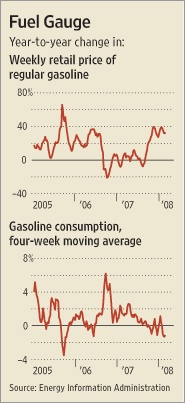
Gaspricesvsgasconsumption

Neil Young Puts On No Airs

Nice piece in a UK paper on Neil Young at the Berlin Film Fest. The admiring reporter/critic brings out a number of details Young would call "innaresting" — such as the fact that Neil ordered his old pals Crosby, Stills, and Nash around on the last tour. He took that right since he released the record they toured behind — "Living With War" — which although not great, did successfully plant a musical flag on a crucial turn in the national view against the Bush administration.

Young wouldn’t let his old pals sing a dippy song about saving the whales, even though a lot of his songs — such as "Let’s Impeach the President" — were only so-so.

‘When the impeachment song was criticized for being monotonous, intriguingly, Young defended that on artistic grounds, saying that having to make that demand necessarily had a grating, edgy tone.

Ultimately, the tour was very successful, although it brought in a lot of death threats. Neil’s bluntly accusative screeds maybe called for that kind of response, although the title song "Living with War" was mournful and melodic in the classic Young mode, and likely to survive this crisis.

Young has a long history of outraging certain individuals, especially in the South.

Once Young memorably pissed off Lynrnd Skynrd, but this turned out well: Sweet Home Alabama.

The English reporter interviewed Young, and saw his most recent film, but the piece concludes with a wonderful look at Neil Young today.

Over the next few days, though, I cross Young several times, in a hotel lift or wandering around the streets, blending in unremarked with the grey winter scenery. He nods at me cordially, keeping a proper distance: a solitary, self-contained figure, still puzzling over the state of the world.

Neilyoungberlinfilmfest


Why Limbaugh (Really) Hates McCain

Given that John McCain is universally considered to be the most electable of all Republican candidates this year, a lot of us pinko lefties have been wondering why rightwing radio blowhard Rush Limbaugh hates him so much.

I mean, sure, McCain is "soft" on torture, and believes we are changing the climate with greenhouse gases, and has cosponsored a few bills with Democrats, but it seemed to be a clear case of cutting off your nose to spite your face, and Limbaugh usually isn’t that stupid.

But now — thanks to a terrific column from Frank Rich, another pinko lefty who, like me, actually kind of likes certain aspects of John McCain — the truth is out.

Back in 2002, when Limbaugh was throwing slime at anyone sensible enough to doubt the wisdom of charging into war in Iraq, he got into it a little with McCain, who went on to compare Limbaugh to "a circus clown."

When Limbaugh called him out, McCain "apologized":

"I regret that statement," he told an
interviewer on Fox News the other night, "because my office has been
flooded with angry phone calls from circus clowns all over America.
They resent that comparison, and so I would like to extend my apologies
to Bozo, Chuckles and Krusty."

Ouch. No wonder Limbaugh now says that if McCain is nominated, it will destroy the GOP. Appears that comment of the Senator’s has left a mark!

The Politics of Fear: Right vs. Left

Last week Andrew Sullivan gave the mic to a National Review editor named Peter Suderman, among others, who has posted on the petty-minded Planet Gore. (That’s the right-wing website devoted to the proposition that global warming is Al Gore’s doing, and if we can just make enough fun of him personally, the whole problem will miraculously vanish).

Suderman borrowed the allegation that global warming is, like the war on terror, part of the politics of fear. He quoted another writer for the seriously thoughtful journal n + 1, Alex Gourevitch, who wrote:

Environmentalism is a left-wing politics of fear because it rests on the
deeply fearful idea that only an overweening threat to our physical and
collective health can inspire us to “transcendence.” Threats to the
very conditions of life, rather than social controversies over power
and distribution, come to motivate political engagement – an engagement
that presumes setting to one side inequality and unfreedom as the
central categories of political contestation.

I realize now that I trust Suderman to quote Gourevitch fairly: I shouldn’t make that assumption. Here’s Gourevitch’s original essay: Will follow up. But for now let me be fair to another of Sullivan’s guest bloggers, Patrick Appel, who posted a deeply thoughtful response from a reader. In part, it read:

That
global warming and global environmentalism both inspire fear, and fear
can result in antipolitics, is quite clear, but the analogy between
this war on terror and the war on global warming breaks apart at a
fundamental level.  The war on terror has been characterized by
affirmative misrepresentation of facts to achieve political ends while
the war on global warming is characterized by a struggle to bring facts
to human consciousness, which will have political consequences.

Yes! Brilliant. Thank you, anonymous reader.

Great California Painter Moves On

The Los Angeles Times reports that Milford Zornes, who had a show just last year at age 100, has died.

His paintings of grassy landscapes, rugged shorelines and coastal hills
recall the time in California before freeways and housing developments.
He was one of a group of area watercolorists led by Millard Sheets who
became known as the California Scene Painters. They worked outdoors and
aimed to create a distinctly American style of art.

Would that we all could lead such noble lives! Here’s a painting I especially love of Zornes, called Mojave, from l963. How perfectly his watercolor catches the arid beauty of that landscape.

Milfordzornes

Cash-rich Obama Buys Yahoo

Outbids Microsoft for Internet Giant


Flush with cash
after a deluge of online donations, Sen. Barack Obama (D-Ill.) stunned
the business world today by outbidding Microsoft for the Internet giant
Yahoo.


The purchase of Yahoo! is believed to be the largest acquisition of
a multibillion-dollar company ever by a Democratic presidential
candidate, industry experts said.


A spokesman for Microsoft at the company’s Redmond, Washington
headquarters acknowledged that the company was “disappointed” to lose
Yahoo to Sen. Obama, but added, “We can’t really be mad at him, because
we love him so.”


The news of Sen. Obama’s $48 billion offer for Yahoo sent a shudder
through Sen. Hillary Clinton (D-NY)’s campaign, which for the past six
weeks has been subsisting on Ramen noodles.


From Andy Borowitz today. More here:


Ralph Nader Takes Credit for Al Gore’s Nobel Prize

Believe it or don’t. Here’s the ever-charming Nader, in an interview with the BBC:

BBC: A lot of people blame you for allowing George Bush to come in in 2000, because you took a fair number of votes that would have gone to Al Gore for the Democrats.

NADER: No, actually the studies show that by pushing Gore to take more progressive stands, he actually ended up with a net vote. That’s Solon Simmons, who teaches at George Mason University. If you ask Al Gore, who’s now world famous, I don’t get credit for that, do I? If I’m going to get blamed for his defeat, why don’t I get credit for his making global climate change a major issue, making him a multi-millionaire, and for getting a Nobel Prize?

Wow. What can you say. By that logic, Nader should run for president. Who knows, maybe Obama will end the war, stop global warming, and restore prosperity — and we’ll have Ralph Nader to thank.

Mr. Fish feels differently. So does Tom Toles:

Tolesonnader

There Will Be Blood: A Dramatization of Peak Oil?

In the realm of art, no interpretation of a work can be final, but intriguing hints from no less than the writer/director Paul Thomas Anderson suggest that the stunning movie There Will Be Blood is actually a story not about the rise and fall of a man so much as it is about the rise and fall of a commodity: oil.

Of course, even the intentions of the creators — and in the case of There Will Be Blood, that means principally the writer/director Paul Thomas Anderson, the star Daniel Day-Lewis, the cinematographer Robert Elswit, and the composer Jonny Greenwood — don’t necessarily prove anything. (After all, Anderson revealed in one interview that he "had no idea what we were doing" until he heard Greenwood’s revelatory score.)

But consider what Anderson said in an interview bout the movie with Terry Gross:

"We all know what has happened with oil, don’t we? We all know the
end of the story. It’s a bit like Titanic, we all know the boat sinks.
The fun of the story is watching how we get there."

Or what he said in an interview about with Charlie Rose, in reference to the oil industry’s recent fortunes:

"I haven’t been living in a bubble for the last six years."

Or what the great music critic Alex Ross said of the score in The New Yorker:

Greenwood, too, writes the music of an injured Earth; if the smeared
string glissandos on the soundtrack suggest liquid welling up from
underground, the accompanying dissonances communicate a kind of
interior, inanimate pain. The cellos cry out most wrenchingly when
Plainview scratches his name on a claim, preparing to bleed the land.

Too literal an interpretation of what Anderson described to Charlie Rose as "a great boxing match" between the two of the most powerful forces in recent American history — evangelical religion and the oil industry — would be pointless.

But when it comes to the controversial ending, we have to consider the possibility that this story is not about an individual, or even an industry.

We have no choice, really, because it’s only in this context that the finale makes sense.

For those who have seen the movie, or who have no intention seeing the movie but still want to consider the idea, please read on.

Therewillbeblood