Lede of the Week

"SANAA, Yemen —  Jaber Elbaneh
is one of the world’s most-wanted terrorism suspects. In 2003, the U.S.
government indicted him, posted a $5 million reward for his capture and
distributed posters bearing photos of him around the globe.

!–
var rn = ( Math.round( Math.random()*10000000000 ) );
document.write(”) ;
// –>
http://www.washingtonpost.com/wp-dyn/content/article/2008/05/16/AR2008051603921_StoryJs.js?8679010439

None of it worked. Elbaneh remains at large, as wanted as ever. The al-Qaeda operative, however, isn’t very hard to find.

One day last month, he shuffled down a busy street here in the
Yemeni capital, past several indifferent policemen. Then he disappeared
inside a building, though not before accidentally stepping on a
reporter’s toes."

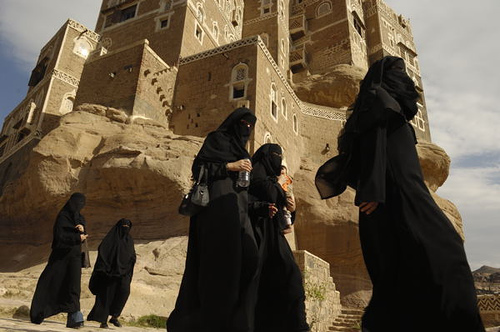
[Those toes belonged, no doubt, to the reporter Craig Whitlock, writing from Yemen for the Washington Post. Great piece — find it here. The great travel writer Pico Iyer also included a harrowing account of visiting Aden, Yemen, an ancient city, in his Sun After Dark. Yemen is one of the most Al Qaida-friendly nations in the world, which can make visiting by Americans a bit perilous…here’s a strong photo of Sanaa from world traveler/photographer Laurent Zylbergman and his interesting 365 Degrees project, via Flickr.]
Rockpalaceinsannayemen

Bush Links Obama to Appeasement: What Obama Should Have Said

What Bush said, what Obama said in response (here). Obama concludes:

George Bush knows that I have never supported engagement
with terrorists, and the President’s extraordinary politicization of
foreign policy and the politics of fear do nothing to secure the
American people or our stalwart ally Israel.

This is okay, but seems a little mild to me. I know, he’s cool. A young black man can’t make any sudden moves, for fear of scaring the white folk. Still, what about —

It’s astonishing to me that a President would use the opportunity to speak on a sacred occasion to Israel as a platform on which to launch a broad attack on a candidate who hasn’t even been nominated yet. But I think the American people are tired of this politics of fear, I think they know that President Bush and Vice-President Cheney took us into a war under false pretenses. I think the people want to change course in Iraq, and I think they know I am the candidate best able to deliver on that promise. So maybe that’s why I am being attacked in this outrageous manner.

Graph of the Week

From a just-published study in Nature that divides the globe into cells, and studies the cells for evidence of warming vs. cooling. Surprise, surprise, they find far more warming than cooling. I know this will change the minds of the delayers. It’s another $32 study, but this one looks like a doozy: may have to buy it.

At least the authors include some great graphs for free (here). Here’s one, looking at warming v. cooling in North America.

North_america_warming_v_cooling

Critical Habitat for Polar Bears Disappearing, WSJ Shows

A tough story from Wall Street Journal tries to strike a balance in discussing the listing of the polar bear as a threatened species. The first two graphs:

Visitors to some of the oil fields that fringe
Alaska’s Beaufort Sea get this rather disturbing warning before
venturing out into the Arctic cold: Look carefully under cars in the
parking lot and the buildings on stilts. Why? Lurking there may be one
of the world’s largest land carnivores — the polar bear, which can
actually track a man down.

But who’s to protect polar bears against humans? For
the past few years, polar bears off the Alaskan coast were observed
drowning many miles out at sea. The suspected culprit: fewer ice floes
upon which to hunt their favorite meal — seals — because of global
warming.

The story lays out the facts, clarifying the importance of a "critical habitat" designation, which the Bush administration is not going to grant, unsurprisingly. But best of all is the graphic, which makes easily visible the shrinking of sea ice in the Arctic, year-round, with an annual median….and the surrounding polar bear range, and its shrinkage. Incredible. To see it, go here.

Enjoying the May Grey

Forecasts say it won’t last much longer this week, with interior valley temps in SoCal expected to climb into the 80’s and even the 90’s by Wednesday. (Some uncertainty remains in the forecast, but a high is expected to build that will end the onshore flow, I regret to report.)

Enjoy it while it lasts, I say to those in this area. If we get some June gloom, savor it. After a good wet January, we’ve had little or no rain since, a phenomenon the climatologists link to a La Nina strengthened by the Pacific Decadal Oscillation (here).

Take a look at this graph of rainfall over the last few years (in LA). The wave form is the "average" — which of course in SoCal is something of a statistical artifact, but nonetheless shows how dry it’s been lately…like, nothing, basically. 

Larainfall2004to2008

Deserts Far Better Carbon Sink Than Expected

Some actual good news today, from a research team at one of this countries premier climate research centers, the Desert Research Institute, which reports that unspectacular desert plants may be far better at taking CO2 out of the atmosphere than previously thought.

The annual removal of the greenhouse gas from the atmosphere was
upwards of 100 grams of carbon per square metre, on a par with some
temperate forests, with the majority being consumed during spring
months.

So reported Nature in a short piece today posted on the study by Georg Wolfhardt and colleagues at the DRI.  They’re quoted in the press release:

Our results indicate that if all the desert ecosystems in the world–which together make up more than 30 percent
of Earth’s land surface–are taking up carbon dioxide at the same rate as our Mojave Desert site, then the amount
of carbon dioxide taken up each year would match the amount emitted to the atmosphere globally through burning of fossil
fuels (about 6-7 gigatons of carbon dioxide per year)." Arnone said. "Another way to look at this is, without
deserts, the annual rate of anthropogenic carbon dioxide rise might be twice as rapid as it is presently and might
therefore promote more rapid global warming.

Amazingly, "the authors suggest that a significant portion could be stored in the
biological crusts, such as blue-green algae, lichens and mosses, that
cover most desert soils."

Who would’ve thunk it? Gives a whole new meaning to the concept of crusty…

Climate200834i1

The Black Swan vs. Power Law

Much talk this year about Nicholas Taleb’s Black Swan. (For short and long — but remarkably lucid — discussions of the concept, from a completely non-mathematical perspective, take a look at this excellent introduction from Grumpy Old Bookman.)

Most of the coverage of the concept has been laudatory, so it’s useful to hear a discouraging word, especially from the great thinker Stewart Brand.

Like most readers, I expect, I know Brand for his incredible outpouring of new ideas — about ways to live, to see, about how buildings learn, on and on beyong recounting except on Wikipedia.

So it’s actually refreshing to hear Brand sounding a little grumpy about Black Swans, in Edge:

Taleb seems oddly innocent of "power law" behavior, in which Black Swans hold a much different position than "outlier," "tail," etc. — all Bell Curve denotations, in power law phenomena, nothing is far from typical, because nothing whatever is typical.

The violence/incident of terrorist incidents can be charted on a power law curve, not a Bell curve.

At base, this criticism is indisputable: a Black Swan is nothing but an extreme example of a familiar phenomenon, the impact of the improbable. You cannot predict a 9/11 or Katrina with a Bell curve.

But it helps us put it in a context. Power laws are nothing new, if not easy to remember. Numerous named examples exist. The Black Swan is a point on a distribution itself. Mustn’t leap to the assumption that the highly improbable must be bad…it’s not necessarily the case. (Taleb would agree, but that’s not why his book is being read around the world.) The graph in Wikipedia makes the point wonderfully clear by charting not a horror but a delight. Popularity.

To wit:

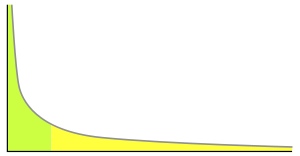
"An example power law graph, being used to demonstrate ranking of
popularity. To the right is the long tail, to the left are the few that
dominate (also known as the 80-20 rule)."

300pxlong_tail

Democrats Poised for November Landslipe, Economic Model Predicts

Krugman runs the numbers and concludes:

Right now, GDP is flat (falling in the monthly estimates); Bush has a
negative net approval of 30 percent or more; and people are tired of
Republicans. So it ought to be a smashing Democratic victory. When I
plug current numbers into the Abramowitz model (making a guess about
1st-half GDP and assuming that Bush approval in June will be about
where it is today), it says 57-43 Democrats.

And although general election polls this early aren’t meaningful historically, they too point to a Dem victory. To GOP pollster Frank Luntz, the landscape looks grim:

"It used to be that Republicans
won [in polls] on economic and values and foreign policy issues," he
says. "Democrats won on quality of life. Now Democrats are winning on
everything."

Luntz is quoted in a piece called Gloomy Republicans in the The Weekly Standard by its editor Fred Barnes, Bush’s adoring biographer. He reports that Republican goals for 2008 are "modest:

There are three major
goals: Hold the White House, avert sweeping House losses, and keep the
Senate defeats to four or fewer.

Basically, avoid a landslide. But the latest poll numbers from a Bloomberg/Los Angeles Times poll look alarming: In fact, the graph for McCain vs. Obama looks downright landslidey…yet the pundits (and the electoral college) say the race will be close. Should be innaresting

Trial_heat