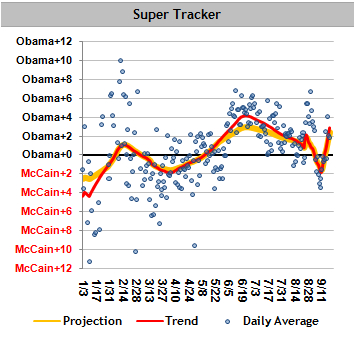
According to the exquisitely tailored statistics of Nate Silver at Five Thirty Eight, a new reason to believe:
A Change in the Wind
According to the exquisitely tailored statistics of Nate Silver at Five Thirty Eight, a new reason to believe:
Steve Lopez, who has a movie coming out this Christmas called The Soloist, is probably the most popular and best-paid columnist in Los Angeles. He’s popular for good reason. He takes on tough issues, including homelessness, illegal immigration, and school bureaucracy, but with bracing good humor.
This weekend he went to Nome, Alaska, to test Sarah Palin’s idea that being able to see Russia gives a person a sense for foreign policy. It’s a good column (and has a video version, if you prefer video).
But best of all, he introduces us to a crusty newspaperwoman named Nancy McGuire, who wrote her own super-blunt column on Sarah Palin for the Nome Nugget, called Lies Fly (see the editorial on this page).
McGuire is a little like Hildy Johnson thirty years later, if Hildy Johnson after "His Girl Friday" had busted up with Cary Grant and impulsively moved up to the Arctic Circle to start over. She’s Ms. No-Nonsense:
Sarah Palin claims she has foreign policy experience because Alaska shares borders with Canada and Russia. Someone please whack her over the head with a geography book.
And:
Sure itʼs flattering that an Alaskan was picked to be McCainʼs running mate. We Alaskans are proud of our state, but letʼs face it; Palin is woefully underqualified to be anywhere near the oval office. It kind of makes one want to go out and find a moose and put lipstick on it.
Lopez, impressed, told McGuire that she might be in line for Secretary of State, since she once actually did come close enough to Russia on a plane trip in college to be chased off by a Soviet MIG fighter.
"I‘ll go for president," she said, noting that she has more Russia experience than Palin. "I’ve seen it closer."
Below Steve Lopez tries to see Russia from Nome, but discovers an island in the way.
[Photo by Myung Chun]

Maher’s opening to this weekend’s "New Rules" segment is not bad, but his rant on Levi Johnston — "America’s #1 political prisoner," being held in that "frozen meth lab they call a town" — is just hilarious. See below and see if you don’t agree:
Barack Obama is making a big push in Florida, greatly aided by a $40 million campaign, and a monumentally stupid — politically speaking — quote from John McCain in this month’s issue of Contingencies (see here).
According to John McCain:
Opening up the health insurance market to more vigorous nationwide
competition, as we have done over the last decade in banking, would
provide more choices of innovative products less burdened by the worst
excesses of state-based regulation.
Barack shot back:
So let me get this straight? He wants to run health care like they’ve been running Wall Street!
And McCain can’t claim he was misquoted: he wrote the article.
Chalk up another gaffe for McCain in his increasingly self-destructive run for president. It’s a gaffe that’s going to hurt his chances in Florida, where seniors think a lot about health care, retirement, and Social Security.
Speaking of elections, while going from one fund-raiser to another in Florida, today Obama added:
I’m confident that we’re going to win this thing. But can I
make this point? There are easier ways to win it and harder ways to win
it. It would be really nice for us to win Florida. I’ll tell you, we
can win this thing without Florida, but boy, it’s a lot easier if we
win Florida. If we win Florida, it is almost impossible for John McCain
to win.
Most pollsters give McCain a slight lead in Florida, but experts say it’s very close, and likely to come down to who better is able to get out the vote. According to the Wall Street Journal, the GOP has successfully put in two measures to suppress ballot-casting by younger, more mobile voters. Democrats have vowed, however, to defend the votes, and promise to have 5,000 volunteer lawyers on hand in the precincts.
According to this second piece in the WSJ:
The Obama campaign also says it has registered about 100,000 new
voters this year, part of 250,000 new registrants in the state overall,
and the majority of them are Democrats.Now comes the bigger task: making sure inexperienced voters can
navigate two new state laws. The first is the so-called "No match, no
vote" law, which requires a match between a voter’s driver’s license or
Social Security number and a government database. Critics say database
records are riddled with errors.A second law allows citizens to challenge the legitimacy of fellow
voters. Challengers need not prove their accusations. Instead, the
challenged voter has two days to justify his right to cast a ballot.State Republican lawmakers who pushed the law say it will help combat fraud. Democrats call it a vote-suppression measure.
Gee, why so cynical, Democrats?
Check out this great Internet graphic from a company — Media Curves — that uses focus groups to test responses from three groups — Democrats, Independents, and Republicans — to political ads. Fascinating results. Watching approval rating in action, you can see suspension of disbelief play out: the spectrum ranges from "Completely Believable" to "Not at All Believable."
The gist: this straightforward advertisement, from the Defenders of Wildlife, makes a potent case against Sarah Palin’s cruelty towards animals. The ad wins over both Democrats and Independents.
Republicans cannot be budged.But to influence two out of three groups is an extraordinary result.
See more here.
Two or three days in a row now, Barack Obama has flat-out mocked John McCain’s attempts to stumble through a fiscal crisis that has taken American values — stock, home, and interest numbers — backwards to the 2004 era.
You know the story. Home values are down, stock prices are down. In Southern California, homes are now worth what they were back in 2003. Stocks are where they were in about 2004-5.
The difference is that 2008 has also brought new present-day economic problems. Joblessness is up, gas prices are up, food prices are up.
On Monday, when the Dow took a 500-point header off a cliff, McCain repeated what he has said countless times before, the GOP mantra of "strength." Bush, Cheney, Huckabee, Giuliani, Thompson, they all cling to this word like drowning men to a plank. McCain claimed "the fundamentals of the economy are strong," in a tone not too far removed from Herbert Hoover or Phil Gramm. But this time McCain ran into a buzzsaw named Barack Obama.
Senator – what economy are you talking about?
What’s more fundamental than the ability to find a job that pays the
bills and can raise a family? What’s more fundamental than knowing that
your life savings is secure, and that you can retire with dignity?
What’s more fundamental than knowing that you’ll have a roof over your
head at the end of the day? What’s more fundamental than that?
Then on Tuesday, McCain comes back with a recommendation for a "bipartisan commission," as with 9/11, to study the issue and offer recommendations.
Obama jumped on that and tore it apart. He mocked the suggestion as:
“the oldest Washington stunt in the book — you pass the buck to a
commission to study the problem. But here’s the thing — this isn’t
9/11. We know how we got into this mess. What we need now is leadership
that gets us out.”
According to the FOX News report, the crowd listening to him in Golden, Colorado cheered loudly.
Then after first saying the government should not bail out AIG, and then saying it should, McCain today suggested firing Christopher Cox, the chairman of the SEC.
Seemingly within the hour, Obama fired right back:
In the next 47 days you can fire the whole trickle-down, on-your-own,
look-the-other-way crowd in Washington who has led us down this
disastrous path. Don’t just get
rid of one guy. Get rid of this administration. Get rid of this
philosophy. Get rid of the do-nothing approach to our economic problem
and put somebody in there who’s going to fight for you.
Pundits are focusing on McCain’s apparent gaffe. Officially the President doesn’t have the right to fire the SEC chairman, and Christopher Cox is a fellow Republican, so if McCain were to try and fire him, he would have to over-rule his own party.
But what stands out to me is the mockery. Once upon a time, it was the GOP who knew how to mock the Democrats and their allies. Ronald Reagan made it look like sport. Right now, it’s Obama. These are clean shots he’s getting in, in a huge campaign, and without apparent effort.
McCain is on his feet, but looks dazed, indecisive, confused. The election still has fifty days to go, but McCain has had a gruesome week. One more mistake, and this could be over.
[AP pic via the Los Angeles Times]
According to a fascinating story by Sarah Posner in Salon (here), when Sarah Palin was Mayor of Wasilla, Alaska, she enrolled the staff in "Basic Life Principles" character training designed by Bill Gothard.
This is a program that focuses on seven "non-optional" principles, such as "The Principle of Authority." The training is not labeled as religious, but every section includes a quote from the Bible.
Christianity Today said "Gothard heavily stresses submission to godly authority," and warned that his courses have been accused of "excessive discipline" of young members in its home state of Illinois.
So, let’s recap. An activist young Mayor wins election, shakes things up by firing city officials, such as the police chief, redecorates her office at a cost of $50,000 without authorization, plunges the town deep into debt, and brings in a quasi-evangelical group for training exercises.
And for this, she is known as a "reformer."
Un-freaking-believable.
How about: crazed?
Plus, she has some strange ideas…if this transcript from a recent town hall meeting in Grand Rapids can be trusted. She was asked how to keep domestic energy at home:
"Oil and coal? Of course, it’s a fungible commodity and they don’t
flag, you know, the molecules, where it’s going and where it’s not. But
in the sense of the Congress today, they know that there are very, very
hungry domestic markets that need that oil first," Palin said. "So, I
believe that what Congress is going to do, also, is not to allow the
export bans to such a degree that it’s Americans that get stuck to
holding the bag without the energy source that is produced here, pumped
here. It’s got to flow into our domestic markets first."
Okay then. Glad that’s cleared up.
Because Hurricane Ike has blown out power to much of the Texas coast, the nation’s largest refinery — the Exxon Bayless facility, which can produce over 500,000 barrels a day — will be out of commission at least until September 30th.
That’s according to the WSJ, which adds in conclusion:
So while the economy is cheering crude’s plunge below $100, that won’t
trickle down to retail gasoline prices for several more weeks at least.
If nothing else, that might help keep Congress’ eye on the ball as it tries to salvage some sort of energy package.
The story doesn’t call for a specific action, but clearly strikes an anti-Congress tone. The Journal has always been known for its activist editorial page, but I don’t recall that pointed a political remark in a business news story before.
The paper also has undergone a radical web design, dropping its association with the iconic white-space design of the newspaper.
Hmmmm.
[pic courtesy of Linbow. She tells about it here]

Finally will it not be enough,
after much living, after
much love, after much dying
of those you have loved,
to sit on the porch near sundown
with your eyes simply open,
watching the wind shape the clouds
into the shapes of clouds?
Even then you will remember
the history of love, shaped
in the shapes of flesh, everchanbgng
as the clouds that pass, the blessed
yearning of body for body,
unending light.
You will remember, watching
the clouds, the future of love.
–-Wendell Berry, from "A Timbered Choir"
[pic via FotoEdge, from Olanthe, Kansas]

From the jaw-dropping Andrew Becevich of The American Conservative:
As portrayed by [President Jimmy] Carter, the mistaken idea of freedom was quantitative:
it centered on the never-ending quest for more while exalting narrow
self-interest. His conception of authentic freedom was qualitative: it
meant living in accordance with permanent values. At least by
implication, it meant settling for less.
How Americans dealt with the question of energy, the president
believed, would determine which idea of freedom would prevail. With
this in mind, Carter outlined a six-point program designed to end what
he called “this intolerable dependence on foreign oil.” Although he
expressed confidence that the United States could one day regain energy
independence, he acknowledged that in the near term “there [was] simply
no way to avoid sacrifice.” Implicit in Carter’s speech was the
suggestion that sacrifice just might be a good thing. For the sinner,
penance must necessarily precede redemption.
As an effort to reorient public policy, Carter’s appeal failed
completely. Americans showed little enthusiasm for the president’s
brand of freedom with its connotations of virtuous austerity. Not
liking the message, Americans shot the messenger.
Carter’s speech did enjoy a long and fruitful life—chiefly as fodder
for his political opponents. The most formidable was Ronald Reagan. He
portrayed himself as conservative but was, in fact, the modern prophet
of profligacy—the politician who gave moral sanction to the empire of
consumption. Beguiling his fellow citizens with talk of “morning in
America,” Reagan added to America’s civic religion two crucial beliefs:
credit has no limits, and the bills will never come due. Balance the
books, pay as you go, save for a rainy day—Reagan’s abrogation of these
ancient bits of folk wisdom did as much to recast America’s moral
constitution as did sex, drugs, and rock and roll.[edit]
The Reagan
Revolution was never about fiscal responsibility or small government.
Far more accurately than Carter, Reagan understood what made Americans
tick: they wanted self-gratification, not self-denial. Although always
careful to embroider his speeches with inspirational homilies and
testimonials to old-fashioned virtues, Reagan mainly indulged American
self-indulgence.[edit]
The events of
Sept. 11, 2001 only hardened this disposition. Donald Rumsfeld
summarized the prevailing view: “We have two choices. Either we change
the way we live, or we must change the way they live. We choose the
latter.”

 Kit Stolz