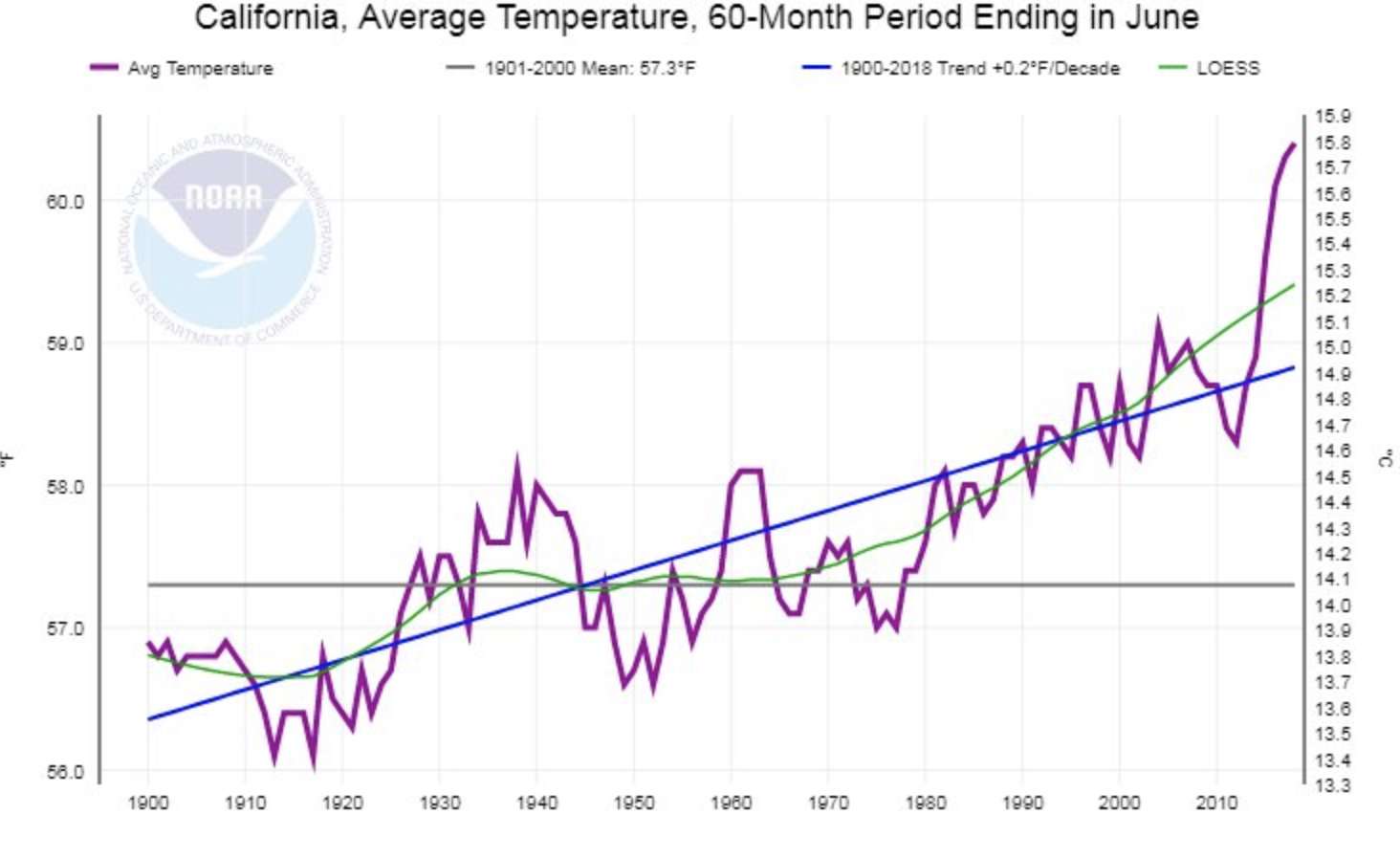
It’s going to be crazy hot the next couple of days here in Ojai (112 on Friday they say) and in coastal Southern California this weekend. In the words of Weather West (aka climate scientist Daniel Swain):
…in Los Angeles and Santa Barbara counties, especially, the heat from Fri-Sun will be extreme due to the localized effects of the downsloping winds and associated compressional warming. Temperatures over 100 will be possible even close to the beach, and just 5-10 miles inland temperatures could approach 110. Meanwhile, Santa Barbara County will likely experience strong “Sundowner” winds, and the rest of SoCal will see some rare mid-summer offshore winds. Surface humidity could be quite low on Friday as the event begins, but will rise to potentially uncomfortable levels by later in the weekend. The National Weather Service expects widespread high temperature records to be set along the SoCal coastal plain this weekend, and an Excessive Heat Watch is in effect to account for this.
Note that mention of offshore winds. Santa Barbara especially is vulnerable to winds that can drive fire from the mountains down towards the ocean, such as the Painted Cave Fire in late June and early July 1990, which the state fire marshall at the time called “the fastest moving fire of its type ever in the United States.”
Stuart Palley, who specializes in taking pictures of wildfire and firefighters in the West, speaks of another devastating fire which struck two years ago, in July 2016, the Sand Fire. At the time temperatures in Santa Clarita were about 110, much as they will be Friday and Saturday, and winds were blowing out toward the coast, just as they will be on Friday and Saturday. Palley posts a picture of that horrific fire, (which like the Painted Cave fire was deadly), and thinks out loud about fire today in California.
The extreme heat wave starting tonight and resulting critical fire weather across Southern CA will create similar conditions to those around the Sand Fire, except it will be hotter with some offshore winds. I was having a discussion with a NWS Incident Meteorologist today and realized I have resigned myself to the occurrence of these destructive megafires in CA each year. It’s not a matter of if, it’s a matter of when (a new start in the Klamath that started 2 hours ago is already 500 plus acres, jumped Interstate 5, and forced the evacuation of an entire town). And the when keeps getting earlier and earlier each year. It’s the stark reality that’s driven by anthropogenic climate change and human-caused ignitions. As the years progress these fires will become less of statistical outliers and more commonplace unless we take action on climate change. The most important thing you can do is register to vote and educate yourself on the issues at hand. What kind of a world to you want to leave to your grandchildren?
On the eve of a hellacious heat wave — up to 110 this weekend they say — here’s a new fact to contemplate about life in Southern California.
We’re losing our cool. Physically, that is. We’re losing clouds and fog in summer over our heads, according to scientific studies and meteorological observations. Here’s the lead from a story about this I wrote for the Santa Barbara Independent.
It’s not just climate change that’s intensifying warming in Southern California. As our cities become more populous and denser with buildings, vehicles, and roads, they capture and reflect more of the sun’s heat, and that heat is increasingly dissipating the morning fog and low clouds that shade coastal Southern California in the summer. A scientific study released last week revealed that clouds in coastal areas have “declined significantly” since the 1970s in the most urbanized areas.
“Cloud cover is plummeting in southern coastal California,” said Park Williams, a climatologist and former graduate student and researcher at UC Santa Barbara. “And as the clouds decrease, that increases the chances of bigger and more intense fires.”
The wrinkle in this case is that it’s not principally due to climate change: it’s due to growth, the warming of the land. Eric Boldt, who works for the National Weather Service in Oxnard, explains:
Eric Boldt, a meteorologist for the National Weather Service station in Oxnard, said that the findings made a lot of sense, based on his years of experience observing weather in Southern California. “I fully think this is accurate,” he said. “If you heat up the land, you’re going to burn off clouds sooner in the morning.”
Boldt said it was plausible that population growth and development of Southern California since the 1970s led to an intensification of what scientists call the “heat island effect.” “I looked up some numbers on population growth in Southern California,” he said. “Los Angeles County went from about 7 million people in 1970, to about 10 million today. With all those people coming in, and a lot of them moving out towards the ocean, you’re going to have more houses and buildings and freeways reflecting heat.”
And yes, this does have implications for fire. Humidity and onshore flow of course helps reduce the risk of wildfires raging out of control along the South Coast: as clouds and fog dissipate, the risk rises.
The study, which was published last week in the Geophysical Research Letters journal, found that with less cloud cover in summer, plants lost a higher percentage of their moisture to the atmosphere, making them more likely to burn if exposed to fire. Williams stressed that summer cloud cover is a less important factor for fires than Santa Ana winds or the timing of rains in the fall and winter, but he said that about 40 percent of wildfires in the region occur from May through September.
As an example of such a summer fire, Boldt pointed to the Springs Fire in the Camarillo area, which in 2013 burned over 25,000 acres in a little more than a day. “Usually in May we have low clouds and sometimes a little drizzle, but in that case we had a Santa Ana [wind] condition, and a major wildfire that burned all the way from Highway 101 to the ocean,” he said.
One little bit of good news for Ventura County and Santa Barbara: Because we’re not as developed as Los Angeles and Orange County and San Diego, we’re losing our clouds (and cool) at a lesser rate.
The impact of the heat island effect has not been as marked in Santa Barbara as in Los Angeles and San Diego, Williams said. “Santa Barbara hasn’t been urbanized enough to have as great an impact,” he said. “There is a slight decrease in cloud formation, but the urban heat island effect hasn’t been strong enough to overcome the forces of natural climate variability. By contrast in Los Angeles, somebody going about their lives could have noticed in recent years clouds burning off earlier in the day, such that there is about one extra hour of clear sky conditions.”
Trees and shrubs not only shade us directly: their existence (and the non-existence of pavement and buildings and cars and such) allows the land (and the atmosphere) to retain and recycle water, benefitting us all.
Philip K. Dick, now widely considered the most brilliant of all science fiction writers, wrote hundreds of extraordinarily imaginative stories and forty-four novels, and — like an innovative artist who only becomes famous after his death — in recent years has had his work splashed across all sorts of screens, including two current television series (“The Man in the High Castle,” and “Electric Dreams”) and numerous movies, including “Minority Report” and “Blade Runner.”
But before becoming known in science fiction in the 1960’s, the relentlessly hard-working, fast-typing Dick wrote a half-dozen traditional novels. The best of these, most critics agree, is Puttering About in a Small Land. Although not published until shortly after Dick’s death in l985, it’s still in print, and though conventional in form, a little shocking in content: half suburban angst, half film noir. To read this book is to see a literary x-ray of Ojai, beautiful but stark, a place physically and psychically removed from the rest of Southern California.
Ojai in the novel has an almost frightening beauty. Dick focuses on the wealth and privilege of white people in Ojai as well as the allure of the land, including barren, fire-scarred hills, prowling hunters with guns, and Mexican workers who know the land better than the white residents. The dominant character in Ojai in the novel is the head of a private school, the imperious Mrs. Alt, who embodies the power and wealth of the school, but seems to care not at all for traditional middle-class values like fidelity in marriage.
As Ojai contrasts with Los Angeles, Alt stands apart from the other characters in this post-war story. She runs the Los Padres Valley School, as it is known in the novel, and from her aerie in the hills looks down on the town, much as she seems to look down on the young couples in this novel.
In real life, Dick — the only child of unhappily married parents who divorced when he was five — attended such a school. His father abandoned the family, as the father in this book abandons his son, and as a teenager Dick himself attended a boarding school in Ojai, the long-gone California Preparatory School. At that time the school was housed in what once was the grand Foothills Hotel.
His counterpart in the novel, a boy named Gregg, is put in the school by his ambitious mother, Virginia, against the wishes of the father Roger Lindahl, a small-minded man who owns an electronics shop in Los Angeles. Mrs. Alt observes the conflict between the parents with cool dispassion. When Roger drives up to Ojai to pull Gregg out of school, the day after his wife enrolled the boy against his father’s wishes — because of the cost — Alt does not object. She returns the check, but observes sharply that the strong-willed Virginia was in “a state of great tension” when she dropped off Gregg the day before. To an admiring Roger, Mrs. Alt “was an “I-take-no-shit-from-anyone woman.” Roger changes his mind and lets Gregg stay.
Dick’s biographer suggests that his time at boarding school was a refuge from an unhappy family home for Dick. Ojai appears to have awed him, and he returned to visit later in life. In “Puttering about in a Small Land,” the long drive from Los Angeles through the wild hills alarms the mother Virginia. Dick describes what is now the well-marked Highway 150 from Santa Paula to Ojai with a touch of the menace for which his imagination later became known
Their road…took them through a dense pack of trees, up a rise away from the farm country and orchards and fields. Tangled growth appeared; they entered an abandoned area that gave her the shivers. The road became narrow and tortuous and again she was aware of the desolation, the between-towns emptiness. Once, she and Gregg saw a hunter with a gun. Signs everywhere warned: NO TRESPASSING. PRIVATE PROPERTY. NO HUNTING OR FISHING. The hills had a hard, primitive vindictiveness, she thought. She noticed rusty barbed wire hanging from trees; it had been strung here and there and then — she supposed — cut away to make passage for some hunter.
Because the drive is hard on Virginia, at Mrs. Alt’s suggestion she and Roger carpool with another couple with boys at the school, the businessman Chic Bonner and his wife Liz. Roger ends up driving to and from the school with the attractive if restless Liz. She can tell he’s attracted to her, but scoffs out loud at the idea of a fling — and then impulsively changes her mind, weary of her overweight husband and his unsatisfying sexuality.
This “other woman” in real life, according to biographer Lawrence Sutin, was based on a dark-haired woman with whom young Dick had an affair after seven years of marriage to his first wife. When Dick’s wife Kleo found out about the affair she went away for a time to let Dick think it over, and the affair cooled. Kleo let it pass, and in fact had the dark-haired woman (who has not been named by biographers) over for dinner with her. The dark-haired woman confessed to Kleo, “I never feel like I know a man unless I go to bed with him.”
In the novel, Roger’s Virginia discovers the affair, and confronts Liz. Liz wants to marry Roger, or even continue the affair. Mrs. Alt at the school encourages Roger to marry Liz; she likes them both, and even set aside a room at the school for their assignations. With a school group of kids and Mrs. Alt, Liz and Roger go on one last camping trip into the hills above the school. They camp by a fire under the stars and Roger once again kisses Liz.
But in the morning, unable to face her or his wife, he loads his cars with televisions and leaves for Chicago, abandoning his life out West. Liz takes her two boys and leaves Chic, never speaking of her fling, so as not to lose custody. Chic goes into business at the electronics store with Virginia, who also never reveals the affair to Chic. Their business succeeds, and Roger is not missed, and all seems placid — on the surface.
Dick — who married five times in his fifty-three years — loved many women but could not make a marriage last. With a spectacular imagination, he dramatized his existential doubts about the trustworthiness of reality itself in his science fiction, but in “Puttering About in a Small Land” he brought forward smaller but similarly corrosive doubts about the American dream.
For him, far-off Ojai was a sort of temporary respite from the dreary suburban life of an everyman: beautiful but harsh, and — despite its romance — ultimately unsustainable for most people. In an introduction to a collection of his short stories issued many years later, Dick wrote:
I became educated to the fact that the greatest pain does not coming zooming down from a distant planet, but up from the depths of the heart. Of course, both could happen; your wife and child could leave you, and you could be sitting alone in your empty house with nothing to live for, and in addition the Martians could bore through the roof and get you.
This blog mostly focuses on questions of climate, wilderness, drama and literature. Inevitably politics sneaks into the discussion, but for the most part against my wishes — my attitude as a reporter is that my opinion is no better than yours, especially on topics with which I have no personal experience. So why talk about it?
But then along comes a fresh horror from this horrific administration, a horror so profound that even Mr. Trump doesn’t want to admit it is (or was) the policy of his administration, and last week after no less than 14 evasions, misstatements and lies (according to the Washington Post) is forced to retract it. Meanwhile, according to numerous news sources, about 2,000 kids have been separated from their parents at the border, many of them very young children, and about another 9.000 children remain in detention.
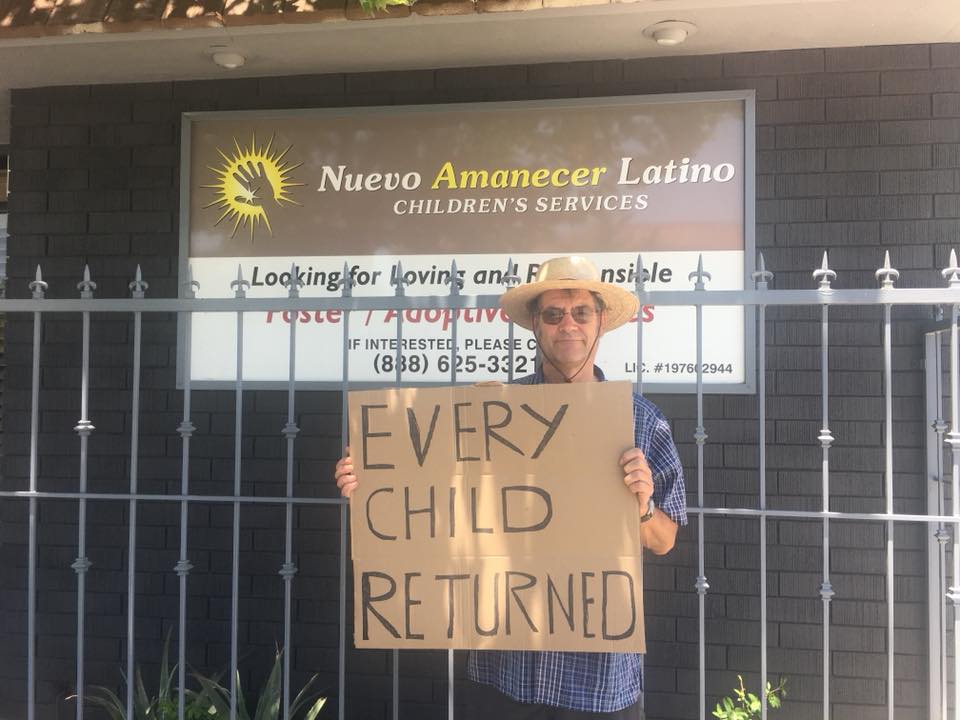
This is a moral atrocity. This wrong is being done in my name (as an American), and probably yours too, and it’s just intolerable. Myself and friends and neighbors feel compelled to do whatever we can to reverse and heal this atrocity. A friend named Rain Perry, who lost her mother at a young age, launched a website — called Every Child Returned, which depends on reputable reporting from the likes of ProPublica — to reverse it. Here I am protesting Tuesday outside a building in San Fernando belonging to a child-holding agency (though we were told that no children were in this particular center).
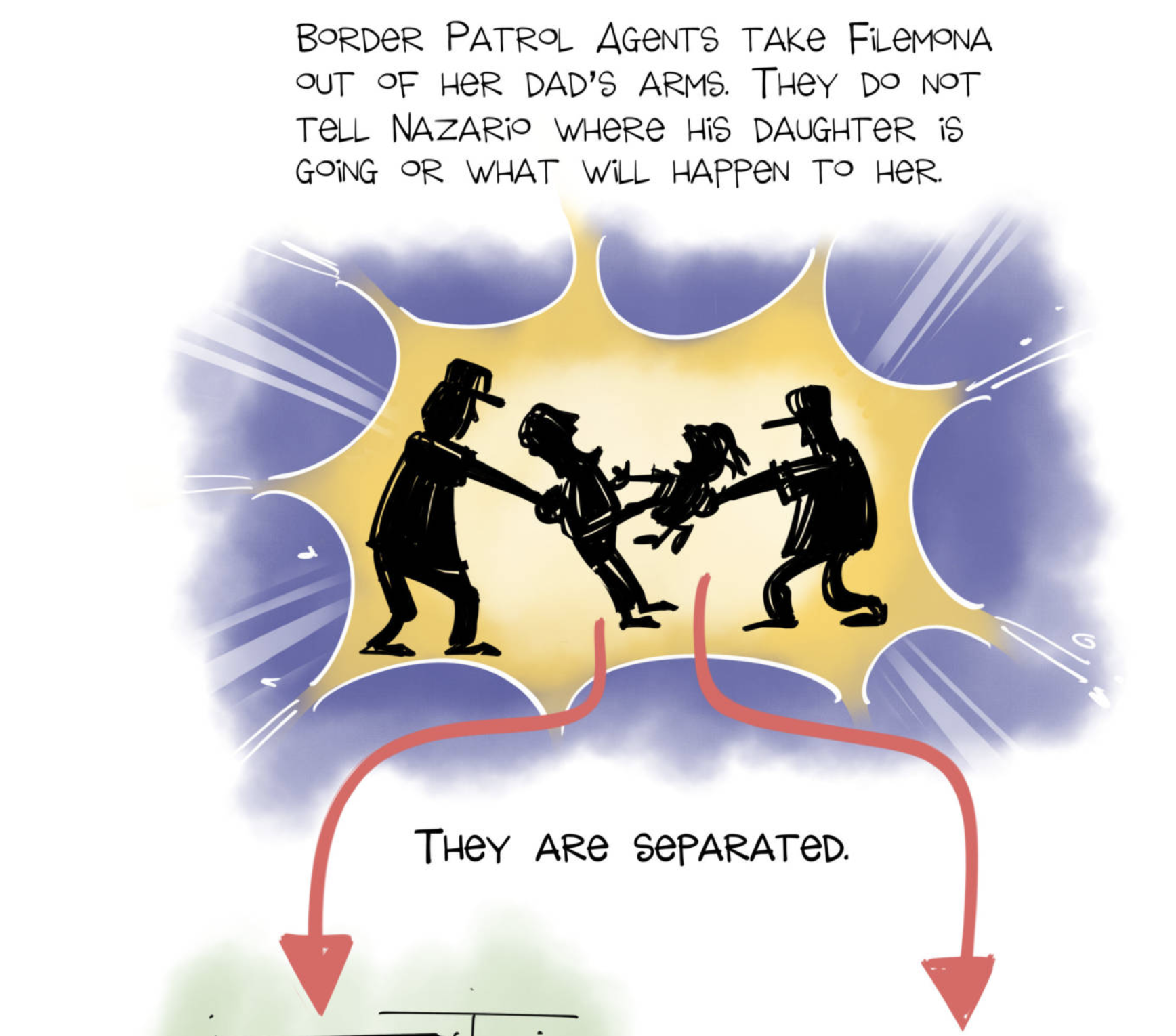
That’s just to set the context. This post is about a true story dramatized impressively by a Pulitzer Prize-winning cartoonist named Mark Fiore, working for KQED in Northern California, who drew the true story, based on KQED reporting of Nazario and Filemona.
The detail that just kills me is that after being separated from his young child for two weeks, the broken father Nazario gives up his asylum claim and is due course deported back to Guatemala, but Filemona, now being held somewhere in New York, still has an asylum claim and a legal right to pursue her case…but she’s five years old! This is simply beyond belief. Tell me that you don’t believe it and I will understand, but point you to a story in The Texas Tribune stating that yes, children as young as three years old are being forced to appear in court. It’s called Immigrant Toddlers Ordered to Appear in Court Alone.
The climate is changing all across the country and around the world, but in traditional communities, people often refuse to accept the evidence of its workings, even if demonstrated by scientists. Along this line a story in The New Yorker — called Tangier, the sinking island in the Chesapeake — profiles Mayor James Eskridge, a long-time crabber and resident of the doomed island.
The headline for the podcast discussion of the island put it best I think:
The island in the Chesapeake Bay is washing out to sea, and its residents may be among the first American refugees of climate change. But that’s not how they see the loss of their land.
The story focuses on the Mayor of the small island, who is named James Eskridge.
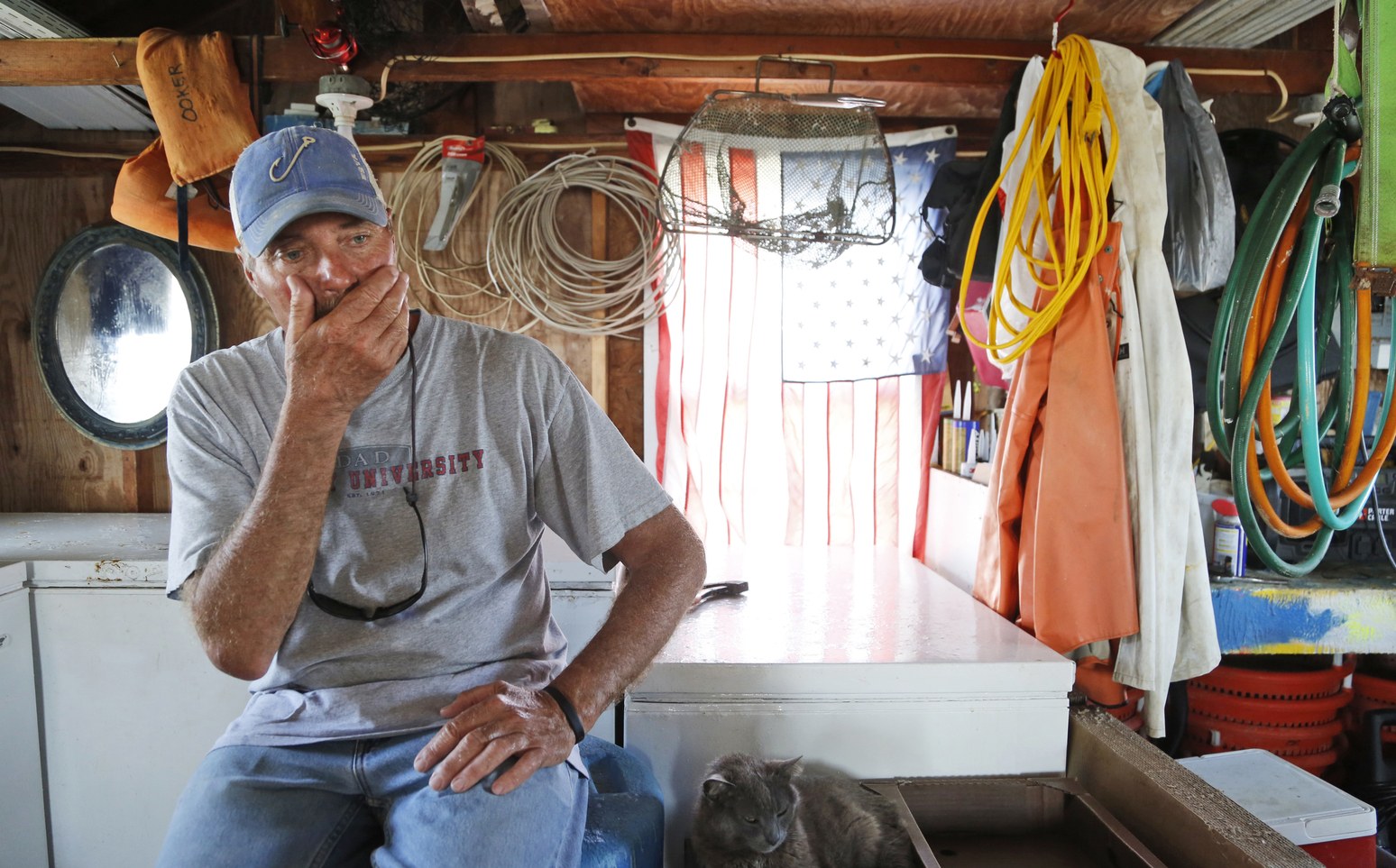
Eskridge, who is sixty, has been the mayor of Tangier for the past decade. Like most people on the island, he is an evangelical Christian; on his right forearm is a tattoo of a Jesus fish, on his left a Star of David. He has pale blue eyes, a Tom Selleck mustache, and deeply tanned, permanently windburned skin. No matter where you met him or what he was wearing, you would know that he had spent his life on the water. Like his grandfather, his father, and his eldest son, Eskridge has been a professional crabber since he graduated from high school. Nearly forty other men, in a community of four hundred and sixty, do the same. He likes to brag, and it’s not much of an exaggeration, that Tangier—located in the widest part of the Chesapeake, six miles south of the Virginia-Maryland border—“is the soft-shell capital of the world.” It’s the only place he has ever lived.
These days, it appears that he may outlive it. Tangier has lost two-thirds of its land since 1850. This is, in part, because of a ten-thousand-year-old phenomenon known as glacial rebound, which has caused the island to sink a millimetre or two each year. But the more urgent problem is a combination of storm-driven erosion and sea-level rise, which are both increasing as climate change advances; scientists who study the region estimate that sea-level rise is tripling or even quadrupling the rate of land loss. Without climate change, the island would have remained above water for perhaps another century; now the cutoff date is only a few decades away, if not sooner. David Schulte, a marine biologist with the U.S. Army Corps of Engineers and the co-author of a study in Nature’s Scientific Reports on Tangier’s fate, told me, “They are literally one storm away from being wiped out.”
But Eskridge blames erosion, not climate change, for the island’s woes. When President Trump heard of his stance, he gave Eskridge a call and encouraged him, but nothing has come of the call but a few minutes of national coverage.
James Eskridge blames conservation groups and environmental-impact studies for hindering the infrastructure projects that he says his island needs in order to endure. (Photograph by Steve Helber / AP)
A similar story of locals refusing to accept the evidence of climate change is playing out in Montana. An excellent reporter I’ve been fortunate to meet named Meera Subramanian, reporting for Inside Climate News and High Country News, focuses on a well-known Montana angler with decades-long experience. He can see that the stream water around his lodge is warming, and see its impact on the fish, but he can’t convince his fellow fisherman that what they are experiencing is an impact of climate change.
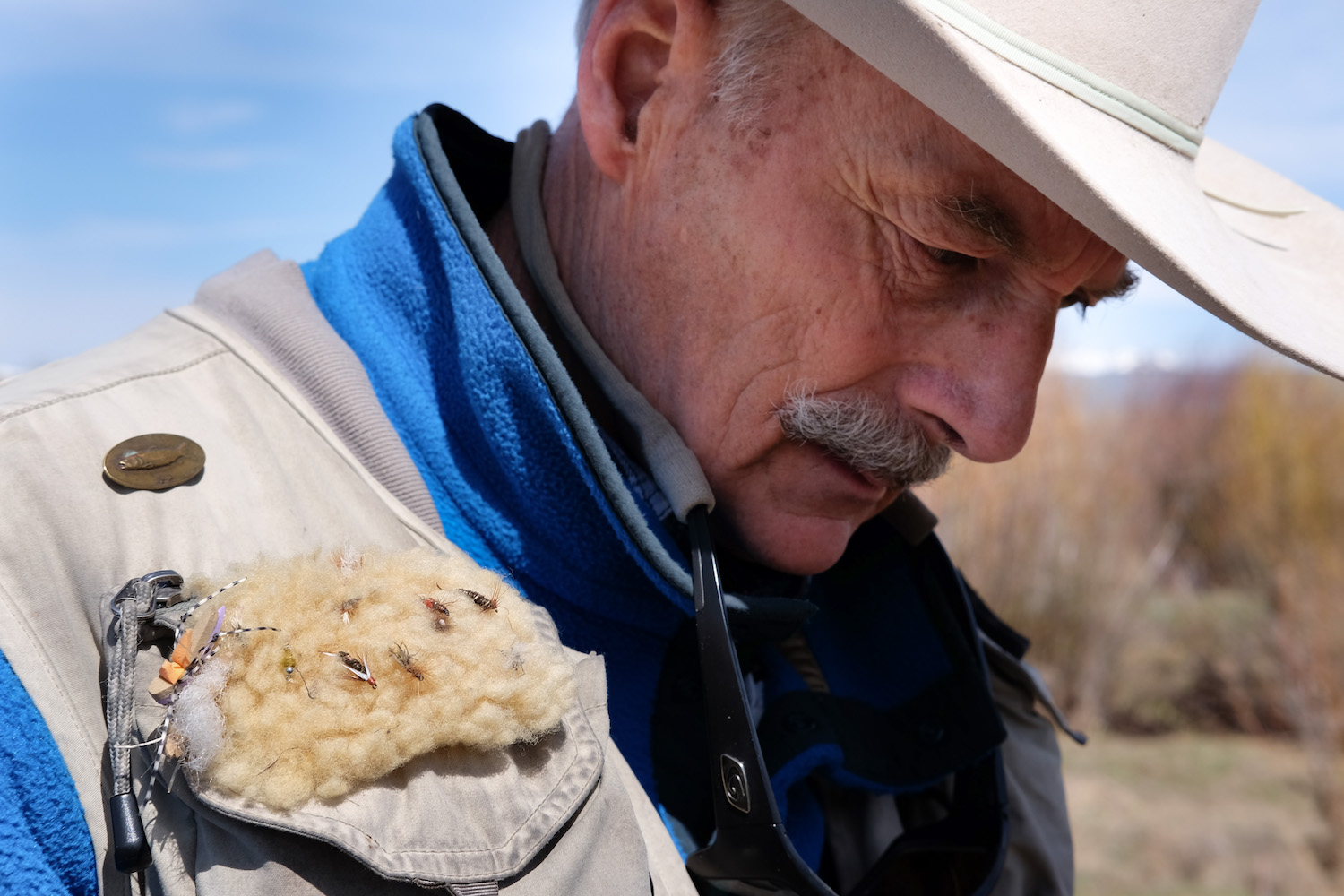
On an early May day, on the upper reaches of the Big Hole River in southwest Montana, fly fisherman Craig Fellin is in that quiet contemplative state of the experimental scientist as he steps out of his Suburban. Already he is studying the swirl of deep eddies on Grayling Pool, searching for the movement of insects. Before he casts his luck into the river, he shows me how he decides which fly to attach to his rod. First step, he says, is to put “your nose on the water.”
Craig Fellin, owner of the Big Hole Lodge, describes himself as a conservative, a conservationist and a “frustrated Republican” who worries about climate change. Meera Subramanian /Inside Climate News
Craig, 71, has a neat swoop of mustache and a calm, deliberate air. He founded the Big Hole Lodge nearly 35 years ago, putting to use a degree in philosophy and a lifetime of fishing, begun during his childhood on family trips to Canada to fish for walleye and pike. He is a Vietnam veteran, and a lifelong Republican. He is also convinced that climate change is affecting the pastime and livelihood he loves, from the trout in his backyard to the steelhead he seeks in the Pacific Ocean. What he can’t figure out is where the outspoken conservationists among his fellow conservatives have gone.
Fellin is an exception to the rule in his neck of the woods: most of his fellow fly fishermen don’t accept the scientific consensus around climate change. He seems all but alone in his stance. Why do those closest to the land and the water so often resist the idea of climate change? Is it purely tribal politics? (That seems to be the implication of The New Yorker piece, although Virginia Senator Tim Kaine has a different idea).
Kaine argues, speaking from experience of Eskridge and his fellow islanders, that:
“Acknowledging climate change is so sort of staggering, in terms of what it might mean to the place they love, that they resist the explanation.”
I think that’s right. An English writer named Timothy Morton has brought forward the term hyperobject to explain in a new word this concept, the news too big to mention, the impossible-to-encompass concept. Something like climate change is too overwhelming to contemplate or fix, realistically, so those most connected to the land are most resistant to seeing it.
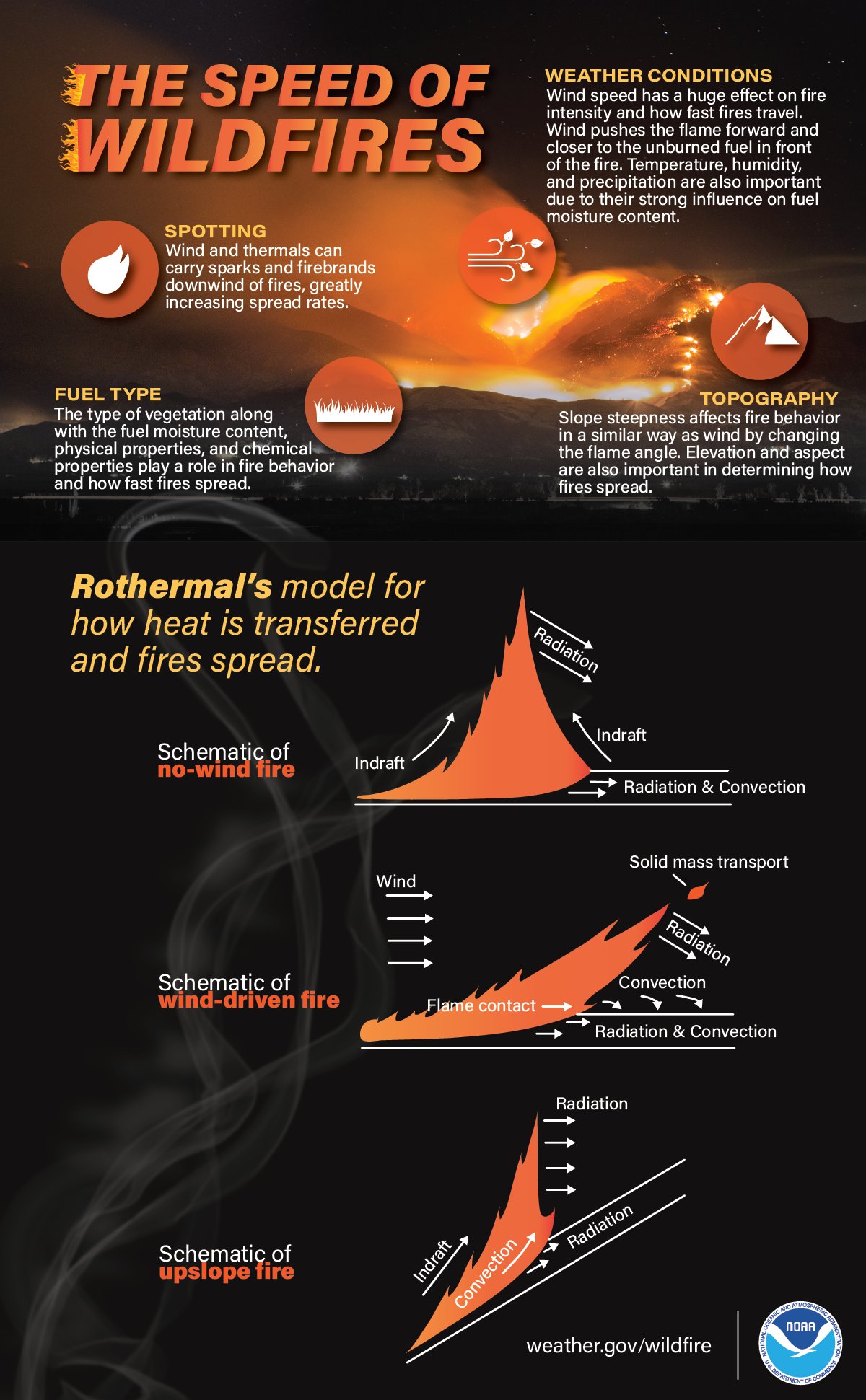
Forty-six years ago a young fire ecologist published a paper that for the first time found a math to usefully describe the behavior of wildfires in the west, as modified by slope and wind. It’s a remarkable achievement and was, according to Wildfire Today, a team effort led by a man named Dick Rothermel.
Rothermel, Anderson, and Bill Frandsen, another physicist on the project, adapted an approach developed by an early Forest Service fire researcher, Wally Fons, which turned on the concept of conservation of energy. A fire spreads by igniting a series of little fires in the fuel ahead of it. The ignitions are driven by convection, radiation, and conduction. Even if it’s unknown which mode is operating in a given instance, the rate of heat transfer can be measured. The researchers reasoned that if they knew how much fuel was ahead of a fire, how big and how densely packed the fuel particles were, and how much moisture the fuel contained, then they could figure out how much energy would be needed to transfer enough heat to bring the fuel up to the ignition point. They could then calculate the rate of ignition that would carry the fire as it spread. The model would also have to account for the critical variables of wind speed and slope of the ground.
This week the National Weather Service and NOAA republished his seminal work, adapting a central diagram from the paper into graphical form.
A firestorm known as the Thomas Fire visited us in Upper Ojai and destroyed many of our neighbors’ property, but we were fortunate, being on flat ground and protected by a tall, thick, and strong canopy of large live oaks.
But all around us the firestorm burned chaparral and trees on thousands of slopes to the ground. Over 200,000 acres in extent into the black. Just as the modeling above implies, the fires burn hottest when driven up a slope by a wind. On mountain slopes in every direction, every living leaf burned.
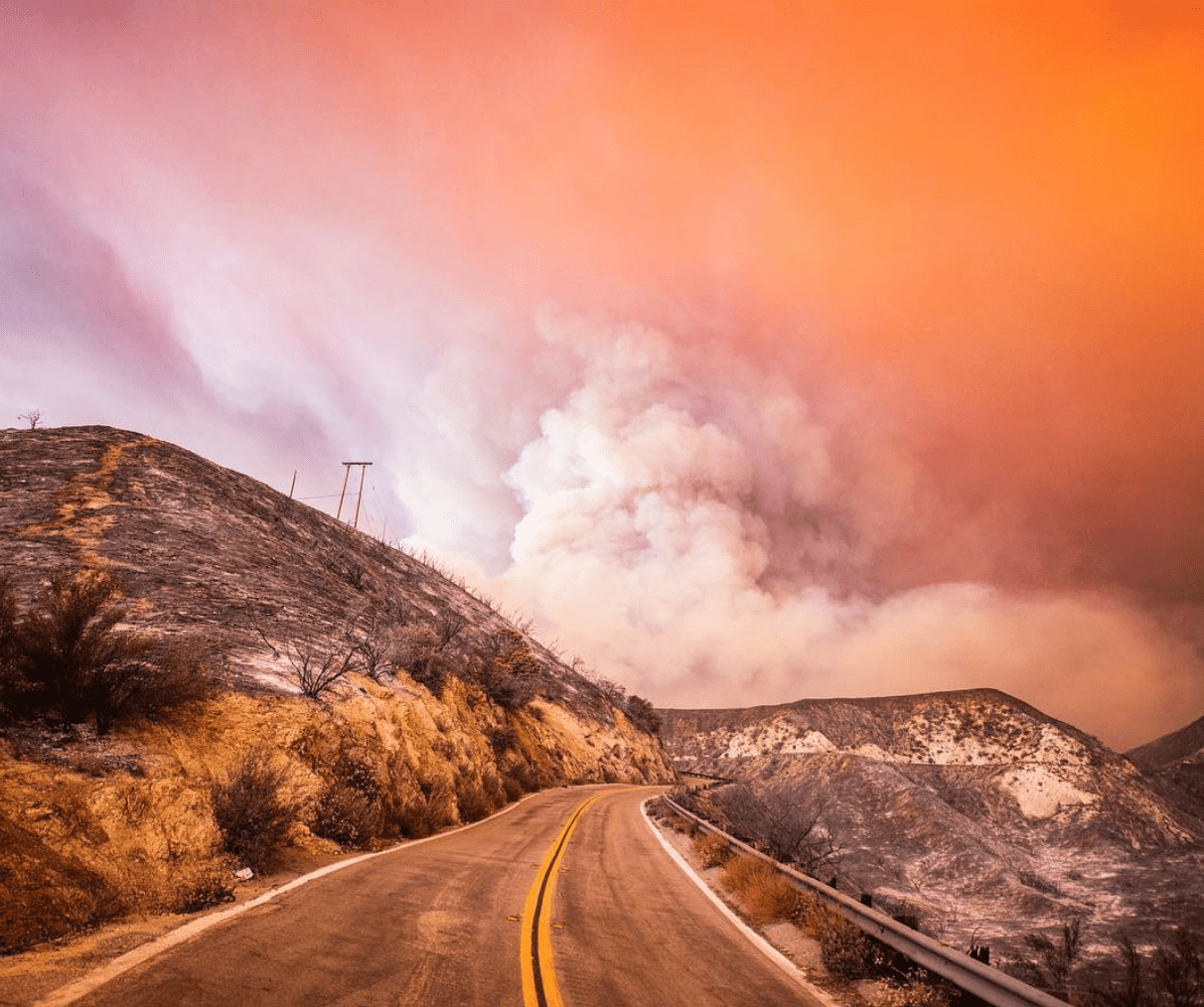
Here’s a picture (if I can find it) from a popular and accomplished adventure photographer who on Instagram is known as Alphawanderlust. I think this captures the feeling of the aftermath almost too enticingly.
Interestingly Alphawanderlust, who appears to earn his countless great and popular shots with bold adventuring, as well as photographic skills, admits this may not be a popular shot. May not get him a lot of heart-shaped “likes.” It’s not fun or cool exactly, as his pictures usually are, but he nonetheless felt compelled to try and capture the starkness that came after the fire.
“We went down to Los Pedros [Padres] national forest last month to camp up in the mountains and as we drove through the mountains, it felt like it was something out of a post-apocalyptic movie. Everything was scorched, no one to be seen or heard for miles however, there was life to be found. Vegetation was sprouting from the rains but the trees and large bushes were goners. After setting up camp, the sun was setting and the fog started to roll in. It was a beautiful disaster.”
It’s true, but it’s also true it’s heart-sinking. This disaster has made us think twice about beauty itself — even if the picture went on to earn over 1000 likes.
In its heyday Nirvana would end live shows in classic rock style by smashing up instruments, sometimes to a guitar freak out called Nameless Endless (which kind of has to be seen to be believed). Being Nirvana, this began as an over-the-top squall of noise, the rawest slab of guitar scream smacked up against a lush melodic and coolly enticing chorus — a screech versus a lullaby. Back and forth, as relentless as windshield wipers.
That spirit can be found today in a tribute of sorts from one of the best of today’s young rockers, Courtney Barnett from Australia, in her song Nameless Faceless. Barnett in an interview calls the song “poppy” and yes, to that point, it’s almost exactly three minutes long, like a proper pop song, and you can understand the lyrics, unlike much of Kurt Cobain. But more importantly, it’s got that slightly nauseating chordal slide into a sludgy all-out roar of a chorus, with caustic don’t-bullshit-me lyrics, adapted from a classic feminist Margaret Atwood quote. To wit:
I want to walk through the park in the dark Men are scared that women will laugh at them I want to walk through the park in the dark Women are scared that men will kill them I hold my keys between my fingers
For whatever reason, women seem to have picked up the torch from the fallen rock star — even arena rocker Pink on her latest tour has been covering Smells Like Teen Spirit, to acclaim from audiences and critics.
It’s weird to say but it’s true: Kurt Cobain will never die.
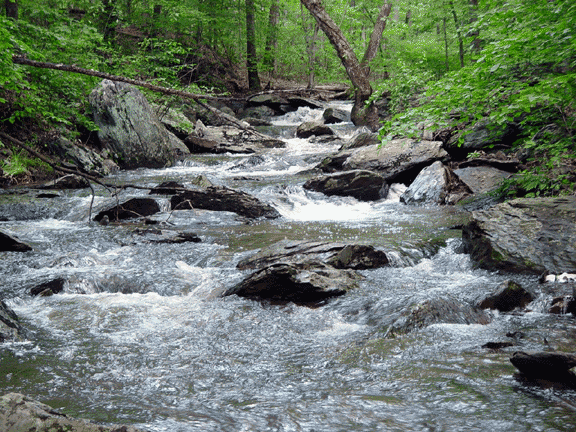
In February a brave writer in Slate published a column arguing that wild water is much over-feared, and that (with reasonable care) hikers in the mountains in places such as the Pacific Northwest need not reflexively filter or treat wild water taken from streams and lakes. To wit:
To be clear, there’s no question that Giardia lamblia, Cryptosporidium parvum, and various strains of fecal coliform bacteria—the waterborne pathogens responsible for giardiasis, cryptosporidiosis, and other diseases—can infect humans, with potentially serious health consequences. Yet research to date has failed to demonstrate any significant link between wilderness water consumption and infection with these threats. A 1993 study looking at the incidence of Giardia infection and gastrointestinal illness in backcountry travelers in a high-use area of California’s Sierra Nevada found only 5.7 percent tested positive, none of whom exhibited symptoms. Broader-scale approaches have similarly failed to justify concerns: Both a survey of health departments and a meta-analysis found that while giardiasis was prevalent enough to justify concern, there was no connection between recorded cases and drinking backcountry water.
In fact, it’s unclear that dangerous protozoans and bacteria occur in very many of North America’s wilderness streams and lakes at all—and where they are present, they are usually found far below levels that should concern humans. Though studies have confirmed thepresence of fecal coliform bacteria near sites with heavy human or pack animal traffic, they occurred only at a minority of sampled areas, and mostly at concentrations so low they were barely detectable. The data on Giardia and Cryptosporidium are similar: A study in the popular magazine Backpackeragain only found pathogens in a minority of sampled sites, with the highest recorded concentration still so dilute that obtaining an infective dose would require consuming 7 liters of water in one sitting.
Author Ethan Linck goes on to argue, angering many commentators on the story at Slate, that white privilege has something to do with the incessant message that all water in the wilderness must be treated. More importantly, he points out that if a backpacker does get sick, it’s likely because he or she hasn’t been careful around his or her own wastes.
If the real danger comes from eating after a trip to the cathole, then that’s the point thatshould be emphasized—not an unsubstantiated view of all water in the mountains as suspect. In all likelihood, it’s not the water that’s gross. It’s you.
For this heresy, Linck is absolutely savaged in the comments. Commentators point out that these days filters (made by Sawyer for example) are readily available for a low-price. Thru-hikers attach them to water bottles and voila, safety at a low-price and light weight. As one emergency MD put it (more calmly than most):
There are very effective ways of treating water that are not expensive. For example, even something as readily available and inexpensive as household bleach can be used in the wilderness to kill giardia. In fact, for those who do wish to use a filter, there are filters available that cost well less than $100.
All true, and points well-taken. But despite this torrent of blame and abuse I admire Linck and the ever-contrarian Slate for pointing out that in fact many many hikers (most thru-hikers, in my experience) including moi do not filter water, and suffer no ill effects. It’s an illusion, to suppose that we live in a world safe from disease, but it’s also an illusion to suppose that we can make our world completely safe from disease.
To blame wilderness lovers for wanting to take wild water into their bodies like a wafer in a religious ceremony — perhaps it’s foolish, but aren’t all leaps of faith a bit foolish?
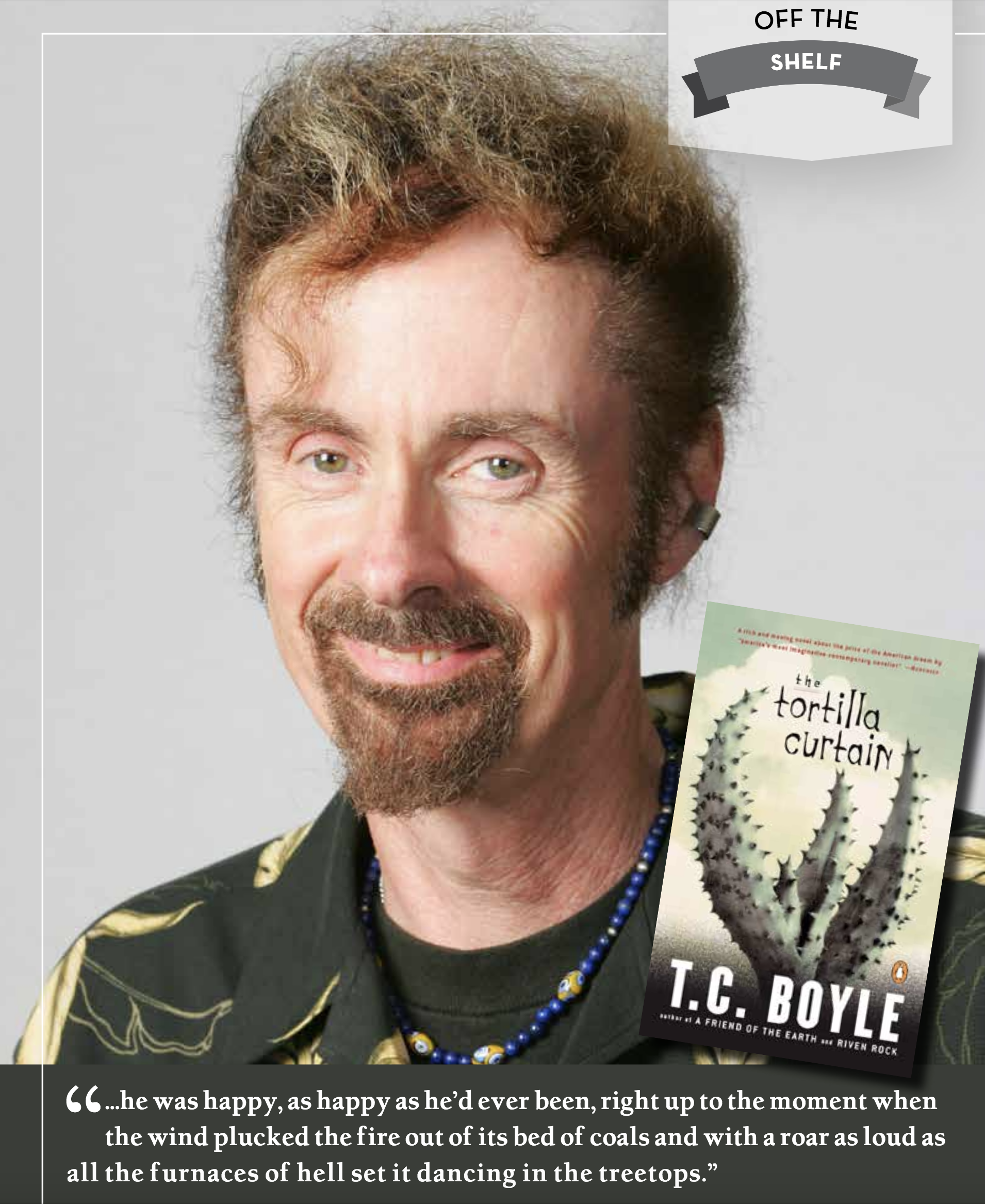
For the Ojai Quarterly[pdf], yours truly had the opportunity to talk to T.C. Boyle about the Thomas fire, debris flows, climate change, and other scary realities of the 21st Century. The interview also motivated me to catch up on some past works of Boyle’s, and boy was that worth the reading. Check it out:
So begins the conclusion of T. Coraghessan Boyle’s most controversial novel, The Tortilla Curtain, which includes a wildfire followed by a mudslide — a potentially fatal disaster for all its central characters. The story begins with a twist of fate. An Anglo nature writer driving through Topanga Canyon inadvertently clips and injures a young Mexican man, who with his teenage mate is trying to find work in Southern California. Unable to afford rent, the immigrant Mexican couple camp out in the canyon and, later in the fall, try to cook a gift Thanksgiving turkey over the fire. Inadvertently they set off a wildfire that all but destroys the development in which the Anglo couple live.
Boyle, one of Southern California’s most prominent writers, and a distinguished professor at USC, has published fourteen novels and ten collections of short stories since the l970’s. After the Thomas Fire, Kit Stolz of OQ’s “Off the Shelf” asked to interview him, because he is a writer who has often focused on environmental topics, including wildfires, mudslides, and climate change. He graciously consented to do so by email, even though his own neighborhood in Montecito was nearly destroyed in the debris flows of January during the course of the interview.
OJAI QUARTERLY: What drew you to the story of “The Tortilla Curtain?” And why do you think it has stood up to the passage of time since the book was published, over twenty years ago?
T.C. BOYLE: I grew up in suburban New York and moved to California in l978 to teach at USC. This translocation is, I think, what gives me a unique outsider’s look at the issues and environment of California. The debate about illegal immigration at the time I was writing The Tortilla Curtain in the 1990’s wasn’t really a debate–it was yes or no, period. I took on the topic, presenting four points of view — those of an Anglo couple living in a gated community at the top of Topanga Canyon and of an immigrant Mexican couple living in the canyon itself, in order to broaden the debate.
Why has the book endured? Because of the hard sociological and environmental issues it takes on — and which remain unresolved. We are now seeing the effects of global warming, overpopulation, and the fight for resources globally. That’s not going to go away until our species is decimated by war, disease, and famine. We are all one and we are all equally subject to the laws of nature and we are in deep trouble.
STOLZ: How did you and yours fare in the Thomas Fire? And when you first heard of the fire in the Santa Paula area, could you imagine facing a threat to your home over a week later?
BOYLE: I’m fielding your question in the aftermath of yesterday’s debris flows that killed fifteen of my neighbors, while twenty-four are still missing. Let me say that the fire had me fully terrified and doubtful that our 109-year-old Frank Lloyd Wright house would survive. The rains? In relief — and oh, so short-sightedly — I welcomed them.
STOLZ: It’s apparent in Ojai and I expect in Montecito that we are not going to be “the same” anytime soon. Yet major disasters — fire, landslide, earthquake — made the dramatic landscape of Southern California. Santa Barbara, for example, is a city built on a landslide. Ojai has a history of monster fires. Is denial baked into our lifestyle? Are we dumb or freaking crazy — unable to see the amount of risk we live with?
BOYLE: See my story, “La Conchita,” about the disastrous mudslide in that community, which was first published in The New Yorker. Our memories are short. The sun shines. Nature smiles on us. Danger? What danger? When we evacuated in advance of the fire last month, I thought all Montecito would burn and knew how hard it would be to live anywhere else. I’ve lived in this house for twenty-five years now and I can’t imagine living anywhere else.
STOLZ: In the story, you describe a mudslide: “I don’t know if the average person really has much of an idea what a mudslide involves…maybe it was the fault of the term itself — mudslide. It sounded innocuous, almost cozy, as if it might be one of the new attractions at Magic Mountain, or vaguely sexy, like mud-wrestling…but that was thinking of a limited sort. A mudslide, as I know now, is nothing short of an avalanche, but instead of snow you’ve got 400,000 tons of liquefied dirt bristling with rocks and tree trunks coming at you with the force of a tsunami. And it moves fast, faster than you would think.”
It feels as if you’re trying to use your imagination to see beyond the obvious, and perhaps for that reason stories like “La Conchita” read almost like prescient visions of the future.
BOYLE: I must compliment you on choosing those apt quotes. Am I prescient? A little, I suppose — or maybe just ahead of the loop. As an environmentalist, I read widely about climate change, habitat loss, extinction — and the sustaining joys of nature itself.










 Kit Stolz